


3 months 3 weeks ago
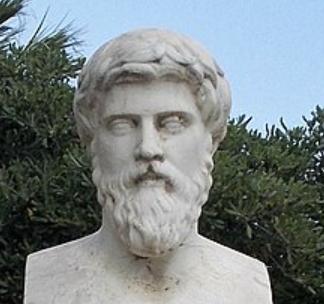
Men use thought only to justify their wrongdoings, and speech only to conceal their thoughts.
▼
Source
source
Dialogue 14, Le Chapon et la Poularde (1766); reported in Bartlett's Familiar Quotations, 10th ed., 1919
3 months 1 week ago
To Harmodius, descended from the ancient Harmodius, when he reviled Iphicrates [a shoemaker's son] for his mean birth, "My nobility," said he, "begins in me, but yours ends in you."
▼
Source
source
54 Iphicrates

3 months 3 weeks ago
Every emancipation is a restoration of the human world and of human relationships to a man himself.
1 month 2 weeks ago
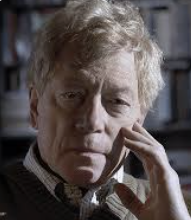
In 1970s Britain, conservative philosophy was the preoccupation of a few half-mad recluses.
▼
Source
source
"Why I became a conservative," The New Criterion
2 months 3 weeks ago
I know now that I shall. But all Actual Knowledge brings with it, by its formal nature, its schematised apposition; - although I now know of the Schema of God, yet I am not yet immediately this Schema, but I am only a Schema of the Schema. The required Being is not yet realised. I shall be. Who is this I? Evidently that which is, - the Ego gives in Intuition, the Individual. This shall be. What does its Being signify? It is given as a Principle in the World of Sense. Blind Instinct is indeed annihilated, and in its place there now stands the clearly perceived Shall. But the Power that at first set this Instinct in motion remains, in order that the Shall my now set it (the Power) in motion, and become its higher determining Principle. By means of this Power, I shall therefore, within its sphere, - the World of Sense, - produce and make manifest that which I recognise as my true Being in the Supersensuous World.
4 months 2 weeks ago
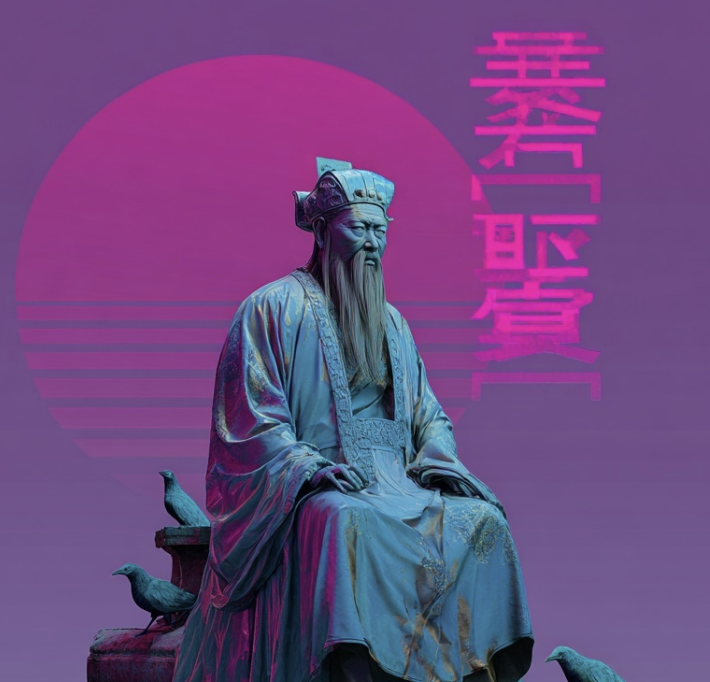
All things are nourished together without their injuring one another. The courses of the seasons, and of the sun and moon, are pursued without any collision among them. The smaller energies are like river currents; the greater energies are seen in mighty transformations. It is this which makes heaven and earth so great.

3 months 4 weeks ago
The greatest problem for the human race, to the solution of which Nature drives man, is the achievement of a universal civic society which administers law among men.
▼
Source
source
Fifth Thesis

1 month 3 weeks ago
Cultural dominance by either the left or the right hemisphere is largely dependent upon environmental factors.
▼
Source
source
p. 72
2 months 2 weeks ago
There is nothing impossible in the existence of the supernatural: its existence seems to me decidedly probable.
▼
Source
source
The Genteel Tradition at Bay
1 month 3 weeks ago
Nonviolence is not an absolute principle, but an open-ended struggle with violence and its countervailing forces.
▼
Source
source
p. 56
1 month 4 days ago
Some days will be sublime. Others will be merely wonderful. But critically, there will be one particular texture ("what it feels like") of consciousness that will be missing from our lives; and that will be the texture of nastiness.
▼
Source
source
"Feeling Groovy, Forever", Institute for Ethics and Emerging Technologies, 14 Mar. 2012

1 month 2 days ago
In ancient Europe, Stoics asserted that a slave could be freer than a master who suffers from self-division. In China, Daoists imagined a type of sage who responded to the flow of events without weighing alternatives. Disciples of monotheistic faiths have believed something similar: freedom, they say, is obeying God's will. What those who follow these traditions want most is not any kind of freedom of choice. Instead, what they long for is freedom from choice.
▼
Source
source
The Faith of Puppets: The Freedom of the Marionette (p. 6-7)
2 months 2 weeks ago
People talk, indeed, of a "primitive mentality", as, for example, to-day that of the inferior races, and in days gone by that of humanity in general, at whose door the responsibility for superstition should be laid.
▼
Source
source
Chapter II : Static Religion
4 months 3 days ago
Holy Christendom has, in my judgment, no better teacher after the apostles than St. Augustine.
▼
Source
source
Luther's Works, American Ed., Robert H. Fischer, Helmut T. Lehman, eds., Concordia Publishing House/Fortress Press, 1959, ISBN 0800603370 (Word and Sacrament III), vol. 37:107
4 months 3 days ago
I'd rather be ruled by a competent Turk than an incompetent Christian.
▼
Source
source
The earliest published source for such a statement yet located is in Pat Robertson - Where He Stands (1988) by Hubert Morken, p. 42, where such a comment is attributed to Luther without citation.

4 months 3 weeks ago
I am not a visual person. I have spent so many bounded years in my childhood that I have grown used to having books as my window on reality.

3 months 3 weeks ago
If there were in the world today any large number of people who desired their own happiness more than they desired the unhappiness of others, we could have a paradise in a few years.
▼
Source
source
As quoted in Think, Vol. 27 (1961), p. 32

4 months 4 days ago
We must learn how to imitate Cicero from Cicero himself. Let us imitate him as he imitated others.
▼
Source
source
in The Erasmus Reader (1990), p. 130.
4 weeks 1 day ago
You can't satisfy everybody; especially if there are those who will be dissatisfied unless not everybody is satisfied.
▼
Source
source
Ch. 10 : A Framework for Utopia; The Framework as Utopian Common Ground, p. 320
2 months 2 weeks ago
Similarly a work of art vanishes from sight for a beholder who seeks in it nothing but the moving fate of John and Mary or Tristan and Isolde and adjusts his vision to this. Tristan's sorrows are sorrows and can evoke compassion only in so far as they are taken as real. But an object of art is artistic only in so far as it is not real. In order to enjoy Titian's portrait of Charles the Fifth on horseback we must forget that this is Charles the Fifth in person and see instead a portrait - that is, an image, a fiction. The portrayed person and his portrait are two entirely different things; we are interested in either one or the other. In the first case we "live" with Charles the Fifth, in the second we look at an object of art.
▼
Source
source
"The Dehumanization of Art"
2 months 4 days ago
Decision making processes are aimed at finding courses of action that are feasible or satisfactory in the light of multiple goals and constraints.
▼
Source
source
p. 274.
2 months 2 weeks ago
Understanding being nothing else, but conception caused by Speech.
▼
Source
source
The First Part, Chapter 4, p. 17
3 months 3 weeks ago
If human nature were unchangeable, as ignorant people still suppose it to be, the situation would indeed be hopeless.
▼
Source
source
Ch. 17: Some Prospects: Cheerful and Otherwise
3 months 3 weeks ago
In Nietzsche's view nihilism is not a Weltanschauung that occurs at some time and place or another; it is rather the basic character of what happens in Occidental history.
▼
Source
source
p. 26

4 months 3 weeks ago
An old proverb fetched from the outward and visible world says: "Only the man that works gets the bread." Strangely enough this proverb does not aptly apply in that world to which it expressly belongs. For the outward world is subjected to the law of imperfection, and again and again the experience is repeated that he too who does not work gets the bread, and that he who sleeps gets it more abundantly than the man who works. In the outward world everything is made payable to the bearer, this world is in bondage to the law of indifference, and to him who has the ring, the spirit of the ring is obedient, whether he be Noureddin or Aladdin, and he who has the world's treasure, has it, however he got it.
2 months 2 weeks ago
So that in the first place, I put for a general inclination of all mankind a perpetual and restless desire of Power after power, that ceaseth only in Death. And the cause of this is not always that a man hopes for a more intensive delight than he has already attained to, or that he cannot be content with a moderate power: but because he cannot assure the power and means to live well, which he hath present, without the acquisition of more.
▼
Source
source
The First Part, Chapter 11, p. 47

2 months 3 weeks ago
One hardly saves a world without ruling it.
2 months 1 week ago
At the deepest level, the desire for complete union with God exhibits a narcissistic structure.

2 weeks 2 days ago
Burns's Brother Gilbert, a man of much sense and worth, has told me that Robert, in his young days, in spite of their hardship, was usually the gayest of speech; a fellow of infinite frolic, laughter, sense and heart; far pleasanter to hear there, stript cutting peats in the bog, or such like, than he ever afterwards knew him. I can well believe it. This basis of mirth, a primal element of sunshine and joyfulness, coupled with his other deep and earnest qualities, is one of the most attractive characteristics of Burns. A large fund of Hope dwells in him; spite of his tragical history, he is not a mourning man. He shakes his sorrows gallantly aside; bounds forth victorious over them.
2 months 3 weeks ago
The obsession with suicide is characteristic of the man who can neither live nor die, and whose attention never swerves from this double impossibility.
1 month 3 weeks ago
I do feel that evolution is being controlled by some sort of divine engineer. I can't help thinking that. And this engineer knows exactly what he or she is doing and why, and where evolution is headed. That's why we've got giraffes and hippopotami and the clap.
▼
Source
source
On evolution vs. "intelligent design", interviewed by Jon Stewart, The Daily Show

3 months 4 weeks ago
I make this chief distinction between religion and superstition, that the latter is founded on ignorance, the former on knowledge; this, I take it, is the reason why Christians are distinguished from the rest of the world, not by faith, nor by charity, nor by the other fruits of the Holy Spirit, but solely by their opinions, inasmuch as they defend their cause, like everyone else, by miracles, that is by ignorance, which is the source of all malice; thus they turn a faith, which may be true, into superstition.
▼
Source
source
Letter 21 (73) to Henry Oldenburg , November

1 week 3 days ago
That you may know that they whom anger possesses are not sane, look at their appearance; for as there are distinct symptoms which mark madmen, such as a bold and menacing air, a gloomy brow, a stern face

3 months 3 weeks ago
One is still what one is going to cease to be and already what one is going to become. One lives one's death, one dies one's life.
▼
Source
source
Book 2, "The Melodious Child Dead in Me"
3 months 2 weeks ago
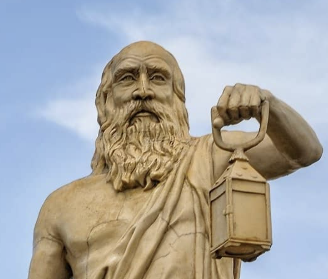
He was going into a theatre, meeting face to face those who were coming out, and being asked why, "This," he said, "is what I practise doing all my life."
▼
Source
source
Diogenes Laërtius, vi. 64

3 months 3 weeks ago
In the old dramas it was love that had to be sacrificed to painful duty. In the modern instance the sacrifice is at the shrine of what William James called "the Bitch Goddess, Success." Love is to be abandoned for the stern pursuit of newspaper notoriety and dollars.
▼
Source
source
"Silence is Golden," p. 61
1 month 3 weeks ago
The fact that life evolved out of nearly nothing, some 10 billion years after the universe evolved out of literally nothing, is a fact so staggering that I would be mad to attempt words to do it justice.
▼
Source
source
From tail to tale on the path of pilgrims in life, The Scotsman

3 months 3 weeks ago
We can act as if there were a God; feel as if we were free; consider Nature as if she were full of special designs; lay plans as if we were to be immortal; and we find then that these words do make a genuine difference in our moral life.
▼
Source
source
Lecture III, "The Reality of the Unseen"

2 months 2 weeks ago
Hegel's philosophy was an integral part of the culture which authoritarianism had to overcome. It is therefore no accident that the National Socialist assault on Hegel begins with the repudiation of his political theory.
▼
Source
source
P. 411
3 months 4 weeks ago
... happiness is not an ideal of reason, but of imagination, resting on merely empirical grounds…
▼
Source
source
4:418-19, p.29
2 months 2 weeks ago
Resignation' is a keynote in Comte's writings, deriving directly from assent to invariable social laws. 'True resignation, that is, a disposition to endure necessary evils steadfastly and without any hope of compensation therefore, can result only from a profound feeling for the invariable laws that govern the variety of natural phenomena.
▼
Source
source
P. 345
2 months 3 weeks ago
A marvel that has nothing to offer, democracy is at once a nation's paradise and its tomb.
1 week 3 days ago
That which Fortune has not given, she cannot take away.
3 months 3 weeks ago
The most violent revolutions in an individual's beliefs leave most of his old order standing. Time and space, cause and effect, nature and history, and one's own biography remain untouched. New truth is always a go-between, a smoother-over of transitions. It marries old opinion to new fact so as ever to show a minimum of jolt, a maximum of continuity.
▼
Source
source
"What Pragmatism Means," Pragmatism, pp. 60-61 (1931); lectures delivered at the Lowell Institute, Boston, Massachusetts
2 months 3 weeks ago
After all, why should ordinary people want to contemplate the End, especially when we see the condition of those who do?
2 weeks 2 days ago
The man whom Nature has appointed to do great things is, first of all, furnished with that openness to Nature which renders him incapable of being insincere! To his large, open, deep-feeling heart Nature is a Fact: all hearsay is hearsay; the unspeakable greatness of this Mystery of Life, let him acknowledge it or not, nay even though he seem to forget it or deny it, is ever present to him,-fearful and wonderful, on this hand and on that.
3 months 4 weeks ago
A metaphysics of morals is therefore indispensably necessary, not merely because of a motive to speculation - for investigating the source of the practical basic principles that lie a priori in our reason - but also because morals themselves remain subject to all sorts of corruption as long as we are without that clue and supreme norm by which to appraise them correctly...
2 months 3 weeks ago
The reaction against your own thought in itself lends life to thought. How this reaction is born is hard to describe, because it identifies with the very rare intellectual tragedies. - The tension, the degree and level of intensity of a thought proceeds from its internal antinomies, which in turn are derived from the unsolvable contradictions of a soul. Thought cannot solve the contradictions of the soul. As far as linear thinking is concerned, thoughts mirror themselves in other thoughts, instead of mirroring a destiny.
1 month 3 weeks ago
The river of my title is a river of DNA, and it flows through time, not space. It is a river of information, not a river of bones and tissues.

3 months 3 weeks ago
For I now saw, or thought I saw, what I had always before received with incredulity-that the habit of analysis has a tendency to wear away the feelings: as indeed it has, when no other mental habit is cultivated, and the analysing spirit remains without its natural complements and correctives.
▼
Source
source
(p. 137)
CivilSimian.com created by AxiomaticPanic, CivilSimian, Kalokagathia