

3 months 4 weeks ago
The wise is one only. It is unwilling and willing to be called by the name of Zeus.

2 months 2 days ago
Behold, we go up to Jerusalem; and the Son of man shall be betrayed unto the chief priests and unto the scribes, and they shall condemn him to death, And shall deliver him to the Gentiles to mock, and to scourge, and to crucify him: and the third day he shall rise again.
▼
Source
source
20:18-19 (KJV)
4 months 1 week ago
There is no one at the Communion table who retains against you even the least of your sins, no one, unless you yourself do it. So cast them away from yourself, and the recollection of them, lest in it your retain them; and cast the recollection of your having cast your sins away, lest in it you retain them.



3 months 3 weeks ago
When the apostle James was talking about faith and works against those who thought their faith was enough, and didn't want to have good works, he said, You believe God is one; you do well; the demons also believe, and tremble.
▼
Source
source
(Jas 2:19) 183:13:2

3 months 1 week ago
I fancy that most people who think at all have done a great deal of their thinking in the first fourteen years.
2 months 4 weeks ago
O Fortune, cruellest of heavenly powers, why make such game of this poor life of ours?
▼
Source
source
Book II, satire viii, line 61 (trans. Conington)
2 months ago
Socrates reminds us that it is not the same thing, but almost the opposite, to understand religion and to accept it.
▼
Source
source
p. 45
2 weeks 4 days ago
[H]uman nature as encoded in our DNA isn't immutable. Mankind's barbaric track-record to date is an unreliable guide to the future. If Homo sapiens' nastier alleles and their more sinister combinations can be silenced or edited out of the genome, and new improved code-sequences inserted instead, then the pessimists will be confounded. A major discontinuity in the development of life lies ahead. Providentially, we've learned that the DNA-driven world isn't written in God-given proprietary code it would be hubris to tamper with, but in bug-ridden open source amenable to improvement.
▼
Source
source
Utopian Pharmacology: Mental Health in the Third Millennium MDMA and Beyond, BLTC Research, last updated 2020
3 months ago
Neither our distance from a preventable evil nor the number of other people who, in respect to that evil, are in the same situation as we are, lessens our obligation to mitigate or prevent that evil.
3 months ago
To protest about bullfighting in Spain, the eating of dogs in South Korea, or the slaughter of baby seals in Canada while continuing to eat eggs from hens who have spent their lives crammed into cages, or veal from calves who have been deprived of their mothers, their proper diet, and the freedom to lie down with their legs extended, is like denouncing apartheid in South Africa while asking your neighbors not to sell their houses to blacks.
▼
Source
source
Ch. 4: Becoming a Vegetarian
4 months 1 week ago
I have needed God every day to defend myself against the abundance of thoughts.
3 months 4 weeks ago
War is the father and king of all: some he has made gods, and some men; some slaves and some free.

2 months 1 week ago
Strange incongruities must ever perplex those, who confound the unhappiness of civil dissensions with the crime of treason.
2 months 5 days ago
All nature abounds in proofs of other influences than merely mechanical action, even in the physical world. They crowd in upon us at the rate of several every minute. And my observation of men has led me to this little generalization. Speaking only of men who really think for themselves and not of mere reporters, I have not found that it is the men whose lives are mostly passed within the four walls of a physical laboratory who are most inclined to be satisfied with a purely mechanical metaphysics. On the contrary, the more clearly they understand how physical forces work the more incredible it seems to them that such action should explain what happens out of doors. A larger proportion of materialists and agnostics is to be found among the thinking physiologists and other naturalists, and the largest proportion of all among those who derive their ideas of physical science from reading popular books.
▼
Source
source
Lecture II : The Universal Categories, §3. Laws: Nominalism, CP 5.65

1 month 1 week ago
Any new technology is an evolutionary and biological mutation opening doors of perception and new spheres of action to mankind.
▼
Source
source
(p. 67)

3 months 1 week ago
Thee might observe incidentally that if the state paid for child-bearing it might and ought to require a medical certificate that the parents were such as to give a reasonable result of a healthy child - this would afford a very good inducement to some sort of care for the race, and gradually as public opinion became educated by the law, it might react on the law and make that more stringent, until one got to some state of things in which there would be a little genuine care for the race, instead of the present haphazard higgledy-piggledy ways.
▼
Source
source
Letter to Alys Pearsall Smith (1894); published in The Selected Letters of Bertrand Russell, Volume 1: The Private Years (1884-1914)
4 months 1 week ago
Since the science of nature is conversant with magnitudes, motion, and time, each of which must necessarily be either infinite or finite...[we] should speculate the infinite, and consider whether it is or not; and if it is what it is. ...[A]ll those who appear to have touched on a philosophy of this kind... consider it as a certain principle of beings. Some, indeed, as the Pythagoreans and Plato, consider it, per se, not as being an accident to any thing else, but as having an essential subsistence... the Pythagoreans... consider the infinite as subsisting in sensibles; for they do not make number to be separate; and they assert that what is beyond the heavens is infinite; but Plato says that beyond the heavens there is not any body, nor ideas, because these are no where: he affirms, however, that the infinite is both in sensibles, and in ideas. ...Plato establishes two infinities, viz. the great and the small.
2 months 1 week ago
The Scientific discourse extracts truths from the errors which surround and oppose it on all sides and in every form; and, by demolition of these opposing views as error, and as impossible to true thought, shows the truth as that which alone remains after their withdrawal, and therefore as the only possible truth:--and in this separation of opposites, and elucidation of the truth from the confused chaos in which truth and error lie mingled together, consists the peculiar and characteristic nature of the Scientific discourse. This method creates and produces truth, before our eyes, out of a world full of error.
▼
Source
source
P. 26-27
1 month 3 weeks ago
I believe that if an individual is not on the path to transcending his society and seeing in what way it furthers or impedes the development of human potential, he cannot enter into intimate contact with his humanity. If the tabus, restrictions, distorted values appear "natural" to him, this is a clear indication that he cannot have a real knowledge of human nature. I believe that society, while having a function both stimulating and inhibiting at the same time, has always been in conflict with humanity. Only when the purpose of society is identified with that of humanity will society cease to paralyze man and encourage his dominance.

3 months 1 week ago
Freedom is what you do with what's been done to you.

1 month 3 weeks ago
The man of flesh and bone; the man who is born, suffers, and dies-above all, who dies; the man who eats and drinks and plays and sleeps and thinks and wills; the man who is seen and heard; the brother, the real brother.
3 months 1 week ago
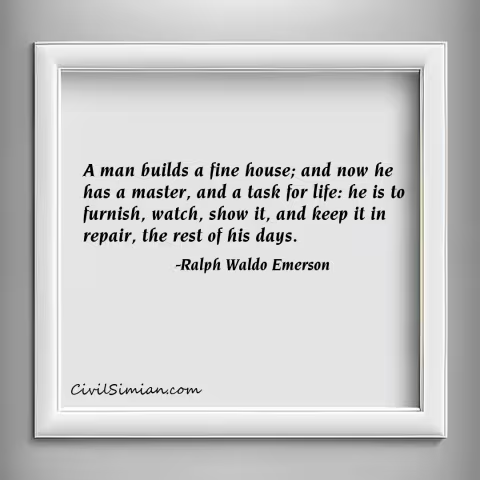
Abjection is a methodological conversion, like Cartesian doubt and Husserlian epoche: it establishes the world as a closed system which consciousness regards from without, in the manner of divine understanding.
▼
Source
source
p. 141
2 months 1 week ago
The pleasures of self-approbation, together with the right cultivation of all our pleasures, require individual independence. Without independence men cannot become either wise, or useful, or happy.
▼
Source
source
"Summary of Principles" 1.3
2 months 1 week ago
This day I heard from Laurence who has sent me papers confirming the portentous State of France-where the Elements which compose Human Society seem all to be dissolved, and a world of Monsters to be producd in the place of it-where Mirabeau presides as the Grand Anarch; and the late Grand Monarch makes a figure as ridiculous as pitiable.
▼
Source
source
Letter to Richard Burke (c. 10 October 1789), quoted in Alfred Cobban and Robert A. Smith (eds.), The Correspondence of Edmund Burke, Volume VI: July 1789-December 1791 (1967), p. 30

1 month 1 week ago
I do not define time, space, place, and motion, as being well known to all. Only I must observe, that the common people conceive those quantities under no other notions but from the relation they bear to sensible objects. And thence arise certain prejudices, for the removing of which it will be convenient to distinguish them into absolute and relative, true and apparent, mathematical and common.
▼
Source
source
Definitions - Scholium
3 months 1 week ago
Change alone is eternal, perpetual, immortal.
▼
Source
source
Unverified attribution noted in Respectfully Quoted: A Dictionary of Quotations (1993), ed. Suzy Platt, Library of Congress, p. 39;
3 weeks 1 day ago
Lost time was like a run in a stocking. It always got worse.
▼
Source
source
The Steep Ascent
4 weeks ago
Free trade, one of the greatest blessings which a government can confer on a people, is in almost every country unpopular.
▼
Source
source
p. 161
3 months 1 week ago
To fear love is to fear life, and those who fear life are already three parts dead.
1 month 2 weeks ago
The real significance of the Russell paradox, from the standpoint of the modal-logic picture, is this: it shows that no concrete structure can be a standard model for the naive conception of the totality of all sets; for any concrete structure has a possible extension that contains more 'sets'. (If we identify sets with the points that represent them in the various possible concrete structures, we might say: it is not possible for all possible sets to exist in any one world!) Yet set theory does not become impossible. Rather, set theory becomes the study of what must hold in, e.g. any standard model for Zermelo set theory.
▼
Source
source
Mathematics without foundations
3 months ago
On James's view, "true" resembles "good" or "rational" in being a normative notion, a compliment paid to sentences that seem to be paying their way and that fit with other sentences which are doing so.
▼
Source
source
Introduction to Consequences of Pragmatism
3 months 1 week ago
I became my own only when I gave myself to Another.
▼
Source
source
Letters of C. S. Lewis (17 July 1953), para. 2, p. 251 - as reported in The Quotable Lewis (1989), p. 334

2 months 5 days ago
The most interesting aspect of suffering is the sufferer's belief in its absoluteness. He believes he has a monopoly on suffering. I think that I alone suffer, that I alone have the right to suffer, although I also realize that there are modalities of suffering more terrible than mine, pieces of flesh falling from the bones, the body crumbling under one's very eyes, monstrous, criminal , shameful sufferings. One asks oneself, How can this be, and if it be, how can one still speak of finality and other such old wives' tales? Suffering moves me so much that I lose all my courage. I lose heart because I do not understand why there is suffering in the world.
▼
Source
source
in essay: the monopoly of suffering
2 months 4 weeks ago
As money grows, care follows it and the hunger for more.
▼
Source
source
Book III, ode xvi, line 17

3 months 1 week ago
The true Enlightenment thinker, the true rationalist, never wants to talk anyone into anything. No, he does not even want to convince; all the time he is aware that he may be wrong. Above all, he values the intellectual independence of others too highly to want to convince them in important matters. He would much rather invite contradiction, preferably in the form of rational and disciplined criticism. He seeks not to convince but to arouse - to challenge others to form free opinions.
3 months 1 week ago
John - I'm trying to find the Island in the West. Sensible - You refer, no doubt to some aesthetic experience.
▼
Source
source
Pilgrim's Regress 77
4 weeks ago
It seems that the creative faculty, and the critical faculty, cannot exist together in their highest perfection.
▼
Source
source
p. 186
1 month 3 weeks ago
We must needs believe with faith, whatever counsels reason may give us, that in the depths of our own bodies, in animals, in plants, in rocks, in everything that lives, in all the Universe, there is a spirit that strives to know itself, to acquire consciousness of itself, to be itself - for to be oneself is to know oneself - to be pure spirit; and since it can only achieve this by means of the body, by means of matter, it creates and makes use of matter at the same time that it remains a prisoner of it.
2 months 1 week ago
I shall in no time forget that moment. We felt as if we had had in our souls a clear passing glimpse into this wondrous World.
1 month 3 weeks ago
Wyman's overpopulated universe is in many ways unlovely. It offends the aesthetic sense of us who have a taste for desert landscapes.
▼
Source
source
"On What There Is", p. 4. a humorous comment on the idea "unactualized possible".
2 months 2 days ago
He also said to them, "You completely invalidate God's command in order to maintain your tradition! For Moses said: Honor your father and your mother; and, Whoever speaks evil of father or mother must be put to death.
▼
Source
source
7:9-10
1 month 3 weeks ago
Emptiness empties the one seeing into what is seen.
2 months 5 days ago
Never to have occasion to take a position, to make up one's mind, or to define oneself - there is no wish I make more often.
1 month 1 week ago
There is absolutely no inevitability, so long as there is a willingness to contemplate what is happening.
▼
Source
source
[A chapter sub-heading attributed by McLuhan to Alfred North Whitehead]

4 months 1 week ago
Civilizations have always been pyramidal in structure. As one climbs toward the apex of the social edifice, there is increased leisure and increasing opportunity to pursue happiness. As one climbs, one finds also fewer and fewer people to enjoy this more and more. Invariably, there is a preponderance of the dispossessed. And remember this, no matter how well off the bottom layers of the pyramid might be on an absolute scale, they are always dispossessed in comparison with the apex.So there is always social friction in ordinary human societies. The action of social revolution and the reaction of guarding against such revolution or combating it once it has begun are the causes of a great deal of the human misery with which history is permeated.

3 months 4 weeks ago
A man living without conflicts, as if he never lives at all.
CivilSimian.com created by AxiomaticPanic, CivilSimian, Kalokagathia