
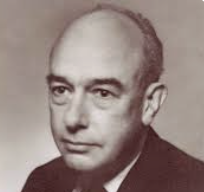
Willard Van Orman Quine — The Philosopher Who Undermined Certainty from Within (1908–2000)
W. V. O. Quine was the quiet revolutionary of analytic philosophy — a thinker who dismantled some of the field’s most cherished assumptions using its own tools. With calm rigor and relentless clarity, Quine challenged the idea that knowledge rests on firm foundations, arguing instead that our beliefs form a flexible, interconnected web answerable to experience only as a whole. In doing so, he reshaped logic, epistemology, and philosophy of language for the second half of the twentieth century.
A Logician Formed by Discipline and Travel
Born in Akron, Ohio, Quine displayed early talent in mathematics and logic. He studied at Oberlin College and later at Harvard, where he would spend nearly his entire academic career. His intellectual formation was rigorous, austere, and deeply shaped by formal logic.
In the 1930s, Quine traveled extensively in Europe, meeting members of the Vienna Circle and absorbing logical positivism firsthand. He admired their precision and respect for science — but he would later become their most devastating internal critic.
“Philosophy of logic is part of logic, or of science.”
The Collapse of the Analytic–Synthetic Distinction
Quine’s most famous contribution came in his 1951 essay Two Dogmas of Empiricism. In it, he attacked what he saw as the twin pillars of modern empiricism: the distinction between analytic truths (true by meaning alone) and synthetic truths (true by empirical fact), and the idea that each meaningful statement can be verified in isolation.
Quine argued that no clear boundary exists between truths of meaning and truths of fact. Definitions rely on background theories. Meanings shift with use. Even logic and mathematics, supposedly immune to revision, depend on broader commitments.
The result was explosive. A distinction that had structured philosophy since Kant quietly collapsed.
“No statement is immune to revision.”
The Web of Belief
In place of foundational certainty, Quine proposed a holistic picture of knowledge. Our beliefs form a web — a network of interconnected statements ranging from everyday observations to abstract logic and mathematics.
Experience confronts the web not at single points, but at its edges. When observation conflicts with expectation, we are free to revise any part of the system — including logic — so long as the overall web remains coherent.
Truth, on this view, is not anchored to indubitable foundations, but maintained through pragmatic adjustment.
“Our statements about the external world face the tribunal of experience not individually but only as a corporate body.”
Naturalized Epistemology
Quine pushed his critique further by rejecting traditional epistemology altogether. The attempt to justify science from outside science, he argued, is misguided.
Instead, epistemology should be naturalized — treated as part of empirical psychology. The proper question is not “How can we justify knowledge?” but “How do human beings, as physical organisms, actually form beliefs from sensory input?”
Philosophy becomes continuous with science, not its tribunal.
“Epistemology, or something like it, simply falls into place as a chapter of psychology.”
Ontology and What There Is
Quine also reshaped ontology — the study of what exists. He famously argued that “to be is to be the value of a bound variable.” Existence claims, in other words, are commitments made by our best theories.
We should believe in the entities required by our most successful scientific explanations — no more, no less. This led Quine to endorse mathematical objects while rejecting many metaphysical abstractions.
Ontology becomes a matter of theoretical economy, not metaphysical intuition.
Language, Translation, and Indeterminacy
In Word and Object, Quine advanced one of his most unsettling ideas: the indeterminacy of translation. Given only behavioral evidence, multiple incompatible translations of a language may be equally valid.
There is no fact of the matter about which translation is “correct.” Meaning is not a hidden entity waiting to be discovered. It is fixed only relative to a theory.
This challenged deep assumptions about meaning, reference, and mental content.
Style, Temperament, and Influence
Personally, Quine was modest, disciplined, and unfailingly polite. His prose was clear, understated, and precise — a sharp contrast to the radical implications of his ideas.
He trained generations of philosophers at Harvard and influenced figures as diverse as Donald Davidson, Hilary Putnam, and Richard Rorty. Even those who rejected his conclusions were forced to reckon with them.
Legacy — Philosophy Without Foundations
Quine did not destroy philosophy. He re-situated it. By dissolving sharp boundaries between logic and fact, language and theory, philosophy and science, he left behind a more modest — and more demanding — picture of human knowledge.
There are no final foundations. No privileged starting points. Only a dynamic system of beliefs continually revised in light of experience.
Quine’s legacy is a philosophy that gives up certainty without giving up rigor — a philosophy at home in a fallible world.
“Each man is given a scientific heritage plus a continuing barrage of sensory stimulation.”
CivilSimian.com created by AxiomaticPanic, CivilSimian, Kalokagathia