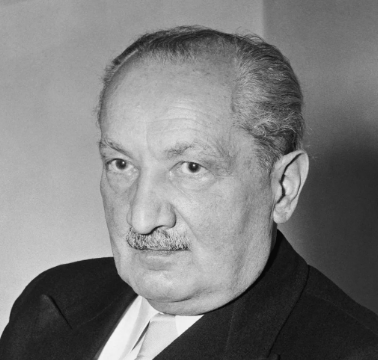
It seems to be for the greater glory of Heidegger that all thinkers of the past twenty-five hundred years are found to have been so tragically off the track.
0
⚖0
▼Source
source
Marjorie Glicksman, "A Note on the Philosophy of Heidegger". The Journal of Philosophy, Vol 35 no 4, Feb 17, 1938, pp. 93-104.
Later, after it was all over, the historian Friedrich Meinecke tried to explain 'the German catastrophe' by arguing that technical specialization had caused some educated Germans (not him, needless to say) to lose sight of the humanistic values of Goethe and Schiller; thus they were unable to resist Hitler's 'mass Machiavellianism'. Thomas Mann was unusual in being able to recognize even at the time that, in 'Brother Hitler', the entire German Bildungsburgertum possessed a monstrous younger sibling who embodied some of their deepest-rooted aspirations. An academic education, far from inoculating people against Nazism, made them more likely to embrace it. So much for the greatness of the German universities. Their fall from grace was personified by the readiness of Martin Heidegger, the greatest German philosopher of his generation, to jump on the Nazi bandwagon, a swastika pin in his lapel.
0
⚖0
▼Source
source
Niall Ferguson, The War of the World: Twentieth-Century Conflict and the Descent of the West (2006), p. xliii
Everything functions. That is exactly what is uncanny. Everything functions and the functioning drives us further and further to more functioning, and technology tears people away and uproots them from the Earth more and more. I don't know if you are scared; I was certainly scared when I recently saw the photographs of the Earth taken from the Moon. We don't need an atom bomb at all; the uprooting of human beings is already taking place. We only have purely technological conditions left. It is no longer an earth on which human beings live today.
I see the situation of man in the world of planetary technicity not as an inexitricable and inescapable destiny, but I see the task of thought precisely in this, that within its own limits it helps man as such achieve a satisfactory relationship to the essence of technicity. National Socialism did indeed go in this direction. Those people, however, were far too poorly equipped for thought to arrive at a really explicit relationship to what is happening today and has been underway for the past 300 years.
0
⚖0
▼Source
source
As translated by William Richardson in Risk and Meaning, Nicolas Bouleau (translated by Dené Oglesby and Martin Crossley), ed. Springer, 2011 , page 102.
From our human experience and history, at least as far as I am informed, I know that everything essential and great has only emerged when human beings had a home and were rooted in a tradition. Today's literature is, for instance, largely destructive.
Philosophy will not be able to bring about a direct change of the present state of the world. This is true not only of philosophy but of all merely human meditations and endeavors. Only a god can still save us. I think the only possibility of salvation left to us is to prepare readiness, through thinking and poetry, for the appearance of the god or for the absence of the god during the decline; so that we do not, simply put, die meaningless deaths, but that when we decline, we decline in the face of the absent god.
Who is to determine what the perfect is? It could only be those who are themselves perfect and who therefore know what it means. Here yawns the abyss of that circularity in which the whole of human Dasein moves. What health is, only the healthy can say. Yet healthfulness is measured according to the essential starting point of health. What truth is, only one who is truthful can discern; but the one who is truthful is determined according to the essential starting point of truth.
We think of beauty as being most worthy of reverence. But what is most worthy of reverence lights up only where the magnificent strength to revere is alive. To revere is not a thing for the petty and lowly, the incapacitated and underdeveloped. It is a matter of tremendous passion; only what flows from such passion is in the grand style.