
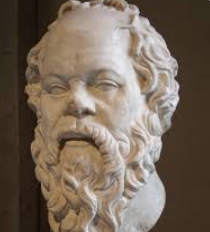
Socrates — The Examined Life and the Death That Defined Philosophy (469–399 BC)
Socrates was an Athenian philosopher who wrote nothing, founded no school, held no official position, and was executed by his own city at the age of seventy — and who is nonetheless the most influential philosopher who ever lived.
Known entirely through the accounts of others — principally Plato, Xenophon, and Aristophanes — he spent his life in public conversation, questioning politicians, poets, craftsmen, and sophists about what they thought they knew, and demonstrating, again and again, that they did not know what they thought they did.
His central concern: that the unexamined life is not worth living — that the most important question any person can face is how to live well, and that most people avoid this question with a thoroughness that amounts to a form of sleep.
The Socratic Method — Knowing That You Do Not Know
Socrates claimed to know nothing — and this claim was not false modesty. When the Oracle at Delphi declared him the wisest man in Athens, he interpreted it to mean not that he knew more than others but that he alone knew he knew nothing, while others were ignorant of their own ignorance. This difference — knowing the limits of one's knowledge — was the beginning of genuine wisdom.
His method, consequently, was not to teach but to question — to take whatever claim his interlocutor offered and press it until it either clarified into genuine knowledge or collapsed into acknowledged confusion. The elenchus — the method of refutation through questioning — was designed not to humiliate but to clear the ground of false certainty so that genuine inquiry could begin.
The process was uncomfortable, often infuriating, and ultimately fatal. The people Socrates questioned frequently left the conversation worse off in terms of social confidence and self-satisfaction — which made him many enemies among the powerful and the proud. His genius was to have found this a sufficient reason to continue anyway.
"I know that I know nothing — and this knowledge is what distinguishes me from those who think they know."
The Apology — A Life Justified
In 399 BC Socrates was tried by an Athenian jury on charges of impiety and corrupting the youth. The charges were political as much as philosophical — the product of the trauma of Athens's defeat in the Peloponnesian War, the oligarchic coup of the Thirty Tyrants, and the democratic restoration's appetite for a scapegoat of sufficient intellectual distinction.
His defense speech — the "Apology" as Plato recorded it — is one of the most extraordinary documents in the history of thought. He did not apologize, did not soften his position, did not offer the jury the flattery it expected. He told them plainly that he had spent his life in the service of philosophy by divine command, that he would continue to do so as long as he breathed, and that if they acquitted him on condition of silence he would refuse the condition.
He was found guilty by a narrow margin. When invited to propose his own penalty, he initially suggested the city provide him with free meals — the honor given to Olympic champions — before settling on a modest fine. The jury, offended, voted for death by a larger margin than had voted him guilty. He accepted the verdict with equanimity and spent his final days in philosophical conversation with his friends.
"The unexamined life is not worth living."
The Phaedo — Philosophy as Preparation for Death
Plato's account of Socrates's final hours — the "Phaedo" — is one of the masterpieces of world literature as well as of philosophy. Socrates spent his last day in conversation about the immortality of the soul, arguing with characteristic irony that the philosopher who has spent a lifetime separating the soul from the body through thought should not fear the final separation of death.
When the hemlock was brought, he drank it without hesitation, continuing to talk with his friends until the numbness reached his heart. His last words — "Crito, we owe a cock to Asclepius. Don't forget to pay the debt" — have puzzled interpreters ever since. Asclepius was the god of healing. A cock was the offering made in thanks for recovery from illness. Whether Socrates meant that death was a cure for life, or was simply remembering a mundane obligation at the moment of his death, is a question that remains beautifully open.
"To fear death, gentlemen, is no other than to think oneself wise when one is not — to think one knows what one does not know."
Ethics, the Soul, and the Good Life
Socrates's philosophical concerns were almost entirely ethical — he had little interest in natural philosophy or cosmology, redirecting Greek philosophy from the question of what the world is made of that Thales had inaugurated to the question of how one ought to live. His contribution was to insist that this question was the most urgent and the most neglected in the entire range of human inquiry.
He argued that virtue is knowledge — that wrongdoing is always a form of ignorance, a failure to understand what is genuinely good — and that no one does wrong willingly. This Socratic paradox has troubled moral philosophy ever since: it seems to deny the reality of weakness of will, of people who know what is right and do otherwise. But Socrates's point was deeper — that what people call knowledge of the good is usually something much thinner, a conventional belief that dissolves under questioning, not the genuine understanding that would make virtue stable.
The care of the soul — attention to one's own moral and intellectual condition — was for Socrates the only activity genuinely worth devoting a life to. Wealth, reputation, political power, physical pleasure — all the things his contemporaries pursued — were at best means and at worst distractions from the single thing that mattered.
"Wealth does not bring about excellence — but excellence makes wealth and everything else good for men, both individually and collectively."
The Socratic Problem — Who Was He Really?
Because Socrates wrote nothing, everything we know about him is filtered through others — and those others disagree in significant ways. Plato's Socrates is a metaphysician who believes in immortal souls and transcendent Forms. Xenophon's Socrates is a practical moralist of conventional piety and common sense. Aristophanes's Socrates in the "Clouds" is a comic figure, a sophist who teaches students to argue any side of any question for money.
The historical Socrates lies somewhere among these portraits — probably closest to the early Platonic dialogues, where the figure is primarily a questioner rather than a systematic thinker. The deeper Socrates cannot be recovered, which is itself philosophically appropriate — a philosopher who insisted on the limits of human knowledge has generated, in his absence, an irresolvable problem of human knowledge about him.
He is, in this sense, the perfect philosophical figure — present enough to be indispensable, absent enough to remain inexhaustible.
"I am not an Athenian or a Greek, but a citizen of the world."
— attributed to Socrates by Plutarch
Legacy — The Philosopher Who Became the Standard
Alfred North Whitehead wrote that the history of Western philosophy is a series of footnotes to Plato — but Plato himself is a series of footnotes to Socrates, or at least to the figure Plato made of him. Every philosophical tradition in the West has defined itself partly in relation to Socrates — claiming his inheritance, criticizing his method, extending or rejecting his conclusions.
He is the model of the philosopher as gadfly — the person whose function in the city is to prevent it from falling asleep in its own assumptions, who must be tolerated because he is necessary and executed because he is intolerable. Every society that has ever killed a philosopher for asking uncomfortable questions has reenacted the trial of Socrates — and every philosopher who has continued asking those questions in the face of that danger has reenacted his defense.
On CivSim he stands at the center of the entire catalogue — the figure from whom Plato learned, who questioned Timon's misanthropy before Timon formulated it, who would have interrogated Thucydides's realism and Marcus Aurelius's Stoicism and Teresa of Ávila's mysticism and every other position in the collection with the same patient, merciless, affectionate questioning that got him killed in Athens in 399 BC.
"An honest man is always a child."
— attributed to Socrates in the ancient tradition
CivilSimian.com created by AxiomaticPanic, CivilSimian, Kalokagathia