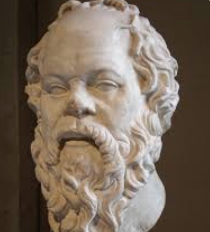
Socrates therefore had something of human wisdom... But many of his actions are not only undeserving of praise, but also most deserving of censure, in which things he most resembled those of his own class. Out of these I will select one which may be judged of by all. Socrates used this well-known proverb:‘That which is above us is nothing to us.’... The same man swore by a dog and a goose... Oh buffoon (as Zeno the Epicurean says), senseless, abandoned, desperate man! If he wished to scoff at religion — madman, if he did this seriously, so as to esteem a most base animal as God! For who can dare to find fault with the superstitions of the Egyptians, when Socrates confirmed them at Athens by his authority? But was it not a mark of consummate vanity, that before his death he asked his friends to sacrifice for him a cock which he had vowed to Aesculapius? He evidently feared lest he should be put upon his trial before Rhadamanthus, the judge, by Aesculapius on account of the vow. I should consider him most mad if he had died under the influence of disease. But since he did this in his sound mind, he who thinks that he was wise is himself of unsound mind.
It is exactly as it was in the time of Socrates, according to the accusation brought against him: “Everyone understood how to instruct the young men; there was but one single individual who did not understand it – that was Socrates.” So in our time, “all” are the wise, there is only one single individual here and there who is a fool. So near is the world to having achieved perfection that now “all” are wise; if it were not for the individual cranks and fools the world would be absolutely perfect. Through all this God sits in heaven. No one longs to be away from the noise and clamor of the moment in order to find the stillness in which God dwells. While man admires man, and admires him – because he is just like everyone else, no one longs for the solitude wherein one worships God. No one disdains this cheap intermission from aiming at the highest, by longing for the standard of the eternal! So important has the immediate itself become. It is for this reason that superficial disinterestedness is needed. Oh, that I might in truth present such a disinterested figure!
0
⚖0
▼Source
source
Soren Kierkegaard, Works of Love (1847), Swenson translation (1946) Princeton University Press, p. 297.
People think the world needs a republic, and they think it needs a new social order, and a new religion, but it never occurs to anyone that what the world really needs, confused as it is by much learning, is a new Socrates.
0
⚖0
▼Source
source
Søren Kierkegaard, in The Sickness unto Death (1849), as translated by Alastair Hannay (1989), p. 124
Agnosticism, in fact, is not a creed, but a method, the essence of which lies in the rigorous application of a single principle. That principle is of great antiquity; it is as old as Socrates; as old as the writer who said, 'Try all things, hold fast by that which is good'; it is the foundation of the Reformation, which simply illustrated the axiom that every man should be able to give a reason for the faith that is in him, it is the great principle of Descartes; it is the fundamental axiom of modern science.