
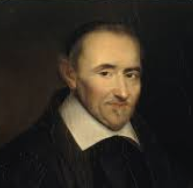
Pierre Gassendi — Atoms, Empiricism, and the Revival of Epicurus (1592–1655)
Pierre Gassendi was a French Catholic priest, astronomer, mathematician, and philosopher whose ambitious intellectual project — the rehabilitation of ancient Epicurean philosophy within a Christian framework — made him one of the most significant and most underappreciated figures of the seventeenth century Scientific Revolution.
A friend of Galileo, a correspondent of Descartes whose philosophy he subjected to penetrating criticism, and a skilled astronomer who made some of the first reliable telescopic observations of Mercury and other planets, he moved at the center of the new science while remaining committed to reconciling it with both classical philosophy and Christian theology.
His central concern: that the ancient atomism of Epicurus and Lucretius — long condemned as atheistic and morally dangerous — could be purified of its materialist excesses and transformed into the philosophical foundation of the new mechanical science, with God restored as the creator of the atoms whose motions constituted the natural world.
The Rehabilitation of Epicurus
Epicurus had been one of antiquity's most maligned philosophers — his name associated in the Christian tradition with atheism, hedonism, and the denial of providence. The survival of Lucretius's "De Rerum Natura" in the Renaissance had reintroduced Epicurean atomism to European thought, but it remained theologically suspect and philosophically marginal.
Gassendi undertook a systematic rehabilitation across several enormous works — beginning with an examination of Epicurean ethics and culminating in his massive "Syntagma Philosophicum," published posthumously in 1658. His strategy was to separate what was genuinely valuable in Epicurus — the atomic theory of matter, the empiricist epistemology, the emphasis on natural pleasure as the foundation of ethics — from what was theologically unacceptable — the denial of divine providence, the mortality of the soul, the derivation of the world from blind atomic chance.
God, in Gassendi's revised Epicureanism, had created the atoms at the beginning, endowed them with their properties, and set them in motion according to divinely ordained laws. The atoms were not eternal and uncreated as Epicurus had held — they were God's instruments, and their mechanical interactions were the means by which divine providence operated in the natural world. This was Epicurus baptized — and the baptism proved philosophically productive.
"Epicurus was not an atheist — he was a man who took nature seriously and refused to dignify superstition with the name of religion. We can do the same without following him into his errors."
Atomism and the Mechanical Philosophy
Gassendi was one of the principal architects of the mechanical philosophy — the program of explaining all natural phenomena in terms of the size, shape, and motion of atoms — that dominated natural philosophy in the second half of the seventeenth century.
His atomism was more sophisticated than Epicurus's original — incorporating insights from the new mathematics and astronomy, addressing objections raised by the Aristotelian tradition, and attempting to specify more precisely the properties that atoms must have to account for the phenomena of chemistry, optics, and mechanics. He distinguished between atoms and molecules — anticipating the modern distinction — and argued that the variety of natural substances arose from different combinations of atoms with different shapes, sizes, and motions.
His influence on the subsequent development of atomism was direct and substantial. Robert Boyle read him carefully and drew on his framework. John Locke absorbed Gassendist themes into his philosophy of knowledge. Isaac Newton's corpuscular theory of light and his mechanical conception of nature owed more to Gassendi than is usually acknowledged. The mechanical world-picture that dominated early modern science was partly Gassendi's construction.
"The whole of nature is explained by the motion of atoms — but the atoms themselves, and the laws governing their motion, are the work of God."
Against Descartes — The Empiricist Critique
Gassendi's philosophical relationship with Descartes was one of the most productive antagonisms of the seventeenth century. He contributed a set of objections to the "Meditations" that struck at the heart of Cartesian rationalism — and Descartes's dismissive responses revealed the depth of the methodological gulf between them.
Where Descartes sought to ground knowledge in clear and distinct ideas accessible to pure reason, Gassendi insisted that all knowledge ultimately derived from the senses — that there was nothing in the intellect that had not first been in the senses, a maxim he attributed to Epicurus and Aristotle against Descartes's Platonic rationalism.
He attacked Descartes's cogito with unusual sharpness — arguing that the inference "I think, therefore I am" already presupposed the concept of a thinking thing that it claimed to establish, and that in any case it established only that thinking was occurring, not that there was an immaterial thinking substance. The body thinks too, Gassendi suggested — and what grounds the certainty that thought requires something beyond the body?
These objections anticipate some of the most powerful critiques of Cartesian dualism developed by subsequent philosophers — and they were largely ignored by Descartes, who had little patience for what he regarded as Gassendi's excessive empiricism.
"You say: I think, therefore I am. But I say: the inference is too hasty — you have assumed what you needed to prove."
Astronomy and Scientific Practice
Gassendi was not merely a philosopher of science but a practicing scientist of genuine accomplishment. In 1631 he made the first recorded telescopic observation of a transit of Mercury across the sun — confirming Kepler's prediction and providing crucial data for the Copernican system. He also made careful observations of the moon, of multiple stars, and of the aurora borealis, and produced work in acoustics that contributed to understanding the speed of sound.
His friendship with Galileo — whom he defended against his ecclesiastical critics — and his correspondence with the leading scientists of Europe placed him at the center of the new science as it was being created. He understood, from the inside, what the new astronomy and mechanics required philosophically — and his atomism was partly an attempt to provide those requirements.
The combination of original astronomical work and philosophical synthesis was characteristic — Gassendi was always trying to hold together the practice of science and its philosophical foundations, to ensure that the new natural philosophy had a coherent account of itself.
"On November 7, 1631, I saw that small star entering the face of the Sun — and for the first time Kepler's prediction met the eye of an observer."
Ethics, Pleasure, and the Christian Epicurean
Gassendi's ethical philosophy was one of the more original attempts in early modern thought to construct a Christian hedonism — an account of the good life grounded in pleasure that was compatible with, and indeed supportive of, Christian piety.
He accepted Epicurus's identification of pleasure as the foundation of ethics but distinguished carefully between pleasures — arguing that the highest pleasures were those of the mind and soul, that tranquility and the absence of anxiety were more genuinely pleasurable than sensory gratification, and that the pleasures of virtue and friendship were both more durable and more deeply satisfying than the pleasures of the body.
This was not a dramatic departure from orthodox Christian ethics — Gassendi was careful to ensure it was not — but it grounded that ethics in a naturalistic account of human motivation that bypassed the often sterile debates about duty and made the good life something that could be recommended to a person as genuinely in their interest. Virtue was pleasant, vice was ultimately painful — and this made the ethical life not merely obligatory but attractive.
"The pleasures of the mind are more lasting, more intense, and more truly human than the pleasures of the body — this Epicurus knew, and we need not blush to agree."
Legacy — The Hidden Architect of Early Modern Thought
Gassendi's influence was enormous and is now largely forgotten — one of intellectual history's more persistent patterns of acknowledged influence followed by unacknowledged absorption. His atomism flowed into Boyle, Newton, and Locke without always carrying his name. His empiricism shaped the philosophical atmosphere in which Locke's "Essay Concerning Human Understanding" grew — a work that acknowledged little of its debt. His rehabilitation of Epicurus made Epicurean themes respectable in natural philosophy in ways that outlasted any specific citation.
He was also an example of a type that the seventeenth century required and produced: the philosophically serious priest who could hold together the new science and the old faith without sacrificing either — a type that became increasingly rare as the century progressed and the gap between natural philosophy and theology widened.
On CivSim he belongs alongside Boyle and Ockham — figures who did the philosophical groundwork that made subsequent scientific development possible, whose contributions have been absorbed so thoroughly into what came after them that their specific role has become hard to see. The atoms that physics now studies are not Gassendi's atoms — but the concept of matter as composed of fundamental particles in motion, governed by mathematical laws and created by a rational God, was partly his invention.
"Let us take from Epicurus what is true and useful, correct what is false and dangerous, and not be deterred by the name from learning what the man actually taught."
CivilSimian.com created by AxiomaticPanic, CivilSimian, Kalokagathia