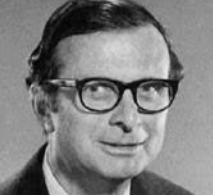
We have overwhelming evidence that available information plus analysis does not lead to knowledge. The management science team can properly analyse a situation and present recommendations to the manager, but no change occurs. The situation is so familiar to those of us who try to practice management science that I hardly need to describe the cases.
0
⚖0
▼Source
source
C. West Churchman, "Managerial acceptance of scientific recommendations" in California Management Review, Vol 7 (1964), p. 33; cited in Management Systems (1971), by Peter P. Schoderbek, p. 199
Analysis of the mathematical form and underlying principles of games was made by von Neumann " as early as 1928. In this early work von Neumann was not so much interested in executive-type problems as he was in the logical foundations of quantum mechanics. It was not until 1944, when von Neumann and Morgenstern published their now well known Theory of Games and Economic Behavior, that the mathematical treatment of games "took fire."
0
⚖0
▼Source
source
p. 519: Partly cited in: E. Roy Weintraub (1992) Toward a history of game theory. p. 235
The concern of OR with finding an optimum decision, policy, or design is one of its essential characteristics. It does not seek merely to define a better solution to a problem than the one in use; it seeks the best solution... [It] can be characterized as the application of scientific methods, techniques, and tools to problems involving the operations of systems so as to provide those in control of the operations with optimum solutions to the problems.
0
⚖0
▼Source
source
p. 8, cited in: R.L. McCown (2001) "Learning to bridge the gap between science-based decision support and the practice of farming". In: Aust. J. Agric. Res., Vol 52, p. 560-561
The systems approach to problems does not mean that the most generally formulated problem must be solved in one research project. However desirable this may be, it is seldom possible to realize it in practice. In practice, parts of the total problem are usually solved in sequence. In many cases the total problem cannot be formulated in advance but the solution of one phase of it helps define the next phase. For example, a production control project may require determination of the most economic production quantities of different items. Once these are found it may turn out that these quantities cannot be produced on the available equipment in the available time. This, then, gives rise to a new problem whose solution will affect the solution obtained in the first phase.
The comprehensiveness of OR’s aim is an example of a ‘systems’ approach, since ‘system’ implies an interconnected complex of functionally related components.
An objective of O.R. as it emerged from this evolution of industrial organization, is to provide managers of the organizations with a scientific basis for solving problems involving the interaction of the components of the organization in the best interest of the organization as a whole. A decision which is best for the organization as a whole is called optimum decision.
0
⚖0
▼Source
source
p. 6; Partly cited in: (2004) "[http://www.wulrich.com/downloads/ulrich_2004d.pdf In memory of C. West Churchman (1913–2004)]." Journal of Organisational Transformation and Social Change. Vol 1 (Nr. 2–3) p. 210
O.R.'s initial development began in the United Kingdom during World War II and was quickly taken up in the United States. This start took place in a military context. After the war O.R. moved into business, industry and civil government. This movement was slower in the United States than in the United Kingdom but in 1951 industrial O.R. took hold in this country and has since developed very rapidly.
No science has ever been born on a specific day. Each science emerges out of a convergence of an increased interest in some class of problems and the development of scientific methods, techniques, and tools which are adequate to solve these problems. Operations Research (O.R.) is no exception. Its roots are as old as science and the management function. Its name dates back only to 1940.
0
⚖0
▼Source
source
p. 3; Partly cited in: Ivor Grattan-Guinness (2003) Companion encyclopedia of the history and philosophy of the mathematical sciences, Vol 1. p. 841
Another way of emphasizing this diversity is to argue that if one cannot forecast (predict), one does not have a theory, and that forecasting is the weakest link in the chain of the management sciences at present. Indeed, if one cannot predict one cannot measure, and if one cannot measure, then there is no "theory."