

8 months 2 weeks ago
He yawned. He had finished the day and he had also finished with his youth. Various well-bred moralities had already discreetly offered him their services: disillusioned epicureanism, smiling tolerance, resignation, common sense stoicism - all the aids whereby a man may savour, minute by minute, like a connoisseur, the failure of a life.
▼
Source
L'âge de raison (The Age of Reason)
8 months 2 weeks ago
I know. I know that I shall never again meet anything or anybody who will inspire me with passion. You know, it's quite a job starting to love somebody. You have to have energy, generosity, blindness. There is even a moment, in the very beginning, when you have to jump across a precipice: if you think about it you don't do it. I know I'll never jump again.
8 months 2 weeks ago
All-powerful god, who am I but the fear that I inspire in others?
▼
Source
King Aegistheus to Jupiter, Act 2
8 months 2 weeks ago
People who live in society have learned how to see themselves in mirrors as they appear to their friends. I have no friends. Is that why my flesh is so naked?
▼
Source
Diary entry of Friday (2 February)
8 months 2 weeks ago
It is certain that we cannot escape anguish, for we are anguish.
8 months 2 weeks ago
For an occurrence to become an adventure, it is necessary and sufficient for one to recount it.
8 months 2 weeks ago
Her face seems ravaged by both lightning and hail. But on yours there is something like the promise of a storm: one day passion will burn it to the bone.
▼
Source
Act 1
8 months 2 weeks ago
A writer who takes political, social or literary positions must act only with the means that are his. These means are the written words.
▼
Source
Refusing the Nobel Prize, New York Times
8 months 2 weeks ago
Existence precedes and rules essence.
▼
Source
Part 4, chapter 1
8 months 2 weeks ago
I wanted for the moments in my life to follow each other and order themselves like those of a life remembered. It would be just as well to try to catch time by the tail.
8 months 2 weeks ago
Admit it, it is your youth that you regret, more even than your crime; it is my youth you hate, even more than my innocence.
▼
Source
Electra to her mother Clytemnestra, Act 1
8 months 2 weeks ago
What then did you expect when you unbound the gag that muted those black mouths? That they would chant your praises? Did you think that when those heads that our fathers had forcibly bowed down to the ground were raised again, you would find adoration in their eyes?
▼
Source
"Orphée Noir (Black Orpheus)" preface, Anthologie de la Nouvelle Poésie Nègre et Malgache
8 months 2 weeks ago
I grasp at each second, trying to suck it dry: nothing happens which I do not seize, which I do not fix forever in myself, nothing, neither the fugitive tenderness of those lovely eyes, nor the noises of the street, nor the false dawn of early morning: and even so the minute passes and I do not hold it back, I like to see it pass.
8 months 2 weeks ago
Blood doubly unites us, for we share the same blood and we have spilled blood.
▼
Source
Orestes to Electra, Act 2
8 months 2 weeks ago
I think they do it to pass the time, nothing more. But time is too large, it can't be filled up. Everything you plunge into it is stretched and disintegrates.
▼
Source
Diary entry of Friday (2 February), concerning a card game
8 months 2 weeks ago
The For-itself, in fact, is nothing but the pure nihilation of the In-itself; it is like a hole of being at the heart of Being.
8 months 2 weeks ago
For the moment, the jazz is playing; there is no melody, just notes, a myriad of tiny tremors. The notes know no rest, an inflexible order gives birth to them then destroys them, without ever leaving them the chance to recuperate and exist for themselves.... I would like to hold them back, but I know that, if I succeeded in stopping one, there would only remain in my hand a corrupt and languishing sound. I must accept their death; I must even want that death: I know of few more bitter or intense impressions.
8 months 2 weeks ago
I felt less alone when I didn't know you yet: I was waiting for the other. I thought only of his strength and never of my weakness. And now here you are, Orestes, it was you. I look at you and I see that we are two orphans.
▼
Source
Electra to her brother Orestes, Act 2
8 months 2 weeks ago
What I see is teeming cohesion, contained dispersal.... For him, to sculpt is to take the fat off space.
▼
Source
On Alberto Giacometti's work, Situations, in Braziller
8 months 2 weeks ago
I am condemned to be free.
▼
Source
Part 4, chapter 1
8 months 2 weeks ago
As if there could be true stories: things happen in one way, and we retell them in the opposite way.
8 months 2 weeks ago
Some men are born committed to action: they do not have a choice, they have been thrown on a path, at the end of that path, an act awaits them, their act.
▼
Source
Act 1
8 months 2 weeks ago
Every age has its own poetry; in every age the circumstances of history choose a nation, a race, a class to take up the torch by creating situations that can be expressed or transcended only through poetry.
▼
Source
"Orphée Noir (Black Orpheus)"
8 months 2 weeks ago
Tout existant naît sans raison, se prolonge par faiblesse et meurt par rencontre. Every existing thing is born without reason, prolongs itself out of weakness and dies by chance.
8 months 2 weeks ago
Suppose that I wish to deserve the title of "robber of remorse" and that I place in myself all the townspeople's repentence?
▼
Source
Orestes to Electra, Act 2
8 months 2 weeks ago
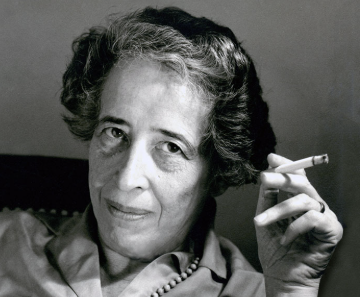
In an ever-changing, incomprehensible world the masses had reached the point where they would, at the same time, believe everything and nothing, think that everything was possible and that nothing was true. [...] under such conditions, one could make people believe the most fantastic statements one day, and trust that if the next day they were given irrefutable proof of their falsehood, they would take refuge in cynicism; instead of deserting the leaders who had lied to them, they would protest that they had known all along that the statement was a lie and would admire the leaders for their superior tactical cleverness.
8 months 2 weeks ago
Kant ... discovered "the scandal of reason," that is the fact that our mind is not capable of certain and verifiable knowledge regarding matters and questions that it nevertheless cannot help thinking about.
▼
Source
p. 14
8 months 2 weeks ago
The essence of totalitarian government, and perhaps the nature of every bureaucracy, is to make functionaries and mere cogs in the administrative machinery out of men, and thus to dehumanise them.
▼
Source
As quoted in Ideas in literature: Ten things Hannah Arendt said that are eerily relevant in today's political times
8 months 2 weeks ago
The main characteristic of any event is that it has not been foreseen. We don't know the future but everybody acts into the future. Nobody knows what he is doing because the future is being done, action is being done by a "we" and not an "I." Only if I were the only one acting could I foretell the consequences of what I'm doing. What actually happens is entirely contingent, and contingency is indeed one of the biggest factors in all history.
8 months 2 weeks ago
Forgiveness is the key to action and freedom.
▼
Source
As quoted in The Concise Columbia Dictionary of Quotations (1989) edited by Robert Andrews, p. 114
8 months 2 weeks ago
For the trouble with lying and deceiving is that their efficiency depends entirely upon a clear notion of the truth that the liar and deceiver wishes to hide. In this sense, truth, even if it does not prevail in public, possesses an ineradicable primacy over all falsehoods.
▼
Source
"Lying in Politics"
8 months 2 weeks ago
Totalitarianism in power invariably replaces all first-rate talents, regardless of their sympathies, with those crackpots and fools whose lack of intelligence and creativity is still the best guarantee of their loyalty.
▼
Source
Part 3, Chapter 10
8 months 2 weeks ago
If a given science accidentally reached its goal, this would by no means stop the workers in the field, who would be driven past their goal by the sheer momentum of the illusion of unlimited progress.
▼
Source
p. 55
8 months 2 weeks ago
No one has the right to obey.
▼
Source
in a radio interview with Joachim Fest (9 November 1964)
8 months 2 weeks ago
The chief reason warfare is still with us is neither a secret death-wish of the human species, nor an irrepressible instinct of aggression, nor, finally and more plausibly, the serious economic and social dangers inherent in disarmament, but the simple fact that no substitute for this final arbiter in international affairs has yet appeared on the political scene.
▼
Source
"On Violence"
8 months 2 weeks ago
Persecution of powerless or power-losing groups may not be a very pleasant spectacle, but it does not spring from human meanness alone. What makes men obey or tolerate real power and, on the other hand, hate people who have wealth without power, is the rational instinct that power has a certain function and is of some general use. Even exploitation and oppression still make society work and establish some kind of order. Only wealth without power or aloofness without a policy are felt to be parasitical, useless, revolting, because such conditions cut all the threads which tie men together. Wealth which does not exploit lacks even the relationship which exists between exploiter and exploited; aloofness without policy does not imply even the minimum concern of the oppressor for the oppressed.
▼
Source
Part 1, Ch. 1, § 1
8 months 2 weeks ago
Kant was also quite aware that "the urgent need" of reason is both different from and "more than mere quest and desire for knowledge." Hence, the distinguishing of the two faculties, reason and intellect, coincides with a distinction between two altogether different mental activities, thinking and knowing.
▼
Source
p. 14
8 months 2 weeks ago
He was genuinely incapable of uttering a single sentence that was not a cliché. Eichmann, despite his rather bad memory, repeated word for word the same stock phrases and self-invented clichés (when he did succeed in constructing a sentence of his own, he repeated it until it became a cliché) each time he referred to an incident or event of importance to him. The longer one listened to him, the more obvious it became that his inability to speak was closely connected with an inability to think, namely to think from the standpoint of somebody else. No communication was possible with him, not because he lied but because he was surrounded by the most reliable of all safeguards against the words and the presence of others, and hence against reality as such.
▼
Source
Ch. III
8 months 2 weeks ago
Nobody knows what is going to happen because so much depends on an enormous number of variables, on simple hazard. On the other hand if you look at history retrospectively, then, even though it was contingent, you can tell a story that makes sense.... Jewish history, for example, in fact had its ups and downs, its, enmities and its friendships, as every history of all people has. The notion that there is one unilinear history is of course false. But if you look at it after the experience of Auschwitz it looks as though all of history-or at least history since the Middle Ages - had no other aim than Auschwitz.... This, is the real problem of every philosophy of history how is it possible that in retrospect it always looks as though it couldn't have happened otherwise?
8 months 2 weeks ago
The cultural treasures of the past, believed to be dead, are being made to speak, in the course of which it turns out that they propose things altogether different than what had been thought.
▼
Source
"Martin Heidegger at Eighty," in Heidegger and Modern Philosophy: Critical Essays (1978) by Michael Murray, p. 294
8 months 2 weeks ago
Clichés, stock phrases, adherence to conventional, standardized codes of expression and conduct have the socially recognized function of protecting us against reality.
▼
Source
p. 4
8 months 2 weeks ago
Real power begins where secrecy begins.
▼
Source
Part 3, Ch. 12, § 1
8 months 2 weeks ago
Thinking withdraws radically and for its own sake from this world and its evidential nature, whereas science profits from a possible withdrawal for the sake of specific results.
▼
Source
p. 56
8 months 2 weeks ago
Political questions are far too serious to be left to the politicians.
▼
Source
Men in Dark Times
8 months 2 weeks ago
The point, as Marx saw it, is that dreams never come true.
▼
Source
"On Violence"
8 months 2 weeks ago
The Nazis were 'convinced that evil-doing in our time has a morbid force of attraction,' Bolshevik assurances inside and outside Russia that they do not recognize ordinary moral standards have become a mainstay of Communist propaganda, and experience has proven time and again that the propaganda value of evil deeds and general contempt for moral standards is independent of mere self-interest, supposedly the most powerful psychological factor in politics.
▼
Source
Part 3, Ch. 10
8 months 2 weeks ago
Kant stated defensively that he had "found it necessary to deny knowledge. . . to make room for faith," but he had not made room for faith; he had made room for thought, and he had not "denied knowledge" but separated knowledge from thinking.
▼
Source
p. 14
8 months 2 weeks ago
The case of the conscience of Eichmann, which is admittedly complicated but is by no means unique, is scarcely comparable to the case of the German generals, one of whom, when asked at Nuremberg, "How was it possible that all of you honorable generals could continue to serve a murderer with such unquestioning loyalty?," replied that it was "not the task of a soldier to act as judge over his supreme commander. Let history do that or God in Heaven."
▼
Source
Ch. VIII
8 months 2 weeks ago
The phenomenon of the will in Epictetus, a different mental ability whose chief characteristic is that it speaks an imperative even when it commands nothing but our ability to think. The goal is to annihilate reality insofar it concerns me.
▼
Source
Hannah Arendt Lecture on Thinking
8 months 2 weeks ago
Could the activity of thinking as such, the habit of examining whatever happens to come to pass or to attract attention, regardless of results and specific content, could this activity be among the conditions that make men abstain from evil-doing?
▼
Source
p. 5
CivilSimian.com created by AxiomaticPanic, CivilSimian, Kalokagathia