

4 months ago
I see no way to secure liberalism by trying to put its core values beyond any but internal or consensual reasoning. The resulting slide into relativism leaves a disastrous parallel between 'liberalism for the liberals!' and 'cannibalism for the cannibals!'
▼
Source
"Is Universalism Ethnocentric?", in C. Joppke and S. Lukes (eds.) Multicultural Questions (Oxford: OUP, 1999) p. 36. Quoted in Steven Lukes, [https://stevenlukes.net/wp-content/uploads/2012/05/liberalism-for-the-liberals.pdf "Liberalism for the liberals,

4 months ago
I have seen manners that make a similar impression with personal beauty, that give the like exhilaration and refine us like that; and in memorable experiences they are suddenly better than beauty, and make that superfluous and ugly. But they must be marked by fine perception, the acquaintance with real beauty. They must always show control; you shall not be facile, apologetic, or leaky, but king over your word; and every gesture and action shall indicate power at rest. They must be inspired by the good heart. There is no beautifier of complexion, or form, or behavior, like the wish to scatter joy, and not pain, around us.
▼
Source
p. 167
4 months ago
If the chance of error alone were the sole basis for evaluating methods of inference, we would never reach a decision, but would merely keep increasing the sample size indefinitely.
▼
Source
p. 255; cited in The Journal of the American Forensic Association. Vol 20-22 (1984), p. 180
4 months ago
When Socrates and his two great disciples composed a system of rational ethics they were hardly proposing practical legislation for mankind...They were merely writing an eloquent epitaph for their country.
4 months ago
Generally speaking, the errors in religion are dangerous; those in philosophy only ridiculous.
▼
Source
Part 4, Section 7
4 months ago
Does anyone bathe in a mighty little time? Don't say that he does it ill, but in a mighty little time. Does anyone drink a great quantity of wine? Don't say that he does ill, but that he drinks a great quantity. For, unless you perfectly understand the principle from which anyone acts, how should you know if he acts ill? Thus you will not run the hazard of assenting to any appearances but such as you fully comprehend. (45).
4 months ago
Pythagoras was a teacher of the purest system of morals ever propounded to man.
▼
Source
Robert Taylor, The Diegesis (1829) p. 219

4 months ago
To conceive the good, in fact, is not sufficient; it must be made to succeed among men. To accomplish this less pure paths must be followed.
▼
Source
Ch. 5.

4 months ago
A man's thinking goes on within his consciousness in a seclusion in comparison with which any physical seclusion is an exhibition to public view.
▼
Source
Pt II, p. 189

4 months ago
When facing the realm of life and death in the form of an enemy's sword, one must be firmly settled in mind and body, and not at all intimidated; without providing your opponent the slightest opening, control his mind in a flash and move where you will — straight, diagonally, or in any other appropriate direction.
▼
Source
p. 31
4 months ago
What lies behind us and what lies ahead of us are tiny matters compared to what lies within us.
▼
Source
As [http://quoteinvestigator.com/2011/01/11/what-lies-within/ reported by Quoteinvestigator on January 11, 2011] the quote appeared in "Meditations in Wall Street" (1940) by Wall Street trader Henry Stanley Haskins, "a Wall Street trader with a checkered
4 months ago
However a systems problem is solved—by a planner, scientist, politician, antiplanner, or whomever—the solution is wrong, even dangerously wrong. There is bound to be deception in any approach to the system.
▼
Source
p. 229; cited in Charles Smith (2007, p. 43)
4 months ago
The living have never shown me how to live.
▼
Source
"On My Friendly Critics"
4 months ago
Eloquence, when at its highest pitch, leaves little room for reason or reflection; but addressing itself entirely to the fancy or the affections, captivates the willing hearers, and subdues their understanding. Happily, this pitch it seldom attains. But what a Tully or a Demosthenes could scarcely effect over a Roman or Athenian audience, every Capuchin, every itinerant or stationary teacher can perform over the generality of mankind, and in a higher degree, by touching such gross and vulgar passions.
▼
Source
Section 10 : Of Miracles Pt. 2
4 months ago
The Pythagorean mathematical concepts, abstracted from sense impressions of nature, were... projected into nature and considered to be the structural elements of the universe. [Pythagoreans] attempted to construct the whole heaven out of numbers, the stars being... material points. ...they identified the regular geometric solids... with the different sorts of substances in nature. ...This confusion of the abstract and the concrete, of rational conception and empirical description, which was characteristic of the whole Pythagorean school and of much later thought, will be found to bear significantly on the development of the concepts of calculus. It has often been inexactly described as mysticism, but such stigmatization appears to be somewhat unfair. Pythagorean deduction a priori having met with remarkable success in its field, an attempt (unwarranted...) was made to apply it to the description of the world of events, in which the Ionian hylozoistic interpretations a posteriori had made very little headway. This attack on the problem was highly rational and not entirely unsuccessful, even though it was an inversion of the scientific procedure, in that it made induction secondary to deduction.
▼
Source
Carl B. Boyer, The History of the Calculus and Its Conceptual Development (1949).

4 months ago
Do not imagine that there is any bird more easily caught by decoy, nor any fish sooner fixed on the hook by wormy bait, than are all these poor fools neatly tricked into servitude by the slightest feather passed, so to speak, before their mouths. Truly it is a marvelous thing that they let themselves be caught so quickly at the slightest tickling of their fancy. Plays, farces, spectacles, gladiators, strange beasts, medals, pictures, and other such opiates, these were for ancient peoples the bait toward slavery, the price of their liberty, the instruments of tyranny. By these practices and enticements the ancient dictators so successfully lulled their subjects under the yoke, that the stupefied peoples, fascinated by the pastimes and vain pleasures flashed before their eyes, learned subservience as naïvely, but not so creditably, as little children learn to read by looking at bright picture books.
▼
Source
Part 2
4 months ago
I sit astride life like a bad rider on a horse. I only owe it to the horse's good nature that I am not thrown off at this very moment.
▼
Source
p. 36e

4 months ago
Divine religion ... does not prod men with an iron rod; it guides them with bands of love. It draws no avenging sword, dispenses no temporal goods, assumes no right to any earthly possessions, and claims no external power over the mind. Its weapons are reason and persuasion; its strength is the divine power of truth.
▼
Source
p. 73
4 months ago
Systems thinking, as written about and practiced by Russell Ackoff, C. West Churchman, Peter Checkland and others, contained within it many of the impulses that motivate the application of design ideas to strategy, organization, society, and management. Ideas such as engaging a broad set of stakeholders, moving beyond simple metrics and calculations, considering idealized options and using scenarios to explore them, shifting boundaries to reframe problems, iteration, the liberal use of diagrams and rich pictures, and tirelessly searching for a better set of alternatives were all there. If the business and management community had bought it, we would not be having the many discussions about design, design thinking, and expanding management education to engage the intuitive, to embrace values, to look beyond available choices.
▼
Source
Fred Collopy (2009) "Lessons Learned -- Why the Failure of Systems Thinking Should Inform the Future of Design Thinking". In Fast Company blog, June 7, 2009
4 months ago
I revelled in the keen analysis of William James, Josiah Royce and young George Santayana.
▼
Source
The Autobiography of W.E.B. Du Bois: A Soliloquy on Viewing My Life from the Last Decade of Its First Century (1968)
4 months ago
The great end of all human industry, is the attainment of happiness. For this were arts invented, sciences cultivated, laws ordained, and societies modelled, by the most profound wisdom of patriots and legislators.
▼
Source
Part I, Essay 16: The Stoic
4 months ago
Is it just I who cannot found a school, or can a philosopher never do so?
▼
Source
p. 69e

4 months ago
We are like sailors who on the open sea must reconstruct their ship but are never able to start afresh from the bottom. Where a beam is taken away a new one must at once be put there, and for this the rest of the ship is used as support. In this way, by using the old beams and driftwood the ship can be shaped entirely anew, but only by gradual reconstruction.
▼
Source
Otto Neurath (1921), "Spengler's Description of the World," as cited in: Nancy Cartwright et al. Otto Neurath: Philosophy Between Science and Politics, Cambridge University Press, 28 Apr. 2008 p. 191
4 months ago
The true value of the Christian religion rests, not upon speculative views of the Creator, which must necessarily be different in each individual, according to the extent of the knowledge of the finite being, who employs his own feeble powers in contemplating the infinite : but it rests upon those doctrines of kindness and benevolence which that religion claims and enforces, not merely in favour of man himself but of every creature susceptible of pain or of happiness.
▼
Source
"Passages from the life of a philosopher", The Basis Of Virtue Is Truth, p. 404-405

4 months ago
There is no chastisement that does not purify; there is no disorder that ETERNAL LOVE does not turn against the principle of evil.
▼
Source
Chapter III, p. 31
4 months ago
Truth springs from argument amongst friends.
4 months ago
W. is very excitable: he has more passion about philosophy than I have; his avalanches make mine seem mere snowballs. He has the pure intellectual passion in the highest degree; it makes me love him. His disposition is that of an artist, intuitive and moody. He says every morning he begins his work with hope, and every evening he ends in despair — he has just the sort of rage when he can't understand things as I have.
▼
Source
Bertrand Russell, as quoted in Young Ludwig: Wittgenstein's life, 1889-1921 (1988) by Brian McGuinness, p. 100

4 months ago
The law is an adroit mixture of customs that are beneficial to society, and could be followed even if no law existed, and others that are of advantage to a ruling minority, but harmful to the masses of men, and can be enforced on them only by terror.
▼
Source
"Words of a Rebel"; as quoted in The Heretic's Handbook of Quotations: Cutting Comments on Burning Issues (1992) by Charles Bufe, p. 26
4 months ago
The immense number and variety of the beautiful optical discoveries which we owe to Sir David Brewster makes the comparison in his case a very imperfect representation of his triumphs over nature; and that, besides his place in the history of the Theory of Optics, he must hold a most eminent position in the history of Optical Crystallography, whenever the discovery of a True Optical Theory of Crystals supplies us with the Epoch to which his labors in this field form so rich.
▼
Source
William Whewell (1859). History of the Inductive Sciences, D. Appleto. p. 133
4 months ago
When we reflect, that the Inquisition, by its restrictions, and authority, would have prevented the French revolution,—it is hard to say, whether the Sovereign, who, wholly, and without reserve, gave up this instrument, would not, in reality, be doing an injury to humanity.
▼
Source
p. 31

4 months ago
If it had pleased them [the legislators] to order that this wealth, after having been possessed by fathers during their life, should return to the republic after their death, you would have no reason to complain of it.
4 months ago
Each individual is a cosmos of organs, each organ is a cosmos of cells, each cell is a cosmos of infinitely small ones; and in this complex world, the well-being of the whole depends entirely on the sum of well-being enjoyed by each of the least microscopic particles of organized matter. A whole revolution is thus produced in the philosophy of life.

4 months ago
Pittacus said that half was more than the whole.
▼
Source
Pittacus, 2.
4 months ago
That brief, nervous, lucid style, stripped of phrases, robust of limb, did not at all recall the softness of the eighteenth century, nor the declamations of the latest French books: it was born and steeped in the breath of the Alps; it was virgin, it was young, it was harsh and savage; it had no human respect, it felt its solitude; it improvised depth and form all at once… That man was new among the enfants du siècle [children of the century].
▼
Source
Alphonse de Lamartine, Cours familier de littérature (1859), pp. 426–427
4 months ago
The principles of pleasure are not firm and stable. They are different in all mankind, and variable in every particular with such a diversity that there is no man more different from another than from himself at different times.
4 months ago
After the publication of my dialogues, I was summoned to Rome by the Congregation of the holy Office, where, being arrived on the 10th of February 1633, I was subjected to the infinite clemency of that tribunal, and of the Sovereign Pontiff, Urban the Eighth; who, notwithstanding, thought me deserving of his esteem.
▼
Source
pp. 145–146
4 months ago
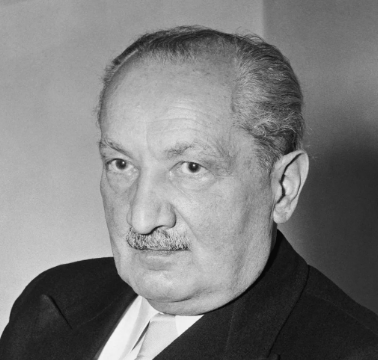
Those in the crossing must in the end know what is mistaken by all urging for intelligibility: that every thinking of being, all philosophy, can never be confirmed by "facts," ie, by beings. Making itself intelligible is suicide for philosophy. Those who idolize "facts" never notice that their idols only shine in a borrowed light. They are also meant not to notice this; for thereupon they would have to be at a loss and therefore useless. But idolizers and idols are used wherever gods are in flight and so announce their nearness.
▼
Source
Contributions to Philosophy (From Enowning) [Beitrage Zur Philosophie (Vom Ereignis)], notes of 1936–1938, as translated by Parvis Emad and Kenneth Maly (1989)
4 months ago
Think of past wars and of those that subjected people will have to wage to conquer the right to breathe freely, the wars for markets, the wars to create colonial empires. And in France we unfortunately know only too well that every war, victorious or not, is followed by slavery. And finally what is even worse than all that has just been enumerated, is the fact that the education we all receive from the State, at school and after, has so warped our minds that the very notion of freedom ends up by being lost, and disguised in servitude. It is a sad sight to see those who believe themselves to be revolutionaries unleashing their hatred on the anarchist — just because his views on freedom go beyond their petty and narrow concepts of freedom learned in the State school. And meanwhile, this spectacle is a reality. The fact is that the spirit of voluntary servitude was always cleverly cultivated in the minds of the young, and still is, in order to perpetuate the subjection of the individual to the State.
▼
Source
IX
4 months ago
Once when Bion was at sea in the company of some wicked men, he fell into the hands of pirates; and when the rest said, "We are undone if we are known,"—"But I," said he, "am undone if we are not known."
▼
Source
Bion, 3.

4 months ago
Of the fifty or hundred systems of philosophy that have been advanced at different times of the world's history, perhaps the larger number have been, not so much results of historical evolution, as happy thoughts which have accidently occurred to their authors. An idea which has been found interesting and fruitful has been adopted, developed, and forced to yield explanations of all sorts of phenomena. … The remaining systems of philosophy have been of the nature of reforms, sometimes amounting to radical revolutions, suggested by certain difficulties which have been found to beset systems previouslv in vogue; and such ought certainly to be in large part the motive of any new theory. … When a man is about to build a house, what a power of thinking he has to do, before he can safely break ground! With what pains he has to excogitate the precise wants that are to be supplied. What a study to ascertain the most available and suitable materials, to determine the mode of construction to which those materials are best adapted, and to answer a hundred such questions! Now without riding the metaphor too far, I think we may safely say that the studies preliminary to the construction of a great theory should be at least as deliberate and thorough as those that are preliminary to the building of a dwelling-house.
4 months ago
Knowledge is like a sphere, the greater its volume, the larger its contact with the unknown.
4 months ago
The critique of the highest values hitherto does not simply refute them or declare them invalid. It is rather a matter of displaying their origins as impositions which must affirm precisely what ought to be negated by the values established.
▼
Source
p. 26
4 months ago
In market gardening the soil is always made... Consequently, it is now a usual stipulation in the renting contracts of the Paris maraîcheres that the gardener may carry away his soil, down to a certain depth, when he quits his tenancy. He himself makes it, and when he moves to another plot he carts his soil away...
4 months ago
Asked from what country he came, he replied, "I am a citizen of the world."
▼
Source
Diogenes, 6.
4 months ago
Man is a thinking being. His reason enables him to recognize his own potentialities and those of his world. He is thus not at the mercy of the facts that surround him, but is capable of subjecting them to a higher standard, that of reason. P. 6

4 months ago
The mind, like the body, has its contagious diseases and its scurvy. ...We catch everything from those with whom we come in contact; their gestures, their accent, etc.
4 months ago
A finite interval of time generally contains an innumerable series of feelings; and when these become welded together in association the result is a general idea.

4 months ago
Those who have nothing else to recommend them to the respect of others but only their blood, cry it up at a great rate, and have their mouths perpetually full of it. They swell and vapor, and you are sure to hear of their families and relations every third word.
▼
Source
p. 22 (Ancestry)
4 months ago
The dominant metaphor of conceptual relativism, that of differing points of view, seems to betray an underlying paradox. Different points of view make sense, but only if there is a common co-ordinate system on which to plot them; yet the existence of a common system belies the claim of dramatic incomparability.
▼
Source
Donald Davidson. "On the Very Idea," p. 184; as cited in: Johannes Brandl, Wolfgang Leopold Gombocz. The Mind of Donald Davidson. Rodopi, 1989, p. 152
4 months ago
To those who hold abstractly to Hegel’s political philosophy, Hobhouse replies that the very fact of class society, the patent influence of class interests on the state, renders it impossible to designate the state as expressive of the real will of individuals as a whole. ‘Wherever a community is governed by one class or one race, the remaining class or race is permanently in the position of having to take what it can get.’ P. 396
CivilSimian.com created by AxiomaticPanic, CivilSimian, Kalokagathia