
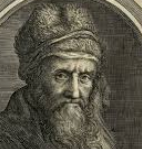
Diogenes Laërtius
Member for
6 months 2 weeksDiogenes Laërtius — Lives of the Eminent Philosophers and the Preservation of Ancient Thought (fl. c. AD 220–240)
Almost nothing is known about Diogenes Laërtius as a person. His hometown is uncertain — perhaps Laerte in Cilicia, which would explain the cognomen. The dates of his birth and death are unknown. His philosophical affiliations are unclear — he copies material from various schools without consistently advocating for any. He appears to have written for a noble lady interested in philosophy, possibly during the reign of Alexander Severus (222–235 AD). He wrote epigrams about many of the philosophers he described, a few of which survive — verses of modest quality but enough to show he was literate in the full ancient sense.
What he left behind — the "Lives and Opinions of Eminent Philosophers," ten books covering more than eighty philosophers from Thales to Epicurus — is one of the most consequential works of compilation in the history of thought. Due to the destruction of the vast majority of the primary sources he used, Diogenes Laërtius became, by default, the foremost surviving source on the history of Greek philosophy. Not because he was the best of the ancient biographers of philosophers — he was not — but because he happened to survive when so much else was lost. Montaigne, who relied on him heavily, wrote that he wished there had been a dozen Laërtii instead of one.
His critics have been as distinguished as his admirers. Hegel called his work a mere compilation. Hermann Usener called him a "complete ass" (asinus germanus). Werner Jaeger called him "that great ignoramus." All of them nonetheless used him. This is his philosophical situation: too unreliable to trust without corroboration, too indispensable to discard.
The Work — Ten Books, Eighty Philosophers
The "Lives" is organized into ten books dividing Greek philosophy into two main streams: the Ionic tradition (beginning with Anaximander, running through Socrates and his successors to Theophrastus) and the Italian tradition (beginning with Pythagoras, running through the Eleatics and atomists to Epicurus). Each life provides, with varying degrees of completeness, biographical details, characteristic sayings and anecdotes, lists of writings, and summaries of philosophical doctrine.
The coverage was neither uniform nor systematic. Some figures received extensive treatment — Epicurus received an entire book, Book X, containing the full text of three letters in which Epicurus summarized his philosophy for different audiences, and a collection of his maxims. These letters — the Letter to Herodotus, the Letter to Pythocles, and the Letter to Menoeceus — survive nowhere else. Without Diogenes Laërtius, our knowledge of Epicurean philosophy would be drastically reduced. Other philosophers received only a paragraph or a page — often the only surviving record of their existence at all.
"Due to the loss of so many of the primary sources on which Diogenes relied, his work has become the foremost surviving source on the history of Greek philosophy. The value of his Lives as an insight into the private lives of the Greek sages led Montaigne to exclaim that he wished that instead of one Laërtius there had been a dozen."
The Method — Compilation Without Philosophy
Diogenes Laërtius's method was that of a compiler rather than a critic. He gathered material from a wide range of sources — earlier biographical works, doxographical collections, catalogs of philosophical writings, collections of sayings and anecdotes — and arranged it under the names of individual philosophers. He frequently preserved contradictory accounts without attempting to adjudicate between them. He repeated stories that were almost certainly apocryphal without indicating any skepticism about their reliability. He copied from sources that themselves copied from earlier sources, creating a Chinese-whisper chain of unknown but certainly significant distortion.
His philosophical understanding of the doctrines he reported was generally shallow — modern scholars regularly find his summaries of philosophical positions inadequate or confused. He was interested in the human details: how philosophers died, what they ate, who they loved, what witty things they said when confronted with provocation or defeat. The anecdote about Diogenes the Cynic masturbating in public and saying he wished he could satisfy hunger by rubbing his stomach — this is Diogenes Laërtius. The anecdote about Plato being sold into slavery by the tyrant Dionysius and bought back by his friends — this is Diogenes Laërtius. The anecdote about Thales falling into a well while looking at the stars while a servant girl laughed at him — Diogenes Laërtius. Whether any of these stories are true is another matter.
"Although it is at best an uncritical and unphilosophical compilation, its value as giving us insight into the private lives of the Greek sages has been recognized since Montaigne. Hegel criticized Diogenes for his lack of philosophical talent — yet admitted the compilation was important for the information it contained."
What Is Preserved — The Irreplaceable Record
Despite all these limitations, the concrete importance of Diogenes Laërtius to the subsequent history of philosophy cannot be overstated. He preserves the three surviving letters of Epicurus — the foundation of our knowledge of Epicurean physics, cosmology, and ethics. He preserves extensive fragments and summaries of Stoic philosophy, the doctrines of the Skeptics, the teachings of the Cyrenaics, and the sayings of the Cynics. He preserves the only surviving lists of the writings of many ancient philosophers — catalogs that allow us to know what was lost even when we cannot recover it. He preserves biographical details about figures that appear in no other surviving source — details that, however unverifiable, are all we have.
The Letter to Menoeceus alone — preserved in Book X — is one of the most important documents in the history of philosophy: a concise, direct statement of the Epicurean account of the good life, including the argument that death is nothing to us (since when we exist, death is absent; when death arrives, we no longer exist), and the case for tranquility as the highest human good. This letter exists only because Diogenes Laërtius thought to include it.
"From the Letter to Menoeceus: 'Get used to believing that death is nothing to us. For all good and bad consists in sense-experience, and death is the privation of sense-experience. When we exist, death is not yet present, and when death is present, then we do not exist.'"
— Epicurus, Letter to Menoeceus, preserved by Diogenes Laërtius
The Renaissance Transmission — How Ancient Philosophy Returned
Diogenes Laërtius had a complicated medieval and Renaissance reception. The monk Ambrogio Traversari produced a Latin translation in Florence between 1424 and 1433 that became one of the key vectors through which ancient philosophical biography reached the Renaissance intellectual world. Leon Battista Alberti modeled his own autobiography on Diogenes Laërtius's Life of Thales. Montaigne returned to the "Lives" repeatedly in the Essays. The book functioned as a kind of philosophical entertainment — a collection of wisdom, wit, and scandalous anecdote about the founders of Western thought — accessible to those who could not read the original texts in Greek and appealing to those who could.
The irony is precise: the most philosophically shallow of the ancient writers about philosophers became the gateway through which Renaissance humanists first encountered many of the ancient schools. Epicureanism in particular was known primarily through Diogenes Laërtius until other sources were recovered and studied. The history of ideas is partly a history of accidents of transmission.
"The Lives of the Eminent Philosophers first compiled in the third century AD came to prominence in Renaissance Italy — remaining to this day a crucial source for much of what we know about the origins and practice of philosophy in ancient Greece, covering a longer period and a larger number of figures than any other ancient source."
What He Tells Us About the CivSim Catalogue Itself
His challenge to Universal Humanism is the archival one: that the preservation of thought is as important as its production — that the thinkers who gather, copy, and transmit serve a function as essential to the life of ideas as the thinkers who originate. Philosophy needs its Diogenes Laërtii as much as its Platos and Aristotles — and sometimes an ass with a good memory is worth more than a genius who fails to write things down.
"The value of his Lives as giving us an insight into the private lives of the Greek sages led Montaigne to write that he wished that instead of one Laërtius there had been a dozen."
— The standard judgment on a writer without whom the catalogue you are currently reading could not have been written
School Certificates: 0
No certificates shown yet.
CivilSimian.com created by AxiomaticPanic, CivilSimian, Kalokagathia