
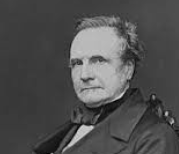
Charles Babbage
Member for
3 months 4 weeksCharles Babbage — The Analytical Engine, the Division of Mental Labour, and the Victorian Who Designed the Computer (1791–1871)
Charles Babbage was an English mathematician, philosopher, inventor, and mechanical engineer — born in London in 1791 to a wealthy banking family, educated at Trinity College Cambridge where he co-founded the Analytical Society to promote Leibnizian over Newtonian calculus notation, elected Lucasian Professor of Mathematics at Cambridge in 1828 (apocryphally, without ever delivering a lecture), a founding member of the Astronomical Society, the Statistical Society, and the British Association for the Advancement of Science — who spent most of his adult life designing mechanical computing machines that could not be built with the precision engineering of his era, wrote the first systematic study of manufacturing economics, pioneered operations research before the field had a name, and died in 1871 having never completed a single one of his calculating engines, furious at the government that had withdrawn funding, at the engineers who had failed him, and at the organ grinders of London who had made it their mission to play outside his house in retaliation for his campaigns to have street music banned.
The Analytical Engine — designed from 1837, never built — was Turing-complete a century before Turing formalized the concept. It had a store (memory), a mill (arithmetic logic unit), control flow via conditional branching and loops, input via punched cards borrowed from the Jacquard loom, and output via printer. Its architecture was essentially identical to the von Neumann architecture that has governed computer design since 1945. Von Neumann was unaware of Babbage's work when he wrote his 1945 report.
His central concern: that the systematic application of mathematical reasoning — first to calculation, then to manufacture, then to the organization of knowledge — could produce outcomes that human labor alone could not achieve, and that the institutions of science and industry needed to be organized to enable this application rather than obstruct it.
The Wish That Started Everything
The story Babbage's biographers return to — probably legendary in its precise form but accurate in its essence — is the moment in his early career when he was working with John Herschel to verify astronomical calculations. Looking at a table of numbers that had been laboriously computed by hand and was full of errors, he said: "I wish to God these calculations had been executed by steam!" That wish — the desire to remove human fallibility from the process of systematic calculation — shaped the next fifty years of his life.
Mathematical tables were essential to navigation, astronomy, insurance, and engineering. They were computed by human "computers" — people employed to do arithmetic — working in parallel, with results cross-checked between them. The errors they produced were consequential: ships ran aground, insurance premiums were wrong, engineering calculations were unreliable. Babbage proposed to replace the human computers with a machine that could not make arithmetic errors — a machine governed by the same mathematical necessity that governed the theorems it was computing.
"I wish to God these calculations had been executed by steam!"
— Babbage, attributed, looking at a table of errors
The Difference Engine — Calculating by the Method of Differences
The Difference Engine, begun in 1822, was the first project: a mechanical calculator that used the mathematical method of finite differences to compute polynomial functions, allowing the full range of standard mathematical tables — logarithms, trigonometric functions, astronomical values — to be generated by repeated addition alone. The beauty of the method was that it reduced every calculation to the one operation simplest to implement mechanically.
Babbage received substantial government funding — ultimately more than £17,000, an enormous sum — and spent nearly twenty years on the project. He never completed it. The precision machining required for tens of thousands of interlocking metal parts was at the absolute limit of what Victorian engineering could achieve, and disputes with his chief engineer Joseph Clement led to an acrimonious breakdown. The Science Museum in London built a working version of Difference Engine No. 2 — Babbage's improved design — in 1991, using nothing but tools and materials available in the 1840s. It worked perfectly. Babbage had been right; the engineering of his era had been the obstacle.
"The Difference Engine calculates with numbers thirty-one digits long, using only arithmetical addition — the method removes the need for multiplication and division, which are more difficult to implement mechanically."
The Analytical Engine — The Computer That Was Never Built
Before the Difference Engine was finished, Babbage had already conceived something far more ambitious: the Analytical Engine, designed from 1834 onward. Where the Difference Engine was a dedicated calculator for polynomials, the Analytical Engine was a general-purpose computing machine — programmable, capable of any calculation, governed by instructions stored on punched cards adapted from the Jacquard loom's pattern-programming system.
The architecture was complete in all essential respects. The "store" held numbers — up to a thousand fifty-digit numbers — that could be read and written as needed. The "mill" performed the arithmetic operations. Conditional branching allowed the machine to take different actions depending on the results of calculations — the fundamental feature that made it programmable rather than merely mechanical. It was, in modern terms, Turing-complete: in principle capable of computing anything computable.
Ada Lovelace — daughter of Lord Byron, mathematician, and Babbage's intellectual collaborator — published in 1843 an annotated translation of an Italian description of the Engine. Her notes, longer than the original text, contained what is now recognized as the first algorithm intended for execution by a machine — a method for computing Bernoulli numbers — and a visionary description of what the Engine might eventually be capable of: composing music, playing chess, solving problems in logic. The reach of her imagination exceeded even Babbage's published claims.
"The analytical engine incorporated an arithmetic logic unit, control flow in the form of conditional branching and loops, and integrated memory — making it the first design for a general-purpose computer that could be described in modern terms as Turing-complete. The architecture that von Neumann described in 1945 is conceptually identical to the architecture Babbage had designed a century earlier."
The Economy of Machinery — The Philosopher of the Factory
While building the Difference Engine, Babbage had toured factories throughout Britain and continental Europe, inspecting every machine and every industrial process with the same systematic attention he applied to calculation. The result was "On the Economy of Machinery and Manufactures" (1832) — the first systematic scientific study of manufacturing, cited by Mill, Marx, and Alfred Marshall, and recognized as the founding text of what became operations research.
The book covered topics that had never been systematically analyzed: the regulation of power, the control of raw materials, division of labour, time studies, inventory control, the advantage of size in manufacturing, the duration and replacement of machinery. Babbage went so far as to publish a detailed accounting of all the costs of producing his own book — the first such analysis in publishing history — thereby incurring the hostility of booksellers who found his analysis of their "too large" profit margins uncomfortable.
"What Arthur Young was to agriculture, Charles Babbage was to the factory visit and machinery."
The Babbage Principle — Division of Mental Labour
Babbage's most influential economic contribution — which became known as the "Babbage principle" — extended Adam Smith's analysis of the division of labour in a specific direction. Smith had analyzed how dividing physical labour into specialized tasks increased productivity. Babbage added a crucial economic observation: skilled workers typically spent parts of their time on tasks below their skill level. If the labour process was divided among several workers — assigning high-skill tasks only to high-cost workers and routine tasks to lower-paid workers — the same output could be produced at significantly lower cost.
The principle had a dark implication that Marx drew out more fully: the motivation for division of labour in the factory system was not productivity but profitability — and the mechanism was the deskilling of workers, the systematic removal of skill from each task so that each task could be performed by the cheapest available labour. The Babbage principle became the intellectual foundation of Frederick Winslow Taylor's "scientific management" and the entire tradition of industrial rationalization.
"Skilled workers typically spend parts of their time performing tasks below their skill level. If the labour process can be divided among several workers, labour costs may be cut by assigning only high-skill tasks to high-cost workers, restricting other tasks to lower-paid workers."
— The Babbage Principle
The Cantankerous Reformer — Streets, Science, and the State
Babbage's public life was characterized by a combativeness that made him many enemies and produced genuine results. He campaigned for the reform of the Royal Society, which he regarded as dominated by gentlemen amateurs who valued social connection over scientific achievement — his 1830 "Reflections on the Decline of Science in England" helped trigger the founding of the British Association for the Advancement of Science. He argued for government funding of scientific research — a position that was radical in his day and has since become standard. He proposed a uniform penny postal rate — contributing to the 1840 postal reform. He contributed to actuarial science, railroad safety analysis, cryptanalysis, and the design of lighthouse signals.
His campaign against street musicians — particularly barrel organ grinders — became a London cause célèbre. He estimated that a quarter of his working capacity had been destroyed by the noise they made. They responded by organizing outside his house in deliberate protest. He wrote an entire chapter of his autobiography documenting the legal remedies he had attempted and the abuse he had received. The episode illustrated something characteristic of Babbage: his absolute certainty that his own projects mattered enough to justify any inconvenience to anyone who obstructed them.
"He invented the cowcatcher for railways, reformed the British postal system, was a pioneer in operations research and actuarial science, and suggested that weather of years past could be read from tree rings — and was famously cantankerous about all of it."
Legacy — The Machine That Waited a Century
Babbage died in 1871 embittered and largely unrecognized for the computer work. His engines were curiosities, not achievements. It was only in the twentieth century — as electronic computers made clear what Babbage had been attempting — that his designs were re-examined and found to be architecturally complete and conceptually correct. The Science Museum's 1991 working construction of Difference Engine No. 2 vindicated him definitively. Carbon molecules — buckminsterfullerenes — were named for Buckminster Fuller because they looked like his domes; the entire field of programmable computation was implicitly named for Babbage's architecture, even though his name was rarely attached to it.
On CivSim he belongs alongside Ada Lovelace, Alan Turing, and John von Neumann — the lineage of thinkers who understood that systematic reasoning could be mechanized and that its mechanization would change the world. His challenge to Universal Humanism is the engineering challenge: that the institutional structures of science, manufacturing, and governance must be organized to enable systematic application of intelligence to the problems of human welfare — and that the obstacles are not intellectual but organizational, political, and economic. He was right about the Analytical Engine. He could not build it because the institutions of his era would not support it. The question his life poses to any philosophy of human progress is whether we have learned to build institutions adequate to the ideas they are asked to realize.
"The analytical engine incorporated an arithmetic logic unit, control flow in the form of conditional branching and loops, and integrated memory, making it the first design for a general-purpose computer that could be described in modern terms as Turing-complete — a century before Turing formalized that concept."
CivilSimian.com created by AxiomaticPanic, CivilSimian, Kalokagathia