
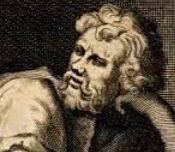
Gaius Musonius Rufus
Member for
4 months 3 weeksGaius Musonius Rufus — The Roman Socrates, Teacher of Epictetus, and Philosopher of Practiced Virtue (c. AD 30 – c. 101)
Gaius Musonius Rufus was a Roman Stoic philosopher — born around AD 30 in Volsinii in Etruria (modern Bolsena, Italy), son of a Roman eques (knight), the second-highest social order, who became by the reign of Nero the most respected Stoic teacher in Rome, was called the "Roman Socrates" by Origen, was described by Tacitus as the foremost Stoic of his day, exiled three times — twice by Nero, once by Vespasian — without abandoning his principles or his students, allowed to remain in Rome when Vespasian expelled all other philosophers in AD 71 and then eventually exiled anyway, and dead by around AD 101, leaving behind no works of his own — or none that survived.
What survived were the notes of his student Lucius: twenty-one discourses and thirty-two pithy sayings, preserved in the fifth-century anthology of Stobaeus. Through these fragments, and through the writings of his most famous student Epictetus, Musonius Rufus stands as the philosophical link between the earlier Stoic tradition and the late Stoic figures — Epictetus, Marcus Aurelius — who remain the most widely read ancient philosophers today. The chain runs directly: Musonius taught Epictetus; Epictetus's Discourses shaped Marcus Aurelius; Marcus Aurelius became the most powerful Stoic emperor in history. Without Musonius, that chain might never have formed.
His central concern: that philosophy was not an intellectual exercise but a practical discipline — that its sole purpose was to produce better human beings, and that this purpose was served not by refined argumentation but by training in virtue, endurance, and the simplest possible life.
Philosophy as Practice — Against the Clever Sophists
Musonius's most fundamental philosophical commitment was to the distinction between knowing virtue and practicing it. He was not interested in philosophical cleverness — in the elaborate argumentation and logical puzzles that had come to define much of the sophistic culture of his day. He regarded the appetite for such display as a symptom of the vice it claimed to cure: a philosopher who spent his energy impressing audiences with arguments rather than reforming their characters had misunderstood what philosophy was for.
His method was accordingly direct and practical: he taught through short, clear discourses on specific topics — on exile, on poverty, on marriage, on women's education, on the proper diet of a philosopher, on the value of manual labor — and through Socratic dialogue in which he pressed his interlocutors not toward clever conclusions but toward self-examination. Epictetus reported that Musonius liked to test students by discouraging them: "Like a stone, if you cast it upward, will be brought down to earth by its own nature, so the man whose mind is naturally good, the more you repel him, the more he turns toward that to which he is naturally inclined."
"Philosophy is training in the nobility of character, and nothing else. The teacher of philosophy should not present many arguments but rather should offer a few, clear, practical arguments oriented to his listener and couched in terms known to be persuasive to that listener."
— Musonius Rufus, Discourse 4
The Equality of Women — Two Thousand Years Ahead of Society
Musonius's most remarkable and most historically significant argument was his case for the philosophical education of women — an argument so explicit, so sustained, and so clearly grounded in Stoic principles that it stands without close parallel in ancient philosophy. The argument was simple: women and men both had reason. The gods had given the gift of reason equally to both sexes. Virtue was the same for both — practical wisdom, courage, justice, temperance. If virtue required cultivation, and reason was the instrument of that cultivation, then women required philosophical education as much as men. To deny them this was not merely unjust but illogical — it contradicted the Stoic premises that virtually everyone accepted.
He extended the argument: a philosophically educated woman would not submit to anything shameful out of fear of death or pain, would not bow to any tyrant, held the same beliefs about death, pain, and good as the Stoic man. He even noted that the Amazons had conquered many peoples with weapons, demonstrating that women were fully capable of courageous action. These were not incidental remarks but explicit, sustained claims — unique in the ancient world for their directness and philosophical grounding.
"Women as well as men have received from the gods the gift of reason, which we use in our dealings with one another and by which we judge whether a thing is good or bad, right or wrong. Since men and women's capacity to understand virtue is the same, both should be trained in philosophy."
— Musonius Rufus
Exile as Philosophical Test — Living the Doctrine
Musonius was exiled from Rome three times — first accompanying his friend Rubellius Plautus into banishment under Nero (AD 60), returning after Plautus's death, then exiled himself to the harsh island of Gyaros in AD 65 on a trumped-up charge connected to the Pisonian conspiracy. Gyaros was described as "harsh and devoid of human culture." Musonius survived, formed a small philosophical community, and wrote a discourse — his ninth — arguing for the positive value of exile.
The argument was characteristically Stoic and characteristically Musonius: exile was not an evil because it was not a moral evil. What was truly evil was vice; what was truly good was virtue. Exile was an inconvenience — sometimes a severe one — but it removed none of the goods that actually mattered. A philosopher on a desolate island still had reason, still had virtue, still had the opportunity to think and teach and act well. Energetic and hardworking and intelligent people, he wrote, fared well wherever they went. His life demonstrated his doctrine. Vespasian expelled all philosophers from Rome in AD 71 but allowed Musonius to remain — testimony to his unusual standing. When Musonius was eventually exiled anyway, he returned after Vespasian's death with his reputation intact and his teaching uninterrupted.
"It is not true that exiles lack the very necessities of life. Energetic and hardworking and intelligent men, no matter where they go, fare well and live without want. The man who is unwilling to exert himself almost always convicts himself as unworthy of good, since we gain every good by toil."
— Musonius Rufus, Discourse 9
Simple Living — Diet, Labor, and the Philosophical Body
Musonius was unusual among ancient philosophers for the attention he paid to the body as a philosophical instrument. He advocated a vegetarian diet — not as an ascetic deprivation but as the rational choice of a person who understood that the body's needs were minimal and that overindulgence degraded the rational faculty. He wore the simplest possible garments and footwear. He advocated manual labor as philosophically appropriate — not degrading but dignifying, because labor developed the qualities of endurance and self-sufficiency that virtue required.
This was not performance but conviction: he believed the philosopher who lived in comfort and luxury was demonstrating by their way of life that they did not actually believe what they taught. Philosophy was not a set of propositions to be entertained but a discipline to be lived — and the body was the primary site where that discipline was either practiced or abandoned.
"How much more fitting it is that we stand firm and endure, when we know that we are suffering for some good purpose — to become good and just and self-controlled, a state which no man achieves without hardships."
— Musonius Rufus
The Stoic Opposition — Philosophy and Political Courage
Musonius was associated throughout his career with what historians call the Stoic Opposition — the network of senators and philosophers who maintained a principled critique of imperial tyranny under Nero and Domitian. This was a genuinely dangerous position: Nero executed members of this circle, and Musonius's own exiles were consequences of his associations. Yet he continued to teach, continued to criticize, and used the influence he retained even in exile to prosecute Publius Egnatius Celer — the Stoic philosopher who had betrayed Barea Soranus to Nero — when political circumstances permitted.
His political courage was of a piece with his philosophy: a person who genuinely held that virtue was the only good and that death, exile, and poverty were not evils had no rational grounds for cowardice in the face of tyranny. The Stoic who collaborated with Nero to avoid exile was not merely craven but philosophically inconsistent — behaving as if the goods they claimed to despise were actually worth purchasing with the corruption of their character. Musonius's life was the refutation of that inconsistency.
"Considered by Origen a 'Roman Socrates' and by Tacitus as the foremost Stoic of his day, Musonius was allowed to remain in Rome when Vespasian banished all other philosophers — testimony to the unusual moral authority that his consistent practice had earned him."
Legacy — The Teacher Behind the Teachers
Musonius is less well known than his students because he wrote nothing that has come down to us directly — or rather, because what was written about him was transmitted through secondary sources rather than through the organized preservation that protected Epictetus's Discourses and Marcus Aurelius's Meditations. The historical irony is precise: his direct influence on Epictetus, and through Epictetus on Marcus Aurelius, was arguably greater than the influence of any single surviving text — yet the mechanism of that influence made him invisible to those who encountered only the later works.
On CivSim he belongs alongside Epictetus, Marcus Aurelius, and Dio Chrysostom — the late Stoic tradition that understood philosophy as ethical training rather than theoretical inquiry. His specific contribution to Universal Humanism's concerns is the equality argument: that the same rational endowment that grounds human dignity in all persons grounds the claim to philosophical education — to moral formation — in all persons equally, regardless of sex, status, or circumstance. The argument that women deserved exactly the same philosophical cultivation as men, grounded in exactly the same Stoic premises that his contemporaries accepted, was two thousand years ahead of the society in which he made it — and remains as clear and as compelling as it was in AD 60.
"If Stoicism is a river, Musonius Rufus is one of its deepest and least explored channels — and the water there is still fresh."
CivilSimian.com created by AxiomaticPanic, CivilSimian, Kalokagathia