
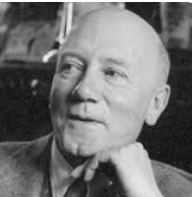
C. D. Broad
Member for
5 months 1 weekC. D. Broad — Systematic Thoroughness, Emergent Mind, the Growing Block Universe, and the Philosophical Treatment of Parapsychology (1887–1971)
Charlie Dunbar Broad was an English philosopher — born in Harlesden, Middlesex in 1887, educated at Dulwich College and then Trinity College Cambridge, where he took first-class honours with special distinction in philosophy in 1910, won a Prize Fellowship for his dissertation on perception in 1911, taught at St Andrews and Bristol before returning to Cambridge permanently in 1923, serving as Knightbridge Professor of Moral Philosophy from 1933 to 1953, and dying in his rooms at Trinity College in 1971 at the age of 83 — who spent his career in the patient, systematic, and comprehensive examination of virtually every major area of philosophy: the philosophy of science, the theory of perception, the mind-body problem, the nature of time, induction and probability, ethics, the history of philosophy, and — distinctively — the philosophical dimensions of parapsychological research.
He worked in the long shadow of his Cambridge contemporaries — Russell, Moore, and Wittgenstein — and was consequently overshadowed in reputation despite the exceptional scope and rigor of his work. Recent scholarship has begun the process of recovery: his theory of emergentism in the philosophy of mind, his "growing block" theory of time, and his careful taxonomy of ethical theories are all recognized as contributions of lasting philosophical value.
His central concern: the systematic and dispassionate examination of all possible positions on any given philosophical problem — mapping the logical space of alternatives, assessing the arguments for each, and arriving at conclusions as clear as the evidence permitted — usually considerably more cautious conclusions than his contemporaries were willing to accept.
Critical and Speculative Philosophy — The Method
Broad drew a fundamental distinction between two modes of philosophical work. Critical philosophy analyzed the concepts used in ordinary life and science — "unanalysed concepts" — exposing them to every objection and clarifying their meaning through examination of exceptional and extreme cases. Speculative philosophy took over all aspects of human experience, reflected on them together, and tried to work out a view of reality as a whole that would do justice to all of them.
Most of Broad's work was critical rather than speculative — not because he thought speculative philosophy was illegitimate but because he thought it required critical work as its foundation, and because his own temperament inclined him toward thoroughness over system-building. He was not, as he correctly said of himself, a system-builder. He was an exceptionally rigorous cartographer of philosophical terrain — mapping every alternative, assessing every argument, and typically finding the decisive considerations more evenly balanced than those who had settled the question in their own minds.
"Broad's writings have two critical merits: he tried his best to classify all the logical and historical philosophical alternative solutions to various philosophical problems, with their accompanying arguments — and he was thorough in investigating any point."
The Mind and Its Place in Nature — Emergentism
Broad's 1925 "The Mind and Its Place in Nature" was his most philosophically ambitious work — a systematic examination of the mind-body problem that remains one of the most thorough treatments of the subject in English. His central contribution was a carefully articulated theory of emergence: the claim that certain properties of complex systems were genuinely novel — not merely the sum of the properties of their components — and that mental properties were among the clearest instances of such emergence.
Broad distinguished between what he called "mechanistic" theories of mind — which attempted to reduce mental properties entirely to physical ones — and "emergentist" theories, which held that mental properties arose from physical organization but could not be predicted from or reduced to the properties of physical components. He took emergence seriously as a philosophical possibility at a time when the dominant tendency in British philosophy was toward some form of physicalist reduction. His detailed analysis of perception — using the terminology of "sensa" rather than "sense data" — engaged carefully with the question of what exactly a perceptual experience was and what its relationship to the physical world could be.
"The concept of emergence is supposed to be a way of making sense of the truism that in some cases 'the whole is greater than the sum of its parts' — that wholes, systems, or higher levels display properties not possessed by the parts or lower levels that make them up."
The Growing Block — Broad's Theory of Time
Broad's philosophy of time — worked out primarily in "Scientific Thought" (1923) — was a distinctive intermediate position between two standard views. The "presentist" view held that only the present was real. The "eternalist" or "block universe" view held that past, present, and future were all equally real — that time was a fourth dimension on a par with the three spatial dimensions, and that the impression of temporal passage was in some sense illusory. Broad proposed what is now called the "growing block" universe: past and present were equally real, but the future was simply nothing at all.
The time series, on Broad's view, was like a growing line: "fresh slices of existence" were continuously added to its forward end, and time had a direction precisely because new existence was always being added. The future was genuinely open — not yet determined, not yet real — which meant that judgments about future events were neither true nor false at the time they were made, since there was nothing yet in existence to make them true or false. This was a philosophically serious position with significant implications for free will, causation, and the nature of temporal experience — and it has attracted renewed philosophical attention in contemporary philosophy of time.
"The time series is like a growing line, possessing direction because 'fresh slices of existence' are always being added to the forward end of it. The future is simply nothing at all."
— Broad, Scientific Thought (1923)
Five Types of Ethical Theory — The Landscape of Moral Philosophy
Broad's 1930 "Five Types of Ethical Theory" was for many years a standard text — a systematic examination of the ethical systems of Spinoza, Butler, Hume, Kant, and Sidgwick, combined with a framework for understanding the different possible structures a moral theory could take. The book was notable for containing one of the first serious treatments of Sidgwick's "The Methods of Ethics" at a time when Sidgwick had largely been forgotten — a scholarly rehabilitation that predated the late-twentieth-century Sidgwick revival by several decades.
His method was characteristic: he mapped the logical space of ethical theories with painstaking care — teleological versus deontological, naturalist versus non-naturalist, cognitivist versus non-cognitivist — without arriving at a settled position of his own. He tentatively inclined toward a form of intuitionism — the view that some moral truths were directly self-evident — but held the position with appropriate diffidence, fully aware of the objections it faced. He also offered, with characteristic self-aware irony, what he described as giving psychological egoism "the longest possible run for its money" before concluding, following Butler, that it was false.
"After Butler there is hardly need of further nails in the coffin of psychological egoism. But because of its shrewd and perceptive treatment of human motivation, Broad's essay is nonetheless of remaining interest."
Free Will — Occurrent and Non-Occurrent Causation
Broad's 1934 essay "Determinism, Indeterminism, and Libertarianism" introduced a conceptual distinction that became foundational for subsequent philosophical debates about free will: the distinction between occurrent causation and non-occurrent causation. Occurrent causation was the familiar kind — one event causing another event. Non-occurrent causation was causation by a continuing thing or agent rather than by a preceding event.
This distinction became, in the hands of later philosophers, the basis for the distinction between "event-causal" and "agent-causal" libertarianism — the two main forms in which the libertarian view about free will has been defended in contemporary philosophy. Agent causation — the view that free acts are caused by agents as such, not merely by prior events in the agent — required Broad's non-occurrent causation as its conceptual foundation. The terminology changed but the conceptual work was Broad's.
"Broad's essay introduced the philosophical terms occurrent causation and non-occurrent causation, which became the basis for the contemporary distinction between 'agent-causal' and 'event-causal' libertarianism in debates on free will."
Basic Limiting Principles — Parapsychology and the Boundaries of Science
Broad's engagement with parapsychological research was neither credulous nor dismissive — it was characteristic of his philosophical method applied to an unconventional domain. He joined the Society for Psychical Research in 1920 and served as its president twice (1935 and 1958). His philosophical contribution to parapsychology was the concept of "basic limiting principles" (BLPs) — the fundamental assumptions about how things can be or be known that formed the background framework of ordinary life, scientific theory, and most fiction.
His argument was that genuine paranormal phenomena — telepathy, precognition, postmortem survival — would require the abandonment of one or more of these basic limiting principles, and that this was why their philosophical significance was so great even if the empirical evidence was uncertain. He did not claim that the phenomena were real — he examined the evidence carefully and found it suggestive but inconclusive — but he argued that philosophers who dismissed the subject without examination were failing in their duty to consider the full range of possible experience. The archive of his papers at Trinity College showed notes on logic and metaphysics sitting alongside horoscopes, letters about ghost sightings, and reflections on parapsychological journals — not a compartmentalized double life but a unified philosophical curiosity.
"The ample scope and scale of Broad's work is impressive. He nourished an interest in parapsychology — a subject he approached with the disinterested curiosity and scrupulous care that is characteristic of his philosophical work."
Legacy — The Thorough Mind
Broad died in his rooms at Trinity College on 11 March 1971 — the college with which he had been associated for sixty years. He was one of the first openly homosexual philosophers in Britain, signing a letter with Ayer and Russell in 1958 calling for the decriminalization of homosexual acts. He had settled into Cambridge life with deliberate permanence, avoiding the Moral Science Club meetings dominated by Wittgenstein and Moore, occupying rooms once inhabited by Isaac Newton, and producing, year after year, philosophy of extraordinary range and care.
His self-assessment in the Schilpp volume was notably candid — he gave what he described as a "rather unflattering appraisal of his own character and accomplishments" — and his contemporaries responded with rather more appreciation than he had offered himself. Recent scholarship has confirmed their judgment: the emergentism, the growing block theory, the agent-causation distinction, and the ethical taxonomy have all found new audiences.
On CivSim he belongs alongside G. E. Moore, Henry Sidgwick, and W. D. Ross — the Cambridge and Oxford philosophers of the early twentieth century who took ethics seriously as a rigorous discipline and who demonstrated, through patience and precision rather than system-building, that moral philosophy required exactly the kind of thorough examination of concepts and alternatives that Broad exemplified. His challenge to Universal Humanism is the taxonomic one: that any ethical framework must locate itself within the logical space of possible moral theories — knowing which type of theory it is, which objections it faces, and what would count as a decisive reason to revise it.
"Scientists who ignore philosophy expose themselves to a danger to which the natural scientist is peculiarly liable. The extraordinary success of physics and chemistry within their own sphere tempts men to think that the world is simply a physico-chemical system."
— Broad on the relationship between science and philosophy
CivilSimian.com created by AxiomaticPanic, CivilSimian, Kalokagathia