
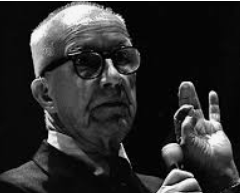
Buckminster Fuller
Member for
6 months 2 weeksBuckminster Fuller — Comprehensive Anticipatory Design Science, Spaceship Earth, and Making the World Work for Everyone (1895–1983)
Richard Buckminster Fuller — "Bucky" to the many who found in him an almost totemic figure for a different way of thinking about the world — was an American inventor, designer, architect, systems theorist, poet, and philosopher, born in Milton, Massachusetts in 1895, twice expelled from Harvard University, descended from a long line of New England Nonconformists that included his great-aunt Margaret Fuller, the Transcendentalist, who died in 1983 after holding 28 patents, authoring 28 books, and receiving 47 honorary degrees from institutions that had not awarded him a single degree he earned in the ordinary way.
He invented the geodesic dome — produced over 300,000 times worldwide during his lifetime — and in doing so gave his name to a molecule: C₆₀, the carbon buckminsterfullerene, whose spherical structure chemists named in his honor when they discovered it in 1985, two years after his death. He coined "Spaceship Earth," "synergetics," "ephemeralization," and "Dymaxion." He designed the only world map that shows all the continents without significant distortion. He proposed floating tetrahedral cities and undersea communities. He conceived the World Game as a simulation tool for allocating the world's resources to meet the needs of all humanity.
His central concern — stated repeatedly throughout his life with the intensity of a mission rather than a professional agenda: to make the world work for 100% of humanity, through the application of design intelligence to the Earth's finite resources, without advantaging one group at the expense of another.
The Crisis and the Commitment — 1927
The origin story Fuller told about himself was pivotal. In 1927, at thirty-two, facing financial ruin, the death of his young daughter from illness he attributed partly to poor housing, and what he described as a complete collapse of confidence, he stood on the shore of Lake Michigan in Chicago contemplating suicide. His conclusion — arrived at in what he described as a kind of visionary moment — was that his life did not belong to himself but was an experiment that the universe might conduct through him. He would commit himself entirely to discovering what one individual could accomplish that could not be achieved by large organizations, governments, or corporations. He would take himself as the guinea pig and the data point.
Whether the story was precisely accurate in its details mattered less than what it meant for how Fuller worked. He refused thereafter to accept the categories and boundaries that organized professional life. He was not an architect, not an engineer, not a philosopher, not a poet — he was a "comprehensive anticipatory design scientist," which was his way of insisting that the world's problems required comprehensiveness rather than specialization, anticipation rather than reaction, and design intelligence rather than political negotiation.
"Comprehensive anticipatory design science: the effective application of the principles of science to the conscious design of our total environment in order to help make the Earth's finite resources meet the needs of all humanity without disrupting the ecological processes of the planet."
— Fuller's definition of his own project
The Geodesic Dome — Structure as Philosophy
Fuller's most famous artifact was the geodesic dome — a structural form derived from his insight that triangles distributed stress more efficiently than any other geometric shape, and that a sphere built from triangular elements would enclose the maximum volume with the minimum surface area and the maximum structural strength. The geodesic dome was not merely an engineering achievement but a philosophical demonstration: that the same principle operated at every scale, that nature's own structures worked through triangular geometry from the nanoscale of molecular lattices to the macroscale of planetary form, and that human design could achieve dramatically more with dramatically less material by understanding and applying this principle.
The dome's structural strength increased in logarithmic ratio to its size — the larger it became, the stronger proportionally it got — which meant that the concept had no theoretical upper limit. Fuller and Shoji Sadao proposed a dome over Manhattan in 1960: two miles in diameter, regulating the city's climate, reducing heating and cooling costs dramatically, a demonstration of the principle at urban scale. The proposal was never built, but it was philosophically serious: an argument that the obstacles to solving urban problems were not resource constraints but design intelligence constraints.
"Fuller discovered that if a spherical structure was created from triangles, it would have unparalleled strength. The sphere uses the 'doing more with less' principle: it encloses the largest volume of interior space with the least amount of surface area, saving on materials and cost."
Ephemeralization — The Logic of Doing More with Less
Fuller's concept of ephemeralization — doing more with less, or progressively increasing performance per unit of resource — was his most philosophically significant contribution to the question of scarcity. He argued that the assumption that human well-being required resource depletion was based on a static view of technology: that as design intelligence advanced, the same human needs could be met with progressively smaller material inputs.
The trajectory was visible in communications technology — where a transatlantic telephone cable of copper had been replaced by a satellite smaller than a car — and Fuller argued it was visible in every domain. The question was not whether there were enough resources to meet human needs, but whether design intelligence was being applied systematically enough to use those resources efficiently. His answer was that it was not — not because the resources were lacking but because political and institutional structures organized competition rather than cooperation around their distribution.
"Ephemeralization — doing more with less — defines the trajectory of technological development. Resources and waste from crude, inefficient products could be recycled into making more valuable products, thus increasing the efficiency of the entire process."
Spaceship Earth — The Planetary Frame
Fuller's most influential conceptual contribution may have been the idea of "Spaceship Earth" — the framing of the planet as a single finite vessel with a fixed supply of resources and no resupply missions. The metaphor was philosophically precise: a spaceship had to be managed as an integrated system, its resources allocated to maintain the life of all its passengers, its systems maintained against failure, its crew responsible for its survival.
The implications were radical. If the Earth was a spaceship, then its political and economic organization — divided into competing nation-states each pursuing national advantage — was not merely inefficient but structurally pathological: it was as if the crew of a spaceship had divided into factions each trying to seize the fuel supply. Fuller was consistently critical of politics and political theory as tools for solving the world's problems — not because he was apolitical but because he thought that political solutions were downstream of design solutions: that the fundamental question was whether the Earth's resources were sufficient to meet all human needs, and his answer was that they were, if used intelligently and cooperatively.
"Comprehensive and anticipatory design initiative alone — exclusive of politics and political theory — can solve the problems of human shelter, nutrition, transportation, and pollution; and it can solve these with a fraction of the materials now inefficiently used."
Synergetics — The Geometry of Thinking
Fuller's most sustained intellectual work was "Synergetics: Explorations in the Geometry of Thinking" (1975), co-written with E. J. Applewhite — a dense, idiosyncratic attempt to develop a comprehensive geometric framework for understanding how structures, energies, and systems behaved. The core principle was synergy itself: that the behavior of whole systems was unpredicted by the behavior of any of their isolated components — that the whole was genuinely more than the sum of its parts in ways that had to be understood through the geometry of how the parts related to each other rather than through their individual properties.
Synergetics was not rigorously mathematical in the sense professional mathematicians expected, and it attracted both devoted advocates and severe critics. Fuller's claim was that conventional geometry — built on Cartesian coordinates, the cube, and the idea of the mathematical point — was philosophically confused at its foundations and that nature actually worked through the tetrahedron and the triangle, not the cube and the square. The claim was partly geometric, partly philosophical, and partly a systematic worldview.
"Synergy: the behavior of whole systems unpredicted by the behavior of any of their isolated components. Reality, whatever it is, is not primarily something existing — it's something happening."
The Trimtab — Small Levers, Large Systems
Fuller's epitaph — which he chose himself — reads: "Call me Trimtab." A trimtab is the small auxiliary rudder attached to the trailing edge of a ship's main rudder: when the captain turns the trimtab, it exerts pressure on the main rudder, which moves the entire ship. Fuller saw the trimtab as a metaphor for the kind of leverage available to the individual thinker: not the brute force of a large organization or political movement, but the precise intervention at the right place in a system that could redirect the whole.
The metaphor captured something essential about Fuller's self-understanding. He did not believe that the world's problems would be solved by political revolution or mass movements but by design intelligence applied at the points where small innovations could have large-scale cascading effects. The geodesic dome was itself a trimtab — a structural innovation that demonstrated a principle with implications far beyond any single building.
"The future is a choice between utopia and oblivion. Call me Trimtab."
— Fuller's epitaph, Cambridge, Massachusetts
Legacy — The Practical Philosopher of Sufficiency
Fuller died in July 1983, weeks before his last geodesic dome project was scheduled to begin construction. His influence persisted most strongly in design, architecture, and sustainability thinking — in the generation of designers, engineers, and thinkers who found in his work both a method and a mission. Carbon buckminsterfullerene — "buckyballs" — became one of the most studied molecules in chemistry and opened the field of nanotechnology. The Buckminster Fuller Institute continues to award the Fuller Challenge for design solutions to the world's most pressing problems.
On CivSim he belongs alongside Thorstein Veblen, Lewis Mumford, and Ivan Illich — thinkers who challenged the assumption that the world's problems were primarily political or economic rather than design problems, and who argued that the way human beings organized material life was as much a philosophical question as an engineering one. His challenge to Universal Humanism is the design challenge: that a philosophy organized around "necessity for all" must engage with the question of how those necessities are to be provided — that the answer "through politics and justice" is incomplete without the answer "through design intelligence that makes provision possible" — and that the two are not alternatives but inseparable dimensions of the same project.
"How can we ever do so without ever advantaging one human at the expense of another? What are the resources? Make the world work for 100% of humanity."
— Fuller's organizing questions
School Certificates: 0
No certificates shown yet.
CivilSimian.com created by AxiomaticPanic, CivilSimian, Kalokagathia