
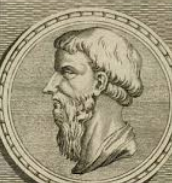
Anacharsis
Member for
5 months 1 weekAnacharsis — The Scythian Sage, Barbarian Wisdom, and the View from Outside (fl. 6th century BC)
Anacharsis was a Scythian prince and philosopher of the sixth century BC — son of the Scythian king Gnurus, brother of the king Saulius, half-Greek through his mother, a traveler to Athens where he formed a celebrated friendship with Solon and became famous for an outsider's sharp eye for the illogic hidden in the familiar customs of the Greeks — and a figure whose historical reality is uncertain, whose writings are lost or never existed, and whose legacy is almost entirely the construction of later Greek writers who found in him the perfect vehicle for a specific philosophical proposition: that the wisest observer of any civilization is the one who arrives from outside it.
He was included in some ancient Greek lists as one of the Seven Sages — alongside Solon, Thales, Bias, and Pittacus — a remarkable distinction for someone who was not Greek, who came from a culture the Greeks called barbarian, and who was eventually killed by his own people for having adopted Greek customs. The death is the pivot around which his whole story turns: too Greek for the Scythians, too Scythian for the Greeks — belonging fully to neither, seeing both more clearly for it.
His central concern — insofar as the tradition captures anything historical — was the gap between the stated purposes of human institutions and what they actually accomplished: the law that did not produce justice, the custom that did not produce what it claimed to produce, the wisdom that stopped at the borders of the familiar.
The Historical Anacharsis — What Little We Know
Anacharsis presents the historian the same problem as most legendary sages: the historical figure, if there was one, is almost entirely buried under the literary construction that used his name. Herodotus — our earliest source — mentions him briefly, saying he traveled to Greece, returned to Scythia, and was killed by his brother Saulius for performing an orgiastic ritual to the Goddess at night, wearing images on his dress and beating drums — a ritual associated with the cult of the Mother Goddess. Herodotus adds that Saulius killed him with a bow for having abandoned Scythian ways.
This account — the only one with a plausible claim to early historical tradition — presents a figure destroyed not by the Greeks but by his own people for having gone native. He became, in this reading, a martyr to cultural exchange: someone who crossed the boundary between civilizations and paid for it with his life. Whether he actually existed in this form, or whether Herodotus invented the story to make a point about Scythian conservatism, is genuinely uncertain. What is certain is that later writers found the story irresistible.
"My homeland is a shame to me, but you, by your behavior, are a shame to your homeland."
— Response to a man who mocked him as a barbarian
The Meeting with Solon — The Outsider Arrives
The most philosophically resonant episode in the Anacharsis tradition is his arrival in Athens and his encounter with Solon — the great Athenian lawgiver who was simultaneously reforming Athenian law and being recognized as the wisest man in Greece. Plutarch's account captures the philosophical dynamic precisely.
Anacharsis arrived at Solon's house and told the slave at the door that Anacharsis was come to see Solon, to make his acquaintance and enter into hospitable relations with him. The slave returned with the quintessentially Greek answer: men generally limit such hospitality to their own countrymen. Thereupon the Scythian stepped across the threshold and said that now that he was in Solon's country, it would be quite suitable for Solon to appear and receive him — turning the rule of hospitality against the exclusion that had been invoked to enforce it. Solon, reportedly, was so delighted that he took him in.
The encounter was remembered as philosophically productive on both sides — the Athenians found in Anacharsis a confirmation of what they already suspected: that the quality of wisdom was not bounded by civilization, that the barbarian who saw clearly could outthink the citizen who was too comfortable to notice what was obvious. Anacharsis found in Solon a man worth arguing with and an institution — the law — worth being skeptical of.
"He cultivated the outsider's knack of seeing the illogic in familiar things. His conversation was droll and frank, and Solon and the Athenians took to him as a natural philosopher — not unlike the way the French took to Benjamin Franklin."
Anacharsis on Law — The Spider's Web
The most famous philosophical observation attributed to Anacharsis — and one of the most quoted remarks in the entire Presocratic tradition — is his response when Solon showed him the laws he was drafting for Athens. Solon asked what he thought would best prevent crimes and injustice in the city. Anacharsis replied that the laws were like spider's webs: they would catch the weak and the small but would be torn through by the powerful and the rich.
This is not cynicism but sociological analysis — the same observation that Marx would make 2,400 years later about formal legal equality and substantive social inequality. The law's claim to generality is undermined by the power differential between those subject to it: the powerful can break or bend it, the weak are caught in it. That a Scythian prince — an outsider to Athenian law — could see this more clearly than Solon who was writing the law was precisely the point the later tradition wanted to make.
"Laws are like spider's webs — they catch the weak and the small, but the powerful and the rich tear through them."
The Aphorisms — Scythian Discourse as a Genre
The tradition attributed to Anacharsis a body of aphorisms that were collectively called "Scythian discourse" — a genre of frank, practical, commonsense observation intended as a counterpoint to the elaborate philosophical argumentation of the Greek schools. Whether or not any of these were actually said by a historical Anacharsis, they express a consistent philosophical attitude: the preference for what actually works over what sounds impressive, for what nature produces over what civilization manufactures, for the honest statement over the elegant one.
Among the observations credited to him: "In Greece wise men speak and fools decide" — a diagnosis of democratic deliberation that retains its accuracy. "Man's enemy is himself" — the Scythian nomination for the principal source of human suffering. When asked what ship was the safest, he replied: "The one that is hauled up on shore" — a preference for not taking risks that the Greeks, a seafaring people, found both funny and disturbing. When asked to compare the Greeks and the Scythians, he said that among the Greeks, the disgraceful things were done in private and the decent ones in public, while among the Scythians it was the other way around — a judgment that cuts both ways.
"In Greece wise men speak, and fools decide."
The Cynics and the Noble Savage — The Literary Anacharsis
The Cynic philosophers of the third century BC found in Anacharsis their perfect ancestor and avatar. He was the noble savage — the man uncorrupted by civilization who could therefore see it clearly — and the Cynics used him to make their argument that civilization's vices were not natural to human beings but products of artificial social arrangements. They attributed to him a collection of letters now recognized as third-century Cynic compositions rather than genuine Scythian correspondence.
The pattern continued through later antiquity — Lucian wrote two works on him — and resurfaced powerfully in the eighteenth century, when Jean-Jacques Barthélemy published "Voyage du Jeune Anacharsis en Grèce" (1788), a learned fictional travel journal presented as the account of a young Scythian touring classical Greece. It became one of the most popular books of the late eighteenth century — running through many editions, translated across Europe, reprinted in the United States — and exercised significant influence on the growth of classical learning and philhellenism in France at the time of the Revolution. The French Revolutionary figure who adopted the name Anacharsis Cloots — a Prussian baron who called himself "the personal enemy of Jesus Christ" and petitioned the National Convention as representative of "the human race" — was deliberately invoking this tradition.
"Foreignness is not only a political or cultural state of being: it can be moral, ethical, the mark of an outsider. Anacharsis represents wisdom that comes not from belonging but from not quite belonging anywhere fully."
The Death — Killed for Being Too Greek
The tradition agrees on the essentials of his end: Anacharsis returned to Scythia from Greece and attempted to introduce practices he had encountered in Athens — whether the worship of the Mother Goddess, the Eleusinian Mysteries, or simply a way of life shaped by Greek habits and thought. His brother Saulius, the Scythian king, killed him for it.
The death completes the philosophical structure of his story. He was too Greek for the Scythians. The tradition also implies — without stating it quite so directly — that he was too Scythian for the Greeks: that the outsider perspective which made him wise in Athens was precisely what prevented his full belonging there. The man who sees both cultures from outside both has the clearest view and the most precarious position. He belongs nowhere; he sees everywhere.
"The historical Anacharsis — if he existed — was a man who crossed the boundary between civilizations and paid for it with his life. Whether or not the story is true, it is not false."
Legacy — The Permanent Value of the Outside View
Anacharsis belongs on CivSim not because his philosophy is well-documented — it is not — but because the figure he became represents a permanent and important philosophical position: that the clearest view of any civilization comes from someone who is genuinely outside it, that the customs which appear natural and inevitable from inside appear arbitrary and contingent from outside, and that the wisdom associated with being the stranger is not a lesser or inferior form of knowledge but a different and often superior kind.
He belongs alongside Diogenes of Sinope, Zhuangzi, and Montaigne — thinkers who used the device of the outsider perspective to make visible what familiarity conceals. His spider's web observation about the law — that it catches the weak and the powerful tear through it — remains among the most compressed and accurate sociological observations in the Western tradition. Universal Humanism cannot build its legal framework without reckoning with the Scythian prince's observation about what legal frameworks actually do.
"Later Graeco-Roman tradition transformed Anacharsis into a legendary figure as a kind of 'noble savage' who represented 'Barbarian wisdom,' due to which the ancient Greeks included him as one of the Seven Sages of Greece."
CivilSimian.com created by AxiomaticPanic, CivilSimian, Kalokagathia