



3 months 1 week ago
The Austrian Germans and Magyars will be set free and wreak a bloody revenge on the Slav barbarians. The general war which will then break out will smash this Slav Sonderbund and wipe out all these petty hidebound nations, down to their very names. The next world war will result in the disappearance from the face of the earth not only of reactionary classes and dynasties, but also of entire reactionary peoples. And that, too, is a step forward.
▼
Source
source
The Magyar Struggle in Neue Rheinische Zeitung (13 January 1849) Referring to the Serb uprising of 1848-49
4 months 2 weeks ago
Encourage therefore his inquisitiveness all you can, by satisfying his demands, and informing his judgement, as far as it is capable. When his reasons are any way tolerable, let him find the credit and commendation of it, without being laugh'd at for his mistake be gently put into the right; and if he shew a forwardness to be reasoning about things that come in his way, take care, as much as you can, that no body check this inclination in him, or mislead it by captious or fallacious ways of talking with him. For when all is done, this is the highest and most important faculty of our minds, deserves the greatest care and attention in cultivating it: the right improvement, and exercise of our reason being the highest perfection that a man can attain to in his life.
▼
Source
source
Sec. 122

4 months 1 week ago
Alcohol, hashish, prussic acid, strychnine are weak dilutions. The surest poison is time.
▼
Source
source
Poetry and Imagination

1 month 4 days ago
Shall we say, for example, that Science and Art are indebted principally to the founders of Schools and Universities? Did not Science originate rather, and gain advancement, in the obscure closets of the Roger Bacons, Keplers, Newtons; in the workshops of the Fausts and the Watts; wherever, and in what guise soever Nature, from the first times downwards, had sent a gifted spirit upon the earth? Again, were Homer and Shakspeare members of any beneficed guild, or made Poets by means of it? Were Painting and Sculpture created by forethought, brought into the world by institutions for that end? No; Science and Art have, from first to last, been the free gift of Nature; an unsolicited, unexpected gift; often even a fatal one.

4 months 2 weeks ago
For want of the apparatus of propositional functions, many logicians have been driven to the conclusion that there are unreal objects. It is argued, e.g., by Meinong, that we can speak about "the golden mountain," "the round square," and so on; we can make true propositions of which these are the subjects; hence they must have some kind of logical being, since otherwise the propositions in which they occur would be meaningless. In such theories, it seems to me, there is a failure of that feeling for reality which ought to be preserved even in the most abstract studies. Logic, I should maintain, must no more admit a unicorn than zoology can; for logic is concerned with the real world just as truly as zoology, though with its more abstract and general features.
▼
Source
source
Ch. 16: Descriptions
1 month 4 days ago
No man who has once heartily and wholly laughed can be altogether irreclaimably bad.
▼
Source
source
Bk. I, ch. 4.

4 months 2 weeks ago
It appears, accordingly, from the experience of all ages and nations, I believe, that the work done by freemen comes cheaper in the end than that performed by slaves.
▼
Source
source
Chapter VIII.

3 months 2 weeks ago
The concessions of the weak are the concessions of fear.

4 months 2 weeks ago
Our labour preserves us from three great evils -- weariness, vice, and want.
2 months 1 week ago
Unfortunately, instead of working out that they have probably misunderstood evolution, creationists conclude, instead, that evolution must be false.
▼
Source
source
Heat the Hornet, a review of Jerry Coyne's book Why Evolution is True

2 months 1 week ago
Man works when he is partially involved. When he is totally involved he is at play or leisure.
3 months 1 week ago
Not official revolutionary commissars in any sort of sashes, but rather revolutionary propagandists are to be dispatched into all the provinces and communes and particularly among the peasants who cannot be revolutionised by principles, nor by the decrees of any dictatorship, but only by the act of revolution itself, that is to say, by the consequences that will inevitably ensure in every commune from complete cessation of the legal and official existence of the state.
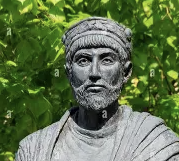
3 weeks 1 day ago
I think he who knows himself will know accurately, not the opinion of others about him, but what he is in reality... he ought to discover within himself what is right for him to do and not learn it from without...
▼
Source
source
Oration to the Cynic Heracleios

5 months 1 day ago
The knowledge of anything, since all things have causes, is not acquired or complete unless it is known by its causes. Therefore in medicine we ought to know the causes of sickness and health. And because health and sickness and their causes are sometimes manifest, and sometimes hidden and not to be comprehended except by the study of symptoms, we must also study the symptoms of health and disease. Now it is established in the sciences that no knowledge is acquired save through the study of its causes and beginnings, if it has had causes and beginnings; nor completed except by knowledge of its accidents and accompanying essentials. Of these causes there are four kinds: material, efficient, formal, and final.
2 months 1 week ago
Omnipresence has become an ordinary human dimension.

5 months 2 weeks ago
Death induces the sensual person to say: Let us eat and drink, because tomorrow we shall die – but this is sensuality's cowardly lust for life, that contemptible order of things where one lives in order to eat and drink instead of eating and drinking in order to live.
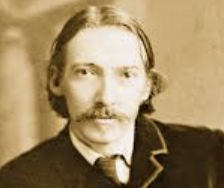
2 months 1 week ago
A man, Mr. Scrymgeour, may fall into a thousand perplexities, but if his heart be upright and his intelligence unclouded, he will issue from them all without dishonour.
▼
Source
source
The Rajah's Diamond, Story of the House with the Green Blinds.
4 months 2 weeks ago
Men fear thought as they fear nothing else on earth - more than ruin, more even than death. Thought is subversive and revolutionary, destructive and terrible; thought is merciless to privilege, established institutions, and comfortable habits; thought is anarchic and lawless, indifferent to authority, careless of the well-tried wisdom of the ages. Thought looks into the pit of hell and is not afraid. It sees man, a feeble speck, surrounded by unfathomable depths of silence; yet it bears itself proudly, as unmoved as if it were lord of the universe. Thought is great and swift and free, the light of the world, and the chief glory of man.
▼
Source
source
pp. 178-179
3 weeks 1 day ago
Of the splendid constellation of great names... we admire the living and revere dead far too warmly and too deeply to suffer us sit in judgment on their respective claims to in this or that particular discovery; to balance mathematical skill of one against the experimental dexterity of another, or the philosophical acumen a third. So long as "one star differs from another in glory," - so long as there shall exist varieties, or even incompatibilities of excellence, - so long will the admiration of mankind be found sufficient for all who merit it.
▼
Source
source
On the Theory of Light (1828) p.494
5 months 2 weeks ago
When you read God's Word, in everything you read, continually to say to yourself: It is I to whom it is speaking - this is earnestness, precisely this is earnestness. Not a single one of those to whom the cause of Christianity in the higher sense has been entrusted forgot to urge this again and again as most crucial, as unconditionally the condition if you are to come to see yourself in the mirror.
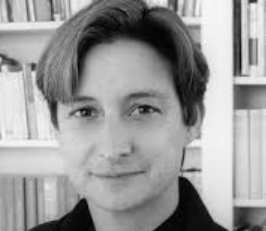
2 months 2 weeks ago
The ethical stand of nonviolence has to be linked to a commitment to radical equality. And more specifically, the practice of nonviolence requires an opposition to biopolitical forms of racism and war logics that regularly distinguish lives worth safeguarding from those that are not-populations conceived as collateral damage, or as obstructions to policy and military aims.
▼
Source
source
p. 62

2 months 4 weeks ago
A man really writes for an audience of about ten persons. Of course if others like it, that is clear gain. But if those ten are satisfied, he is content.
▼
Source
source
p. 66

4 months 2 weeks ago
Beauty is no quality in things themselves: It exists merely in the mind which contemplates them; and each mind perceives a different beauty. One person may even perceive deformity, where another is sensible of beauty; and every individual ought to acquiesce in his own sentiment, without pretending to regulate those of others.
▼
Source
source
Part I, Essay 23: Of The Standard of Taste

2 months 4 weeks ago
We do not obtain the most precious gifts by going in search of them but by waiting for them. Man cannot discover them by his own powers, and if he sets out to seek for them he will find in their place counterfeits of which he will be unable to discern falsity.
1 week 3 days ago
Don't tell yourself anything more than what the initial impressions report. It's been reported to you that someone is speaking badly about you. This is the report - the report wasn't that you've been harmed. I see that my son is sick - but not that his life is at risk. So always stay within your first impressions, and don't add to them in your head - this way nothing can happen to you.
▼
Source
source
VIII. 49:238
3 weeks 2 days ago
Engels feared that the Socialists, in order to gain adherents in the electoral struggles rapidly, would make promises which were contrary to Marxist doctrine. The antisemites told the peasants and the small shopkeepers that they would protect them from the development of capitalism. Engels thought that an imitation of this procedure would be dangerous, since, in his opinion, the social revolution could only be realised when capitalism had almost completely destroyed the small proprietors and small industries; if the Socialists, then, endeavoured to hinder this evolution, they would ultimately compromise their own cause.
▼
Source
source
Reflections on Violence, London: UK, George Allen & Unwin, (reprinted in Saxony 1925) p. 180

1 week 3 days ago
Everything is the work of imagination, and... all the faculties of the soul can be correctly reduced to pure imagination...
1 month 4 days ago
There have been other Priests perhaps equally notable, in calmer times, for doing faithfully the office of a Leader of Worship; bringing down, by faithful heroism in that kind, a light from Heaven into the daily life of their people; leading them forward, as under God's guidance, in the way wherein they were to go. But when this same way was a rough one, of battle, confusion and danger, the spiritual Captain, who led through that, becomes, especially to us who live under the fruit of his leading, more notable than any other.

3 months 2 weeks ago
We term sleep a death, and yet it is waking that kills us, and destroys those spirits that are the house of life.
▼
Source
source
Section 12
4 months 1 day ago
There were two brothers called Both and Either; perceiving Either was a good, understanding, busy fellow, and Both a silly fellow and good for little, Philip said, "Either is both, and Both is neither."
▼
Source
source
35 Philip

4 months 1 week ago
He is dead, and my hatred has died with him.
▼
Source
source
Electra, before the dead Aegistheus, Act 2

4 months 4 days ago
One who is serious all day will never have a good time, while one who is frivolous all day will never establish a household.
▼
Source
source
Maxim no. 25.

5 months 1 week ago
Knowing that certain nights whose sweetness lingers will keep returning to the earth and sea after we are gone, yes, this helps us to die.

4 months 1 week ago
The political, ethical, social, philosophical problem of our day is not to try to liberate the individual from the state and from the state's institutions but to liberate us both from the state and from the type of individualization which is linked to the state. We have to promote new forms of subjectivity through the refusal of this kind of individuality which has been imposed on us for several centuries.
▼
Source
source
p. 785

3 months 1 week ago
We always love . . . despite; and that "despite" covers an infinity.

3 months ago
The wretched consciousness shrinks from it own annihilation, and just as an animal spirit newly severed from the womb of the world, finds itself confronted with the world and knows itself distinct from it, so consciousness must needs desire to possess another life than that of the world itself.
3 months 1 week ago
For you who no longer possess it, freedom is everything, for us who do, it is merely an illusion.
4 months 2 weeks ago
The fundament upon which all our knowledge and learning rests is the inexplicable.
▼
Source
source
Vol. 2, Ch. 1, § 1
3 months 2 weeks ago
Prejudice is of ready application in the emergency; it previously engages the mind in a steady course of wisdom and virtue and does not leave the man hesitating in the moment of decision sceptical, puzzled, and unresolved. Prejudice renders a man's virtue his habit, and not a series of unconnected acts. Through just prejudice, his duty becomes a part of his nature.
1 week 3 days ago
Remember this, then, that this little compound, thyself, must either be dissolved, or thy poor breath must be extinguished, or be removed and placed elsewhere.
▼
Source
source
VIII, 25
1 week 3 days ago
Rememberest the gods, and that they wish not to be flattered, but wish all reasonable beings to be made like themselves; and... rememberest that what does the work of a fig-tree is a fig-tree, and that what does the work of a dog is a dog, and that what does the work of a bee is a bee, and that what does the work of a man is a man.
▼
Source
source
X, 8
4 months 1 day ago
Aristodemus, a friend of Antigonus, supposed to be a cook's son, advised him to moderate his gifts and expenses. "Thy words," said he, "Aristodemus, smell of the apron."
▼
Source
source
44 Antigonus I
4 months 2 weeks ago
Knowledge is not so precise a concept as is commonly thought. Instead of saying "I know this," we ought to say "I more or less know something more or less like this." It is true that this proviso is hardly necessary as regards the multiplication table, but knowledge in practical affairs has not the certainty or the precision of arithmetic. Suppose I say "democracy is a good thing": I must admit, first, that I am less sure of this than I am that two and two are four, and secondly, that "democracy" is a somewhat vague term which I cannot define precisely. We ought to say, therefore: "I am fairly certain that it is a good thing if a government has something of the characteristics that are common to the British and American Constitutions," or something of this sort. And one of the aims of education ought to be to make such a statement more effective from a platform than the usual type of political slogan.
1 week 4 days ago
Wait for the appointed hour.
▼
Source
source
As quoted in The Lives of the Sophists by Eunapius (online exerpt)
2 months 3 weeks ago
The vitality of the ordinary members of society is dependent on its Outsiders.
▼
Source
source
Chapter Three, The Romantic Outsider
2 months 1 week ago
When a man is in a fair way and sees all life open in front of him, he seems to himself to make a very important figure in the world. His horse whinnies to him; the trumpets blow and the girls look out of window as he rides into town before his company; he receives many assurances of trust and regard--sometimes by express in a letter--sometimes face to face, with persons of great consequence falling on his neck. It is not wonderful if his head is turned for a time. But once he is dead, were he as brave as Hercules or as wise as Solomon, he is soon forgotten.
▼
Source
source
The Sire de Maletroit's Door.
3 months 6 days ago
It really is worth the trouble to invent a new symbol if we can thus remove not a few logical difficulties and ensure the rigour of the proofs. But many mathematicians seem to have so little feeling for logical purity and accuracy that they will use a word to mean three or four different things, sooner than make the frightful decision to invent a new word.
▼
Source
source
Gottlob Frege in: Dagobert David Runes (1962). Readings in epistemology, theory of knowledge and dialectics. p. 334
3 months 1 week ago
To have grazed every form of failure, including success.
2 months 3 weeks ago
The STATE IDEA, the authoritarian principle, has been proven bankrupt by the experience of the Russian Revolution. If I were to sum up my whole argument in one sentence I should say: The inherent tendency of the State is to concentrate, to narrow, and monopolize all social activities; the nature of revolution is, on the contrary, to grow, to broaden, and disseminate itself in ever-wider circles. In other words, the State is institutional and static; revolution is fluent, dynamic. These two tendencies are incompatible and mutually destructive. The State idea killed the Russian Revolution and it must have the same result in all other revolutions, unless the libertarian idea prevail.
CivilSimian.com created by AxiomaticPanic, CivilSimian, Kalokagathia