

2 months 3 weeks ago
If by enlightenment and intellectual progress we mean the freeing of man from superstitious belief in evil forces, in demons and fairies, in blind fate-in short, emancipation of fear-then denunciation of what is currently called reason is the greatest service reason can render.

2 months 2 weeks ago
Parents will strip themselves of everything, will sacrifice everything for the physical well-being of their child, will wake nights and stand in fear and agony before some physical ailment of their beloved one; but will remain cold and indifferent, without the slightest understanding before the soul cravings and the yearnings of their child, neither hearing nor wishing to hear the loud knocking of the young spirit that demands recognition. On the contrary, they will stifle the beautiful voice of spring, of a new life of beauty and splendor of love; they will put the long lean finger of authority upon the tender throat and not allow vent to the silvery song of the individual growth, of the beauty of character, of the strength of love and human relation, which alone make life worth living.

4 months 2 weeks ago
I care not so much what I am to others as what I am to myself. I will be rich by myself, and not by borrowing.
▼
Source
source
Book II, Ch. 16

3 months 2 days ago
Imaginary pains are by far the most real we suffer, since we feel a constant need for them and invent them because there is no way of doing without them.

4 months 1 week ago
The Christian Religion not only was at first attended with miracles, but even at this day cannot be believed by any reasonable person without one. Mere reason is insufficient to convince us of its veracity: and whoever is moved by Faith to assent to it, is conscious of a continued miracle in his own person, which subverts all the principles of his understanding, and gives him a determination to believe what is most contrary to custom and experience.
▼
Source
source
Section 10 : Of Miracles Pt. 2
3 months 3 weeks ago
All of us, I believe, are fortunate to have been born.
▼
Source
source
"Death" (1970), p. 7.
3 days ago
You don't love yourself enough. Or you'd love your nature too, and what it demands of you. People who love what they do wear themselves down doing it, they even forget to wash or eat. Do you have less respect for your own nature than the engraver does for engraving, the dancer for the dance, the miser for money or the social climber for status? When they're really possessed by what they do, they'd rather stop eating and sleeping than give up practicing their arts. Is helping others less valuable to you? Not worth your effort?
▼
Source
source
(Hays translation) V, 1


4 months 1 week ago
The best is the enemy of the good.

4 months 1 week ago
In early times, the great majority of the male sex were slaves, as well as the whole of the female. And many ages elapsed, some of them ages of high cultivation, before any thinker was bold enough to question the rightfulness, and the absolute social necessity, either of the one slavery or of the other.
▼
Source
source
Ch. 1
1 month 3 days ago
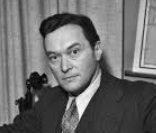
The present crisis of Western democracy is a crisis in journalism.
▼
Source
source
Journalism and the Higher Law, p. 5

4 months 1 week ago
The commonest and cheapest sounds, as the barking of a dog, produce the same effect on fresh and healthy ears that the rarest music does. It depends on your appetite for sound. Just as a crust is sweeter to a healthy appetite than confectionery to a pampered or diseased one.
▼
Source
source
December 27, 1857

4 months 5 days ago
Commoners are weightless. But he was a royal bon vivant who, no matter what, always weighed 125 kilos. I would be very surprised if he didn't have a few pounds left.
▼
Source
source
A soldier in Argos, speaking of the dead King Agamemnon, Act 2
2 weeks 1 day ago
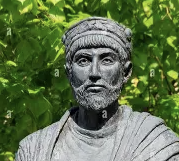
As a general rule, all that has been hitherto advanced respecting the nature of this deity, must be understood to refer to his properties: for the nature of the god is not one thing, and his influence another: and truly, besides these two, his energy a third thing: seeing that all things which he wills, these he is, he can, and he works. For neither doth he will that which he is not; nor is he without strength to do that which he wills; nor doth he will that which he cannot effect. Now this is very different in the case of men, for theirs is a double nature mixed up in one, that of soul and body; the former divine, the latter full of darkness and obscurity: hence naturally arise warfare and discord between the two.
3 months 4 days ago
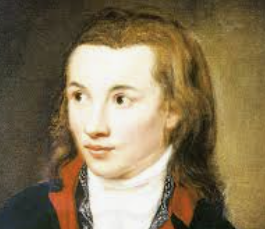
Philosophy ... bears witness to the deepest love of reflection, to absolute delight in wisdom.
▼
Source
source
"Logological Fragments," Philosophical Writings, M. Stolijar, trans. (Albany: 1997) #12
3 months 1 week ago
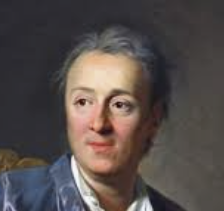
To say that man is a compound of strength and weakness, light and darkness, smallness and greatness, is not to indict him, it is to define him.
▼
Source
source
As quoted in The Anchor Book of French Quotations with English Translations (1963) by Norbert Gutermam
2 weeks 2 days ago
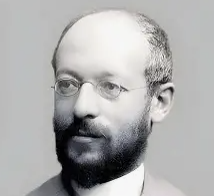
Objectivity may also be defined as freedom: the objective individual is bound by no commitments which could prejudice his perception, understanding, and evaluation of the given.
▼
Source
source
p. 403
4 months 1 week ago
Life is bristling with thorns, and I know no other remedy than to cultivate one's garden.
▼
Source
source
Letter to Pierre-Joseph Luneau de Boisjermain (21 October 1769), from Oeuvres Complètes de Voltaire: Correspondance [Garnier frères, Paris, 1882], vol. XIV, letter # 7692 (p. 478)
1 week ago
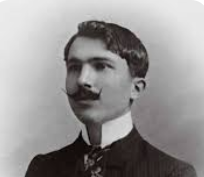
One power descends and wants to scatter, to come to a standstill, to die. The other power ascends and strives for freedom, for immortality. These two armies, the dark and the light, the armies of life and of death, collide eternally.
4 months 1 day ago
There is nothing outside the text," which Derrida opponents have characterized to mean that nothing exists but language.
▼
Source
source
Il n'y a pas de hors-texte. Of Grammatology (1967). G. Spivak translated this as "

4 months 6 days ago
Alcohol, hashish, prussic acid, strychnine are weak dilutions. The surest poison is time.
▼
Source
source
Poetry and Imagination
2 months 4 weeks ago
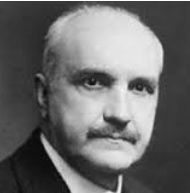
Prosperity, both for individuals and for states, means possessions; and possessions mean burdens and harness and slavery; and slavery for the mind, too, because it is not only the rich man's time that is pre-empted, but his affections, his judgement, and the range of his thoughts.
▼
Source
source
"The Irony of Liberalism"

4 months 2 weeks ago
Most Christians are superstitious rather than pious, and except for the name of Christ differ hardly at all from superstitious pagans.
▼
Source
source
The Erasmus Reader (1990), pp. 140-141.

2 months 2 weeks ago
I've always believed that a writer has got to remain an outsider. If I was offered anything like the Nobel Prize for Literature, I'd find it an extremely difficult conflict because I'd be basically disinclined to accept.
▼
Source
source
Interview with Paul Newman in Abraxas Unbound #7

4 months 1 week ago
Philosophy of religion ... really amounts to ... philosophizing on certain favorite assumptions that are not confirmed at all.
▼
Source
source
E. Payne, trans. (1974) Vol. 1, p. 143

2 months 3 weeks ago
The safest general characterization of the European philosophical tradition is that it consists of a series of footnotes to Plato.
▼
Source
source
Pt. II, ch. 1, sec. 1.

4 months 5 days ago
Much of the modern resistance to chastity comes from men's belief that they "own" their bodies - those vast and perilous estates, pulsating with the energy that made the worlds, in which they find themselves without their consent and from which they are ejected at the pleasure of Another!
▼
Source
source
Letter XXI
2 months 3 weeks ago
Modern science has imposed on humanity the necessity for wandering. Its progressive thought and its progressive technology make the transition through time, from generation to generation, a true migration into uncharted seas of adventure.
▼
Source
source
Ch. 13: "Requisites for Social Progress", p. 291

2 months 4 weeks ago
The Kingdom is like a wise fisherman who cast his net into the sea and drew it up from the sea full of small fish. Among them the wise fisherman found a fine large fish. He threw all the small fish back into the sea and chose the large fish without difficulty. Whoever has ears to hear, let him hear.
1 week ago
Descend you weary-laden, descend in the dark earth,help me to finish swiftly my dread master's shroud,let each hem hold my pain, each corner hide a crow,a lean, voracious crow to peck his heart out bit by bit.
▼
Source
source
Slave's prayer, Book XI, line 708

4 months 1 week ago
It is the highest impertinence and presumption, therefore, in kings and ministers, to pretend to watch over the economy of private people, and to restrain their expence, either by sumptuary laws, or by prohibiting the importation of foreign luxuries. They are themselves always, and without any exception, the greatest spendthrifts in the society. Let them look well after their own expence, and they may safely trust private people with theirs. If their own extravagance does not ruin the state, that of their subjects never will.
▼
Source
source
Chapter III, p. 381.

3 months 1 week ago
People must be governed in a manner agreeable to their temper and disposition; and men of free character and spirit must be ruled with, at least, some condescension to this spirit and this character.
▼
Source
source
Observations on a Late Publication on the Present State of the Nation (1769), page 76.
4 months 1 week ago
[H]e regarded it with the feelings due not to a mere mental delusion, but to a great moral evil. He looked upon it as the greatest enemy of morality: first, by setting up factitious excellencies,-belief in creeds, devotional feelings, and ceremonies, not connected with the good of human kind,-and causing these to be accepted as substitutes for genuine virtues: but above all, by radically vitiating the standard of morals; making it consist in doing the will of a being, on whom it lavishes indeed all the phrases of adulation, but whom in sober truth it depicts as eminently hateful.
▼
Source
source
(p. 40)

5 months 1 week ago
If you have hitherto believed that life was one of the highest value and now see yourselves disappointed, do you at once have to reduce it to the lowest possible price?
2 months 4 weeks ago
It is written, Man shall not live by bread alone, but by every word that proceedeth out of the mouth of God.
▼
Source
source
4:4 (KJV) Said to Satan. The reference is to Deuteronomy 8:3, "... that he might make thee know that man doth not live by bread only, but by every word that proceedeth out of the mouth of the Lord doth man live." (KJV)

4 months 1 week ago
Days of absence,
sad and dreary,
Clothed in sorrow's dark array,
Days of absence, I am weary: She I love is far away.
▼
Source
source
Day of Absence, reported in Bartlett's Familiar Quotations, 10th ed. (1919).
4 months 5 days ago
There is no spiritual sustenance in flat equality. It is a dim recognition of this fact which makes much of our political propaganda sound so thin. We are trying to be enraptured by something which is merely the negative condition of the good life. That is why the imagination of people is so easily captured by appeals to the craving for inequality, whether in a romantic form of films about loyal courtiers or in the brutal form of Nazi ideology. The tempter always works on some real weakness in our own system of values - offers food to some need which we have starved.
3 months 3 weeks ago
When my ability to reason shows me that the suffering of another being is very similar to my own suffering and matters just as much to that other being as my own suffering matters to me, then my reason is showing me something that is undeniably true. ... The perspective on ourselves that we get when we take the point of view of the universe also yields as much objectivity as we need if we are to find a cause that is worthwhile in a way that is independent of our own desires. The most obvious such cause is the reduction of pain and suffering, wherever it is to be found.
▼
Source
source
p. 238
2 months 1 week ago
All of our conscious states, without exception, are caused by lower level neurobiological processes in the brain, and they are realized in the brain as higher level, or system features. It's about as mysterious as the liquidity of water, right? The liquidity is not an extra juice squirted out by the H2O molecules, it's a condition that the system is in; and just as the jar full of water can go from a liquid to solid, depending on the behavior of the molecules, so your brain can go from a state of being conscious to a state of being unconscious, depending on the behavior of the molecules. The famous mind body problem is that simple.
4 months 6 days ago
It makes a great difference in the force of a sentence whether a man be behind it or no.
▼
Source
source
p. 261
3 months 6 days ago
Hegel ... proceeds abstractly from the pre-existence of the intellect. ... He does not appeal to the intellect within us.
▼
Source
source
Z. Hanfi, trans., in The Fiery Brook (1972), p. 68
3 months 1 week ago
The writers against religion, whilst they oppose every system, are wisely careful never to set up any of their own.
▼
Source
source
Preface

3 months 3 weeks ago
In fact we do not know anything infallibly, but only that which changes according to the condition of our body and of the [influences] that reach and impinge upon it.

4 months 6 days ago
All that the conscious ego can do is to formulate wishes, which are then carried out by forces which it controls very little and understands not at all.
5 months 1 week ago
The reasons and purposes for habits are always lies that are added only after some people begin to attack these habits and to ask for reasons and purposes. At this point the conservatives of all ages are thoroughly dishonest: they add lies.
4 months 1 week ago
Every time a man is begotten and born, the clock of human life is wound up anew to repeat once more its same old tune that has already been played innumerable times, movement by movement and measure by measure, with insignificant variations.
▼
Source
source
Vol. I, Ch. 4, The World As Will: Second Aspect, as translated by Eric F. J. Payne (1958) p. 322
6 days ago
To farm is to be placed absolutely.
▼
Source
source
"Imagination in Place"
CivilSimian.com created by AxiomaticPanic, CivilSimian, Kalokagathia