

1 month 1 week ago
Excellence is an art won by training and habituation: we do not act rightly because we have virtue or excellence, but we rather have these because we have acted rightly; 'these virtues are formed in man by his doing the actions'; we are what we repeatedly do. Excellence, then, is not an act but a habit: 'the good of man is a working of the soul in the way of excellence in a complete life... for as it is not one swallow or one fine day that makes a spring, so it is not one day or a short time that makes a man blessed and happy'.
▼
Source
source
p. 87; the quoted phrases within the quotation are from the Nicomachean Ethics, Book II, 4; Book I, 7


4 weeks 1 day ago
Physicists and philosophers stick stubbornly to the principles of a mechanistic interpretation of the world after physics has, in its factual structure, already outgrown the latter. They have the same excuse as the inhabitant of the mainland who for the first time travels on the open sea: he will desperately try to stay in sight of the vanishing coast line, as long as there is no other coast in sight, towards which he steers.
▼
Source
source
"Wissenschaft als symbolische Konstruktion des Menschen" Eranos-Jahrbuch (1948) GA IV, as quoted/translated by Erhard Scholz, "Philosophy as a Cultural Resource and Medium of Reflection for Hermann Weyl"

5 months 1 week ago
A true friend will partake of the wants and sorrows of his friend, as if they were his own; if he be in want, he will relieve him; if he be in prison, he will visit him; if he be sick, he will come to him; nay-situations may occur, in which he would not scruple to die for him. It cannot then be doubted, that friendship is one of the most useful means of procuring a secure, tranquil, and happy life.
2 months 3 weeks ago
Yet there is a certain solitude like no other - that of the man preparing his meal in public on a wall, or on the hood of his car, or along a fence, alone. You see that all the time here. It is the saddest sight in the world. Sadder than destitution, sadder than the beggar is the man who eats alone in public. Nothing more contradicts the laws of man or beast, for animals always do each other the honour of sharing or disputing each other's food. He who eats alone is dead (but not he who drinks alone. Why is this?).
▼
Source
source
New York (p. 15)
3 months 1 week ago
The real struggle is not between East and West, or capitalism and communism, but between education and propaganda.
▼
Source
source
As quoted in Encounter with Martin Buber (1972) by Aubrey Hodes, p. 135

3 months 2 weeks ago
His power to adore is responsible for all his crimes: a man who loves a god unduly forces other men to love his god, eager to exterminate them if they refuse.

4 months 3 weeks ago
I am angry at the custom of forbidding children to call their father by the name of father, and to enjoin them another, as more full of respect and reverence, as if nature had not sufficiently provided for our authority. We call Almighty God Father, and disdain to have our children call us so. I have reformed this error in my family.-[As did Henry IV of France]-And 'tis also folly and injustice to deprive children, when grown up, of familiarity with their father, and to carry a scornful and austere countenance toward them, thinking by that to keep them in awe and obedience; for it is a very idle farce that, instead of producing the effect designed, renders fathers distasteful, and, which is worse, ridiculous to their own children.
▼
Source
source
Ch. 8. On the Affections of Fathers to their Children, tr. Cotton, rev. W. Carew Hazlitt, 1877
4 months 2 weeks ago
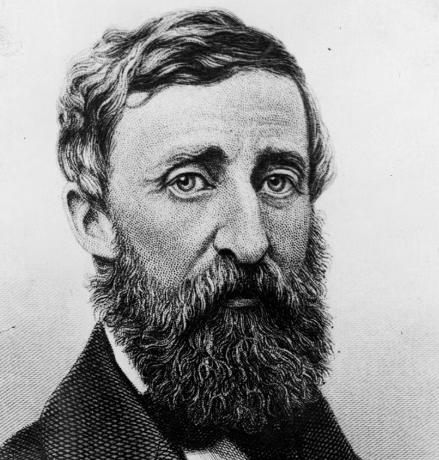
The bluebird carries the sky on his back.
▼
Source
source
April 3, 1852

4 months 3 weeks ago
The heroes in paganism correspond exactly to the saints in popery, and holy dervises in MAHOMETANISM. The place of, HERCULES, THESEUS, HECTOR, ROMULUS, is now supplied by DOMINIC, FRANCIS, ANTHONY, and BENEDICT. Instead of the destruction of monsters, the subduing of tyrants, the defence of our native country; whippings and fastings, cowardice and humility, abject submission and slavish obedience, are become the means of obtaining celestial honours among mankind.
▼
Source
source
Part X - With regard to courage or abasement
4 months 3 weeks ago
I doubt not, but from self-evident Propositions, by necessary Consequences, as incontestable as those in Mathematics, the measures of right and wrong might be made out.
▼
Source
source
Book IV, Ch. 3, sec. 18
2 months 4 weeks ago
We do not think good metaphors are anything very important, but I think that a good metaphor is something even the police should keep an eye on...
▼
Source
source
E 91 Variant translation: A good metaphor is something even the police should keep an eye on.

4 months 3 weeks ago
If you punish a child for being naughty, and reward him for being good, he will do right merely for the sake of the reward; and when he goes out into the world and finds that goodness is not always rewarded, nor wickedness always punished, he will grow into a man who only thinks about how he may get on in the world, and does right or wrong according as he finds either of advantage to himself.
2 months 1 week ago
Train any population rationally, and they will be rational. Furnish honest and useful employments to those so trained, and such employments they will greatly prefer to dishonest or injurious occupations. It is beyond all calculation the interest of every government to provide that training and that employment; and to provide both is easily practicable.

2 weeks 2 days ago
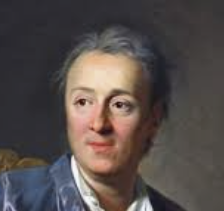
A wrongdoer is often a man who has left something undone, not always one who has done something.
▼
Source
source
IX, 5
3 months 3 weeks ago
From fanaticism to barbarism is only one step.
▼
Source
source
Essai sur le Mérite de la Vertu (1745)
4 months 3 days ago
Incorporeal hypostases, in descending, are distributed into parts, and multiplied about individuals with a diminution of power; but when they ascend by their energies beyond bodies, they become united, and proceed into a simultaneous subsistence, through exuberance of power.

4 months 2 weeks ago
The doctrine that there is as much science in a subject as... mathematics in it, or as much... measurement or 'precision' in it, rests upon... misunderstanding.

2 months 2 weeks ago
In an age of multiple and massive innovations, obsolescence becomes the major obsession.
▼
Source
source
"Innovation is obsolete", Evergreen review, Volume 15, Issues 86-94, Grove Press, 1971, p. 64
4 months 2 weeks ago
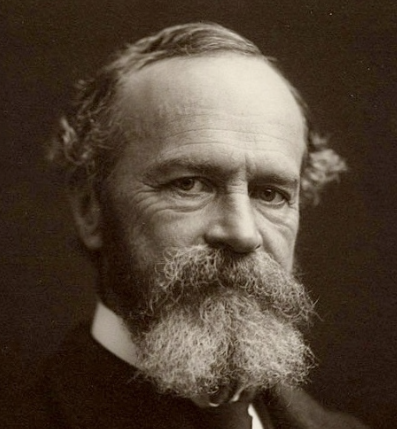
In its widest possible sense, however, a man's Self is the sum total of all that he can call his, not only his body and his psychic powers, but his clothes and his house, his wife and children, his ancestors and friends, his reputation and works, his lands and horses, and yacht and bank-account. All these things give him the same emotions. If they wax and prosper, he feels triumphant; if they dwindle and die away, he feels cast down.
▼
Source
source
Ch. 10

4 months 2 weeks ago
It seems to me that science has a much greater likelihood of being true in the main than any philosophy hitherto advanced (I do not, of course, except my own). In science there are many matters about which people are agreed; in philosophy there are none. Therefore, although each proposition in a science may be false, and it is practically certain that there are some that are false, yet we shall be wise to build our philosophy upon science, because the risk of error in philosophy is pretty sure to be greater than in science. If we could hope for certainty in philosophy, the matter would be otherwise, but so far as I can see such a hope would be chimerical.
▼
Source
source
Logical Atomism, 1924

3 months 2 days ago
An absolute power would be one that never becomes apparent, never pointed to itself, one that rather blended completely into what goes without saying. Power shines in its own absence.
4 months 2 weeks ago
For the purpose of acquiring gain, everything else is pushed aside or thrown overboard, for example, as is philosophy by the professors of philosophy.
▼
Source
source
E. Payne, trans. (1974) Vol. 1, p. 347
4 months 2 weeks ago
You can hardly convince a man of an error in a lifetime, but must content yourself with the reflection that the progress of science is slow. If he is not convinced, his grandchildren may be.
3 months 5 days ago
Objectification is above all exteriorization, the alienation of spirit from itself.
▼
Source
source
p. 63
3 months 1 week ago
To be old is a glorious thing when one has not unlearned what it means to begin, this old man had perhaps first learned it thoroughly in old age.
▼
Source
source
p. 6
3 months 2 weeks ago
The stars are scattered all over the sky like shimmering tears, there must be great pain in the eye from which they trickled.
▼
Source
source
Act IV.
4 months 2 weeks ago
All the higher, more penetrating ideals are revolutionary. They present themselves far less in the guise of effects of past experience than in that of probable causes of future experience.
▼
Source
source
"The Moral Philosopher and the Moral Life" in address to the Yale Philosophical Club, published in the International Journal of Ethics, April 1891

8 months 3 weeks ago
I already am eating from the trash can all the time. The name of this trash can is ideology. The material force of ideology makes me not see what I am effectively eating.

1 month 4 days ago
We must admit, however, that neither wild beasts nor any other creature except man is subject to anger: for, whilst anger is the foe of reason, it nevertheless does not arise in any place where reason cannot dwell. Wild beasts have impulses, fury, cruelty, combativeness: they have not anger any more than they have luxury: yet they indulge in some pleasures with less self-control than human beings.
2 weeks 5 days ago
The Process of Induction may be resolved into three steps ; the 'Selection of the Idea', the 'Construction of the Conception', and the 'Determination of the Magnitudes'. These three steps correspond to the determination of the 'Independent Variable', the 'formula', and the 'coefficients', in mathematical investigations; or to the 'Argument', the 'Law', and the 'Numerical Data', in a Table of an Inequality. The conceptions involved in scientific truths have attained the requisite degree of clearness by means of the Discussions respecting ideas which have taken place among discoverers and their followers. Such discussions are very far from being unprofitable

4 months 4 weeks ago
As we divided natural philosophy in general into the inquiry of causes, and productions of effects: so that part which concerneth the inquiry of causes we do subdivide according to the received and sound division of causes. The one part, which is physic, inquireth and handleth the material and efficient causes; and the other, which is metaphysic, handleth the formal and final causes.
▼
Source
source
Book VII, 3
1 month ago
If I first see a tree in the winter, I might assume that it is not a fruit-tree. But when I return in the summer to find it covered with plums, I must exclaim, 'Excuse me! You were a fruit-tree after all.' Imagine, then, that a billion years ago some beings from another part of the galaxy made a tour through the solar system in their flying saucer and found no life. They would dismiss it as 'Just a bunch of old rocks!' But if they returned today, they would have to apologize: 'Well - you were peopling rocks after all!' You may, of course, argue that there is no analogy between the two situations. The fruit-tree was at one time a seed inside a plum, but the earth - much less the solar system or the galaxy - was never a seed inside a person. But, oddly enough, you would be wrong.
▼
Source
source
p. 74
4 months 3 weeks ago
Since the great foundation of fear is pain, the way to harden and fortify children against fear and danger is to accustom them to suffer pain. This 'tis possible will be thought, by kind parents, a very unnatural thing towards their children; and by most, unreasonable...
▼
Source
source
Sec. 115
1 month 4 weeks ago
The educated man is the man who does not live in immediate intuition, but in his recollection so that little is new to him any longer.
▼
Source
source
Chapter 4, Philosophy As Writing: The Case Of Hegel, p. 74
3 months 1 week ago
It is the highest service to submit the evil impulse to God through the power of love.
▼
Source
source
p. 45
4 months 3 weeks ago
I thought that I was the only historian, that had at once neglected present power, interest, and authority, and the cry of popular prejudices; and as the subject was suited to every capacity, I expected proportional applause. But miserable was my disappointment: I was assailed by one cry of reproach, disapprobation, and even detestation; English, Scotch, and Irish, Whig and Tory, churchman and sectary, freethinker and religionist, patriot and courtier, united in their rage against the man, who had presumed to shed a generous tear for the fate of Charles I and the Earl of Strafford.
▼
Source
source
My Own Life' (1776), quoted in David Hume, Essays: Moral, Political, and Literary (1741-1777), ed. Eugene Miller (1985), p. xxxvii
3 months 2 weeks ago
The conception of Rights involves that when men are to live in a community, each must so restrict his freedom as to permit the coexistence of the freedom of all others. But it does not involve that this particular person, A, is to restrict his freedom by the freedom of those particular persons, B, C, and D. That it has happened so that I, A, must conform myself particularly to the freedom of these, B, C, and D, of all other men, is purely the result of my living together with them; and I so live with them, simply by my free-will, not because there is an obligation for me to do so.
▼
Source
source
P. 23-24

1 month ago
The old view was that delicacy of language was part of the nature, the sacred nature, of eros and that to speak about it in any other way would be to misunderstand it. What has disappeared is the risk and the hope of human connectedness embedded in eros. Ours is a language that reduces the longing for an other to the need for individual, private satisfaction and safety.
▼
Source
source
pp. 13-14.
3 months 1 week ago
Fanaticism consists in redoubling your efforts when you have forgotten your aim.

3 months 2 days ago
This is a strange -- and rather alarming -- realisation. For it clearly implies that masturbation is one of our highest faculties that human beings have developed. Many animals masturbate -- but never without the presence of another animal, or some similar stimulus. A human being can masturbate in an empty room: a triumph of pure imagination.
▼
Source
source
p. 90
5 months 1 week ago
It is quite clear to you that all the people see that lower kinds of creation could have been made in a different way from that in which they really are, and as they see this lower degree in many things they think that they must have been made by chance.
3 months 2 weeks ago
Revolution is like the daughters of Pelias: it cuts humanity to pieces in order to rejuvenate it.
▼
Source
source
Act II.
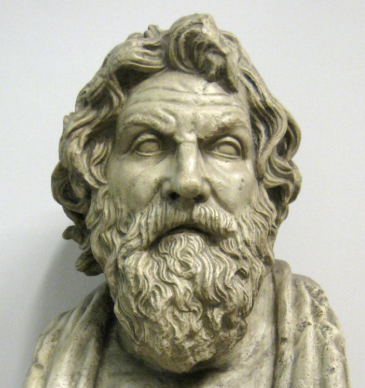
4 months 1 week ago
Virtue is the same for a man and for a woman.
▼
Source
source
§ 5
2 weeks 2 days ago
No longer let thy breathing only act in concert with the air which surrounds thee, but let thy intelligence also now be in harmony with the intelligence which embraces all things. For the intelligent power is no less diffused in all parts and pervades all things for him who is willing to draw it to him than the aërial power for him who is able to respire it.
▼
Source
source
VIII, 54

5 months 2 weeks ago
No human being, even the most passionately loved and passionately loving, is ever in our possession.

5 months 3 days ago
For what is it that everyone is seeking? To live securely, to be happy, to do everything as they wish to do, not to be hindered, not to be subject to compulsion.
▼
Source
source
Book IV, ch. 1, 46.
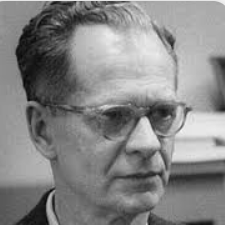
1 month 2 weeks ago
Many instructional arrangements seem "contrived", but there is nothing wrong with that. It is the teacher's function to contrive conditions under which students learn. Their relevance to a future usefulness need not be obvious. It is a difficult assignment. The conditions the teacher arranges must be powerful enough to compete with those under which the student tends to behave in distracting ways.
▼
Source
source
Free and Happy Student in The Phi Delta Kappan (September 1973); later published in Reflections on Behaviorism and Society

1 month 3 weeks ago
The belief in unity that has fuelled so many utopian dreams is an effort to reconcile the irreconcilable that ends in repression. Berlin suggests we renounce this venerable faith, and learn how to live with intractable conflict.
▼
Source
source
'Isaiah Berlin: The Value of Decency' (p.106-7)
2 weeks 5 days ago
Discovery depends upon the previous cultivation or natural clearness of the appropriate Idea, and therefore no discovery is the work of accident.
CivilSimian.com created by AxiomaticPanic, CivilSimian, Kalokagathia