


4 months 3 weeks ago
What is the Jew?...What kind of unique creature is this whom all the rulers of all the nations of the world have disgraced and crushed and expelled and destroyed; persecuted, burned and drowned, and who, despite their anger and their fury, continues to live and to flourish. What is this Jew whom they have never succeeded in enticing with all the enticements in the world, whose oppressors and persecutors only suggested that he deny (and disown) his religion and cast aside the faithfulness of his ancestors?! The Jew - is the symbol of eternity. ... He is the one who for so long had guarded the prophetic message and transmitted it to all mankind. A people such as this can never disappear. The Jew is eternal. He is the embodiment of eternity.
▼
Source
source
Attributed in "The Final Resolution", in Jewish World Periodical (1908), p. 189
4 months 2 weeks ago
Eight hours daily labour is enough for any human being, and under proper arrangements sufficient to afford an ample supply of food, raiment and shelter, or the necessaries and comforts of life, and for the remainder of his time, every person is entitled to education, recreation and sleep.
▼
Source
source
"Foundation Axioms" of Society for Promoting National Regeneration


6 months 3 weeks ago
As far as men go, it is not what they are that interests me, but what they can become.
▼
Source
source
Act 5, sc. 3

7 months 3 days ago
By the law is the knowledge of sin [Rom 3:20], so the word of grace comes only to those who are distressed by a sense of sin and tempted to despair.
▼
Source
source
p. 168

6 months 3 weeks ago
The moral things I wish to say to future generations is very simple. I should say love is wise hatred is foolish. In this world which is getting more and more closely interconnected, we have to learn to tolerate each other. We have to learn to put up with the fact that some people say things that we don't like. We can only live together in that way, and if we are to live together and not die together we must learn the kind of charity and kind of tolerance which is absolutely vital to the continuation of human life on this planet.
6 months ago
Bad company is as instructive as licentiousness. One makes up for the loss of one's innocence with the loss of one's prejudices.
3 months 1 week ago
The English, generally remarkable for doing very good things in a very bad manner, seem to have reserved the maturity and plenitude of their awkwardness for the pulpit.
▼
Source
source
Vol. I, ch. 3, p. 83
7 months 1 week ago
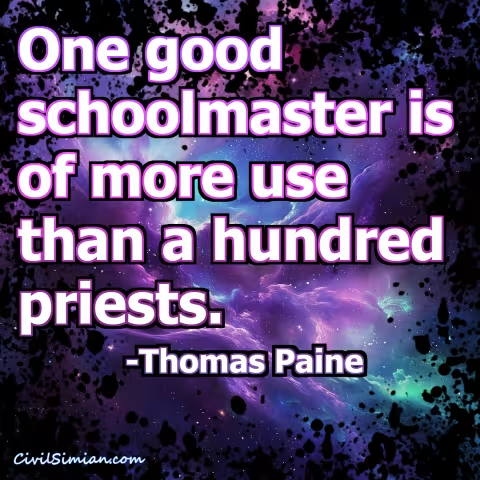
If it is my interest to have a farm, it is my interest to take it away from my neighbour; if it is my interest to have a cloak, it is my interest also to steal it from a bath. This is the source of wars, seditions, tyrannies, plots.
▼
Source
source
Book I, ch. 22, 14.
6 months 3 weeks ago
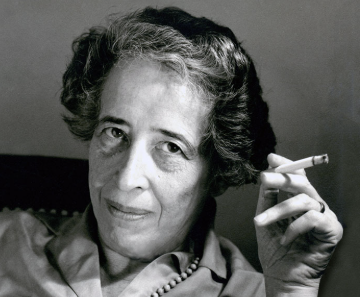
The Nazis were 'convinced that evil-doing in our time has a morbid force of attraction,' Bolshevik assurances inside and outside Russia that they do not recognize ordinary moral standards have become a mainstay of Communist propaganda, and experience has proven time and again that the propaganda value of evil deeds and general contempt for moral standards is independent of mere self-interest, supposedly the most powerful psychological factor in politics.
▼
Source
source
Part 3, Ch. 10
7 months 3 weeks ago
A fate is not a punishment.
6 months 3 weeks ago
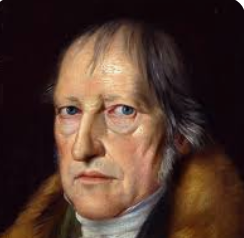
The great thing however is, in the show of the temporal and the transient to recognize the substance which is immanent and the eternal which is present. For the work of Reason (which is synonymous with the Idea) when considered in its own actuality, is to simultaneously enter external existence and emerge with an infinite wealth of forms, phenomena and phases - a multiplicity that envelops its essential rational kernel with a motley outer rind with which our ordinary consciousness is earliest at home. It is this rind that the Concept must penetrate before Reason can find its own inward pulse and feel it still beating even in the outward phases. But this infinite variety of circumstances which is formed in this element of externality by the light of the rational essence shining in it - all this infinite material, with its regulatory laws - is not the object of philosophy....To comprehend what is, is the task of philosophy: and what is is Reason.
▼
Source
source
Works, VII, 17.

4 months 3 weeks ago
Environments work us over and remake us. It is man who is the content of and the message of the media, which are extensions of himself. Electronic man must know the effects of the world he has made above all things.
▼
Source
source
(p. 90)

5 months 1 week ago
Like monarchy, monotheism had a martial origin. "It is only on the march and it time of war," says Robertson Smith in The Prophets of Israel, "that a nomad people feels any urgent need of a central authority, and so it came about that in the first beginnings of national organization, centering in the sanctuary of the ark, Israel was thought of mainly as a host of Jehovah. the very name of Israel is martial, and means 'God (El) fighteth,' and Jehovah in the Old Testament is Iahwé Cebāôth - the Jehovah of the armies of Israel. It was on the battlefield that Jehovah's presence was most clearly realized; but in primitive nations the leader in time of war is also the natural judge in time of peace."

3 months 3 weeks ago
It is hard to see how the discarding of liberal values is going to lead to anything in the long term other than increasing social conflict and ultimately a return to violence as a means of resolving differences.

6 months 3 weeks ago
Man exists for his own sake and not to add a laborer to the state.
▼
Source
source
November 15, 1839
2 months 3 weeks ago
Our profound human duty is not to interpret or to cast light on the rhythm of God's arch, but to adjust, as much as we can, the rhythm of our small and fleeting life to his. Only thus may we mortals succeed in achieving something immortal, because then we collaborate with One who is Deathless. Only thus may we conquer mortal sin, the concentration on details, the narrowness of our brains; only thus may we transubstantiate into freedom the slavery of earthen matter given us to mold.
6 months 4 weeks ago
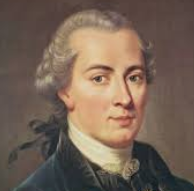
The woman wants to dominate, the man wants to be dominated.
▼
Source
source
Kant, Immanuel (1996), page 220
7 months 3 days ago
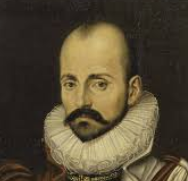
Wherever your life ends, it is all there. The utility of living consists not in the length of days, but in the use of time; a man may have lived long, and yet lived but a little. Make use of time while it is present with you. It depends upon your will, and not upon the number of days, to have a sufficient length of life. Is it possible you can imagine never to arrive at the place towards which you are continually going? and yet there is no journey but hath its end. And, if company will make it more pleasant or more easy to you, does not all the world go the self-same way?
4 months 3 weeks ago
Radio affects most intimately, person-to-person, offering a world of unspoken communication between writer-speaker and the listener. That is the immediate aspect of radio. A private experience. The subliminal depths of radio are charged with the resonating echoes of tribal horns and antique drums. This is inherent in the very nature of this medium, with its power to turn the psyche and society into a single echo chamber.
▼
Source
source
(p. 261)

6 months 3 weeks ago
The foundation of irreligious criticism is: Man makes religion, religion does not make man.
5 months 4 days ago
Organizations are systems of coordinated action among individuals and groups whose preferences, information, interests, or knowledge differ. Organization theories describe the delicate conversion of conflict into cooperation, the mobilization of resources, and the coordination of effort that facilitate the joint survival of an organization and its members.
▼
Source
source
Simon (1993. p. 2); Cited in Mario Catalani, Giuseppe F. Clerico (1996) Decision making structures. p. 1.
7 months 3 weeks ago
Outside of that single fatality of death, everything, joy or happiness, is liberty.
4 months 3 weeks ago
And therefore just as a brigand caught in broad daylight in the act cannot persuade us that he did not lift his knife in order to rob his victim of his purse, and had no thought of killing him, we too, it would seem, cannot persuade ourselves or others that the soldiers and policemen around us are not to guard us, but only for defense against foreign foes, and to regulate traffic and fetes and reviews; we cannot persuade ourselves and others that we do not know that the men do not like dying of hunger, bereft of the right to gain their subsistence from the earth on which they live; that they do not like working underground, in the water, or in the stifling heat, for ten to fourteen hours a day, at night in factories to manufacture objects for our pleasure. One would imagine it impossible to deny what is so obvious. Yet it is denied.
▼
Source
source
Chapter XII, Conclusion-Repent Ye, for the Kingdom of Heaven is at Hand
6 months 2 weeks ago
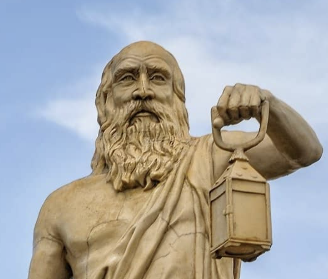
He was going into a theatre, meeting face to face those who were coming out, and being asked why, "This," he said, "is what I practise doing all my life."
▼
Source
source
Diogenes Laërtius, vi. 64
6 months 4 weeks ago
The first who was king was a fortunate soldier: Who serves his country well has no need of ancestors.
▼
Source
source
Mérope, act I, scene III (1743). Borrowed from Lefranc de Pompignan's "Didon"
3 months 5 days ago
The good effects that emanate from the same source are equally diffused upon the earth. Different regions become partakers in these benefits in different ways; so that neither their production comes to an end, nor does the Deity confer his blessings upon the recipient world with any degree of variation. For where the substance is the same, so is the action thereof, in the case of Divine Powers; especially with him who is king of them all, namely, the Sun; of whom the motion is the most simple amongst all the bodies that move in a contrary direction to the world, which fact that most excellent philosopher, Aristotle, adduces to prove the superiority of that luminary to the others.
6 months 3 weeks ago
Capital is money: Capital is commodities. For the movement, in the course of which it adds surplus-value, is its own movement, its expansion, therefore, is automatic expansion. Because it is value, it has acquired the occult quality of being able to add value to itself. It brings forth living offspring, or, at the least, lays golden eggs.
▼
Source
source
Vol. I, Ch. 2, pg. 171.

6 months 2 weeks ago
The enmity of one's kindred is far more bitter than the enmity of strangers.
7 months 3 days ago
Not being able to govern events, I govern myself.
▼
Source
source
Book II, Ch. 17
7 months 2 weeks ago
Come the Day of Judgment, some believe that the body will be different from our present body. This is only transient, that will be eternal. For this also there are religious arguments.
5 months 4 days ago
The function of knowledge in the decision-making process is to determine which consequences follow upon which of the alternative strategies. It is the task of knowledge to select from the whole class of possible consequences a more limited subclass, or even (ideally) a single set of consequences correlated with each strategy.
▼
Source
source
p. 78.
3 months 4 days ago
How many of us are able to distinguish between the odors of noon and midnight, or of winter and summer, or of a windy spell and a still one? If man is so generally less happy in the cities than in the country, it is because all these variations and nuances of sight and smell and sound are less clearly marked and lost in the general monotony of gray walls and cement pavements.
▼
Source
source
p. 129
4 months 3 weeks ago
History is the life of nations and of humanity. To seize and put into words, to describe directly the life of humanity or even of a single nation, appears impossible.
▼
Source
source
Epilogue II, ch. 1
3 months 5 days ago
Of the splendid constellation of great names... we admire the living and revere dead far too warmly and too deeply to suffer us sit in judgment on their respective claims to in this or that particular discovery; to balance mathematical skill of one against the experimental dexterity of another, or the philosophical acumen a third. So long as "one star differs from another in glory," - so long as there shall exist varieties, or even incompatibilities of excellence, - so long will the admiration of mankind be found sufficient for all who merit it.
▼
Source
source
On the Theory of Light (1828) p.494

5 months 1 week ago
The Outsider has his proper place in the Order of Society, as the impractical dreamer.
▼
Source
source
Chapter Three, The Romantic Outsider

5 months 3 weeks ago
Self-knowledge - the bitterest knowledge of all and also the kind we cultivate least: what is the use of catching ourselves out, morning to night, in the act of illusion, pitilessly tracing each act back to its root, and losing case after case before our own tribunal?
6 months 3 weeks ago
Physics is mathematical not because we know so much about the physical world, but because we know so little: it is only its mathematical properties that we can discover.
▼
Source
source
An Outline of Philosophy Ch.15 The Nature of our Knowledge of Physics, 1927
7 months ago
Marriage is encouraged in China, not by the profitableness of children, but by the liberty of destroying them.
▼
Source
source
Chapter VIII, p. 87.

7 months 3 weeks ago
Consider the most famous pure dystopian tale of modern times, 1984, by George Orwell (1903-1950), published in 1948 (the same year in which Walden Two was published). I consider it an abominably poor book. It made a big hit (in my opinion) only because it rode the tidal wave of cold war sentiment in the United States.
7 months 3 weeks ago
It is the mark of an educated man to look for precision in each class of things just so far as the nature of the subject admits; it is evidently equally foolish to accept probable reasoning from a mathematician and to demand from a rhetorician scientific proofs.
5 months 3 weeks ago
Feeling which has not yet emerged into immediate consciousness is already affectible and already affected. In fact, this is habit, by virtue of which an idea is brought up into the present consciousness by a bond that has already been established between it and another idea while it was still in futuro.


3 months 1 week ago
At any rate, if you wish to sift doubtful meanings of this kind, teach us that the happy man is not he whom the crowd deems happy, namely, he into whose coffers mighty sums have flowed, but he whose possessions are all in his soul, who is upright and exalted, who spurns inconstancy, who sees no man with whom he wishes to change places, who rates men only at their value as men, who takes Nature for his teacher, conforming to her laws and living as she commands, whom no violence can deprive of his possessions, who turns evil into good, is unerring in judgment, unshaken, unafraid, who may be moved by force but never moved to distraction, whom Fortune when she hurls at him with all her might the deadliest missile in her armoury, may graze, though rarely, but never wound.
5 months 3 weeks ago
Mere imagination would indeed be mere trifling; only no imagination is mere.
▼
Source
source
Vol. VI, par. 286
4 months 2 weeks ago
I would rather be a poor man in a garret with plenty of books than a king who did not love reading.
▼
Source
source
Letter to his Niece, 15 September 1842
CivilSimian.com created by AxiomaticPanic, CivilSimian, Kalokagathia