A command can express no more than an ought or a shall, because it is a universal, but it does not express an 'is'; and this at once makes plain its deficiency. Against such commands Jesus sets virtue, i.e., a loving disposition, which makes the content of the command superfluous and destroys its form as a command, because that form implies an opposition between a commander and something resisting the command.
In the "fulfillment" of both the laws and duty, ... the moral disposition ceases to be the universal, opposed to inclination, and inclination ceases to be particular, opposed to the law.
The inclination to act as the laws command, a virtue, is a synthesis in which the law ... loses its universality and the subject its particularity; both lose their opposition, while in the Kantian conception of virtue this opposition remains, and the universal becomes the master and the particular the mastered.
Between the Shaman of the Tungus, the European prelate who rules church and state, the Voguls, and the Puritans, on the one hand, and the man who listens to his own command of duty, on the other, the difference is not that the former make themselves slaves, while the latter is free, but that the former have their lord outside themselves, while the latter carries his lord in himself, yet at the same time is his own slave.
Without being known too well, it [India] has existed for millennia in the imagination of the Europeans as a wonderland. Its fame, which it has always had with regard to its treasures, both its natural ones, and in particular, its wisdom, has lured men there.
0
⚖0
▼Source
source
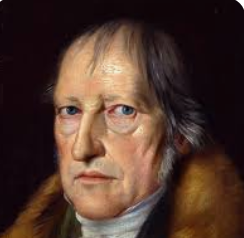
Friedrich Hegel .source: Contesting the Master Narrative, Jeffrey Cox and Shelton Stromquist Quoted from Gewali, Salil (2013).
It strikes everyone in beginning to form an acquaintance with the treasures of Indian literature, that a land so rich in intellectual products and those of the profoundest order of thought..."
0
⚖0
▼Source
source
quoted in De Riencourt, Amaury The Soul of India Harper & Brothers Publishers New York 1960 p. 301
India has always been an object of yearning, a realm of wonder, a world of magic... India is the land of dreams. India had always dreamt - more of the Bliss that is man's final goal. And this has helped India to be more creative in history than any other nation. Hence the effervescence of myths and legends, religious and philosophies, music, and dances and the different styles of architecture." ...
0
⚖0
▼Source
source
quoted in Patri, Umesh Hindu scriptures and American transcendentalists 1st ed. quoted from Londhe, S. (2008).
In Mohammedanism the narrow principle of the Jews is expanded into universality and thereby overcome. Here, God is no longer, as in the Far East, regarded as existent in an immediately sensory way but is conceived as the one infinite power elevated above all the multiplicity of the world. Mohammedanism is, therefore, in the strictest sense of the word, the religion of sublimity.
0
⚖0
▼Source
source
Hegel, Philosophy of Mind (quoted by W. Wallace & A. V. Miller in Philosophy of Mind, Oxford 2010; also quoted in other words by Slavoj Žižek in A Glance into the Archives of Islam, Lacan dot com, 1997).