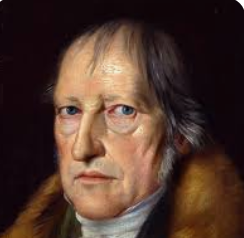
The beginning of religion, more precisely its content, is the concept of religion itself, that God is the absolute truth, the truth of all things, and subjectively that religion alone is the absolutely true knowledge.
The science of religion is one science within philosophy; indeed it is the final one. In that respect it presupposes the other philosophical disciplines and is therefore a result.
What the English call "comfortable" is something endless and inexhaustible. Every condition of comfort reveals in turn its discomfort, and these discoveries go on for ever. Hence the new want is not so much a want of those who have it directly, but is created by those who hope to make profit from it.
To be independent of public opinion is the first formal condition of achieving anything great or rational whether in life or in science. Great achievement is assured, however, of subsequent recognition and grateful acceptance by public opinion, which in due course will make it one of its own prejudices.
The good is the idea, or unity of the conception of the will with the particular will. Abstract right, well-being, the subjectivity of consciousness, and the contingency of external reality, are in their independent and separate existences superseded in this unity, although in their real essence they are contained in it and preserved. This unity is realized freedom, the absolute final cause of the world. Addition.-Every stage is properly the idea, but the earlier steps contain the idea only in more abstract form. The I, as person, is already the idea, although in its most abstract guise. The good is the idea more completely determined; it is the unity of the conception of will with the particular will. It is not something abstractly right, but has a real content, whose substance constitutes both right and well-being.
0
⚖0
▼Source
source
Georg Wilhelm Friedrich Hegel, Philosophy of Right translated by SW Dyde Queen's University Canada 1896 p. 123
The external embodiment of an act is composed of many parts, and may be regarded as capable of being divided into an infinite number of particulars. An act may be looked on as in the first instance coming into contact with only one of these particulars. But the truth of the particular is the universal. A definite act is not confined in its content to one isolated point of the varied external world, but is universal, including these varied relations within itself. The purpose, which is the product of thought and embraces not the particular only but also the universal side, is intention.
0
⚖0
▼Source
source
Georg Wilhelm Friedrich Hegel, Philosophy of Right translated by SW Dyde Queen's University Canada 1896 p. 114-115
Not only must philosophy be in agreement with our empirical knowledge of Nature, but the origin and formation of the Philosophy of Nature presupposes and is conditioned by empirical physics. However, the course of a science's origin and the preliminaries of its construction are one thing, while the science itself is another. In the latter, the former can no longer appear as the foundation of the science; here, the foundation must be the necessity of the Concept.