↑ Back to the start
6 months 4 weeks ago
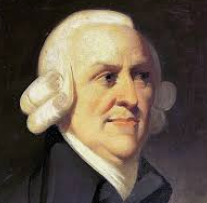
Adam Smith was the first academic economist; and his career is not very different from that of many economists in the last hundred and fifty years.
0
⚖0
▼ Source
source
Eric Roll (1938) A History Of Economic Thought, Chapter IV, p. 144.
6 months 4 weeks ago
[T]hat constant accumulation of capital, that continual tendency to increase, the operation of which is universally seen in a greater or less proportion, whenever it is not obstructed by some...mistaken and mischievous policy. ... Simple and obvious as this principle is... I doubt whether it has ever been fully developed and sufficiently explained, but in the writings of an author of our own time, now unfortunately no more (I mean the author of the celebrated treatise on the Wealth of Nations), whose extensive knowledge of detail, and depth of philosophical research, will, I believe, furnish the best solution of every question connected with the history of commerce, or with the system of political economy.
0
⚖0
▼ Source
source
William Pitt, speech in the House of Commons (17 February 1792), quoted in The Parliamentary History of England, From the Earliest Period to the Year 1803, Vol. XXIX (1817), columns 833-834

6 months 4 weeks ago
Most economists now recognize climate change as a market failure, but only a few understand it as part of the larger pattern of environmental destruction that scientists have labelled the 'Great Acceleration'. Capitalism as currently practised has imperilled the existence of millions of planetary species, as well as the health and well-being of billions of humans. It also threatens the prosperity that it was intended to create. Challenging 250 years of dominant economic thinking, the climate crisis has shown that the unrestrained pursuit of self-interest does not serve the common good. It has shown, in the words of economist Joseph Stiglitz, that Adam Smith's invisible hand - the idea that free markets lead to efficiency as if consciously guided - is invisible because it is not there'. And it has proved, in the words of Pope Francis, that 'technological products are not neutral, for they create a framework which ends up conditioning lifestyles and shaping social possibilities along the lines dictated by the interests of certain powerful groups'.
0
⚖0
▼ Source
source
Naomi Oreskes in The Climate Book edited by Greta Thunberg (2022)
6 months 4 weeks ago
It appears... that a work similar in its object and general conception to that of Adam Smith, but adapted to the more extended knowledge and improved ideas of the present age, is the kind of contribution which Political Economy at present requires. The Wealth of Nations is in many parts obsolete, and in all, imperfect. Political Economy... has grown up almost from infancy since the time of Adam Smith; and the philosophy of society... has advanced many steps beyond the point at which he left it.
0
⚖0
▼ Source
source
John Stuart Mill, ' (1848) Preface
6 months 4 weeks ago
Economic theory as derived from Adam Smith assumes first that homo economicus acts with perfect optimality on complete information, and second that when many of the species homo economicus do that, their actions add up to the best possible outcome for everybody. Neither of these assumptions stands up long against the evidence.
0
⚖0
▼ Source
source
Donella Meadows, Thinking in Systems: A Primer, Chelsea Green Publishing, 2008, page 107 (ISBN 9781603580557).
6 months 4 weeks ago
What strikes one here above all is the crudely empirical conception of profit derived from the outlook of the ordinary capitalist, which wholly contradicts the better esoteric understanding of Adam Smith.
0
⚖0
▼ Source
source
Karl Marx (1867) Das Kapital, Volume II, Chapter X, p. 202.
6 months 4 weeks ago
While discussing what it is that makes the “pleasures of wealth and greatness ... strike the imagination as something grand and beautiful,” [Adam Smith] remarks that “in the languor of disease and the weariness of old age” we cease to be so impressed, for we then take note of the fact that the acquisition of wealth and greatness leaves their possessors “always as much, and sometimes more exposed than before, to anxiety, to fear, and to sorrow, to diseases, to danger, and to death” (The Theory of Moral Sentiments IV, chapter I). But to allow our attention to dwell on this is, on Smith’s view, misguided.To do so is to embrace a “splenetic philosophy,” the effect of “sickness or low spirits” upon an imagination “which in pain and sorrow seems to be confined,” so that we are no longer “charmed with the beauty of that accommodation which reigns in the palaces and economy of the great.” The imagination of those “in better health or in better humor” fosters what may, Smith concedes, be no more than seductive illusions about the pleasures of wealth and greatness, but they are economically beneficial illusions. “It is this deception which rouses and keeps in continual motion the industry of mankind.” So even someone as perceptive as Smith, when he does pause to recognize the perspectives of ill health and old age, finds reason at once to put them on one side. And in so doing Smith speaks for moral philosophy in general.
0
⚖0
▼ Source
source
Alasdair MacIntyre, Dependent Rational Animals (1999), p. 2
6 months 4 weeks ago
The one case in which he referred to the "invisible hand" was that in which private persons preferred the home trade to the foreign trade, and he held that such preference was in the national interest, since it replaced two domestic capitals while the foreign trade replaced only one. The argument of the two capitals was a bad one, since it is the amount of capital that matters, not its subdivision; but the invisible sanction was given to a Protectionist idea, not for defence but for employment. It is not surprising that Smith was often quoted in Parliament in support of Protection. His background, like ours today, was private enterprise; but any dogma of non-intervention by government has to make heavy weather in The Wealth of Nations.
0
⚖0
▼ Source
source
D. H. MacGregor, Economic Thought and Policy (1949), pp. 81-82
6 months 4 weeks ago
He said that the maintenance of public works was a duty of government; and his list of such works included all that at that time could have been possibly socialized—roads, canals, bridges, harbours, etc. Private enterprise could not be expected to erect or maintain these services, and this was a limited sort of socialism... [H]is concessions to Protectionism went very far. The doctrine of defence as prior to opulence was not stated only in respect of the Navigation Act: "if any particular manufacture was necessary for the defence of the society it might not always be prudent to depend upon our neighbours for the supply; and, if such manufacture could not otherwise be supported at home, it might not be unreasonable that all the other branches of industry should be taxed in order to support it". This goes a long way with modern Protectionism.
0
⚖0
▼ Source
source
D. H. MacGregor, Economic Thought and Policy (1949), p. 81
6 months 4 weeks ago
What the Wealth of Nations is all about is the difference between one kind of market system in commercial society and another. It is about the difference between, on the one hand, a market system dominated by merchants and manufacturers who are able to bend the government to their will in order to obtain legislation which makes what is in their private interest the law of the land, and, on the other, a truly open and competitive—"natural"—market system in which everyone who is industrious and/or has any capital has a fair chance. The withdrawal of the state is not, for Smith, the removal of government from its role as owner, entrepreneur, economic planner or re-distributor—roles readily conceivable to all who know of socialism but wholly inconceivable to Adam Smith—but its removal from the role of regulator of private enterprise, a role in which it had long been used to promote the interests of the merchants and the manufacturers over those of all others.
0
⚖0
▼ Source
source
Heinz Lubasz, 'Adam Smith and the ‘free market’', in Stephen Copley and Kathryn Sutherland (eds.), Adam Smith's Wealth of Nations: New Interdisciplinary Essays (1995), p. 52

CivilSimian.com created by AxiomaticPanic, CivilSimian, Kalokagathia