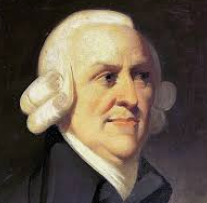
Partisans of the free market invoke Adam Smith in order to lend the authority of his name to the case they themselves want to make: for the complete removal of the state from economic enterprise; for the economic sovereignty of the market; and for leaving all questions of production and distribution to the magic of the invisible hand... But...the reason Adam Smith wanted an end to government intervention in the market was that in his time (in contrast to today) it was only thanks to state intervention that what he called "the mean rapacity, the monopolising spirit of merchants and manufacturers" was able to dominate the economy, to the great detriment of the society as a whole.
0
⚖0
▼Source
source
Heinz Lubasz, 'Adam Smith and the ‘free market’', in Stephen Copley and Kathryn Sutherland (eds.), Adam Smith's Wealth of Nations: New Interdisciplinary Essays (1995), p. 49
In Victorian times - at the apex of the repression of the Great Mother - a Scottish schoolmaster named Adam Smith noticed a lot of greed and scarcity around him and assumed that was how all "civilized" societies worked. Smith, as you know, created modern economics, which can be defined as a way of allocating scarce resources through the mechanism of individual, personal greed... If a society is afraid of scarcity, it will actually create an environment in which it manifests well-grounded reasons to live in fear of scarcity. It is a self-fulfilling prophecy!
0
⚖0
▼Source
source
Bernard Lietaer, [https://library.uniteddiversity.coop/Money_and_Economics/Bernard_Lietaer/Interview_Yes%21.pdf Beyond Greed and Scarcity, YES! A Journal of Positive Futures] , (Spring 1997)
It is worth remembering that Adam Smith, the founder of classical economics, was first and foremost a philosopher. He strove to be a moralist and in doing so, became an economist. When he published The Theory of Moral Sentiments in 1759, modern capitalism was just getting under way. Smith was entranced by the sweeping changes wrought by this new force, but it wasn’t just the numbers that interested him. It was the human effect, the fact that economic forces were vastly changing the way a person thought and behaved in a given situation. What might lead one person to cheat or steal while another didn’t? How would one person’s seemingly innocuous choice, good or bad, affect a great number of people down the line? In Smith’s era, cause and effect had begun to wildly accelerate; incentives were magnified tenfold. The gravity and shock of these changes were as overwhelming to the citizens of his time as the gravity and shock of modern life may seem to us today.
0
⚖0
▼Source
source
Steven D. Levitt and Stephen J. Dubner, [https://www.google.com/books/edition/Freakonomics/mXQVbIRkHegC?hl=en&gbpv=1&printsec=frontcover Freakanomics], Introduction: The Hidden Side of Everything
He now and then revisited London. The last time he was there, he had engaged to dine with Lord Melville, then Mr Dundas, at Wimbledon; Mr Pitt, Mr Grenville, Mr Addington, afterwards Lord Sidmouth, and some other of his lordship's friends were there. Dr Smith happened to come late, and the company had sat down to dinner. The moment, however, he came into the room, the company all rose up; he made an apology for being late, and entreated them to sit down. "No," said the gentlemen, "we will stand till you are seated, for we are all your scholars."
0
⚖0
▼Source
source
John Kay, A Series of Original Portraits and Caricature Etchings, Vol. I. Part I. (1838), pp. 74-75
Smith argued in 1776 that the division of labor was the basis for the separation between mental and manual labor, and therefore between natural philosopher and laborer.
0
⚖0
▼Source
source
Myles W. Jackson, Spectrum of Belief: Joseph Von Fraunhofer and the Craft of Precision Optics (2000)
Upon the whole, I have always considered him, both in his lifetime and since his death, as approaching as nearly to the idea of a perfectly wise and virtuous man, as perhaps the nature of human frailty will permit.
0
⚖0
▼Source
source
On David Hume, in a letter To William Strachan, Esq., Kirkaldy, Fifeshire (9 November 1776).
Perhaps no economist will ever again so utterly encompass his age as Adam Smith. Certainly none was ever so serene, so devoid of contumacy, so penetratingly critical without rancor, and so optimistic without being utopian.
0
⚖0
▼Source
source
Robert Heilbroner, The Worldly Philosophers 7th ed. (1999), Chapter III. The Wonderful World of Adam Smith
For Smith’s encyclopedic scope and knowledge there can be only admiration. It was only in the eighteenth century that so huge, all-embracing, secure, caustic, and profound a book could have been written. Indeed, The Wealth of Nations and The Theory of Moral Sentiments, together with his few other essays, reveal that Smith was much more than just an economist. He was a philosopher-psychologist-historian-sociologist who conceived a vision that included human motives and historic “stages” and economic mechanisms, all of which expressed the plan of the Great Architect of Nature (as Smith called him). From this viewpoint, The Wealth of Nations is more than a masterwork of political economy. It is part of a huge conception of the human adventure itself.
0
⚖0
▼Source
source
Robert Heilbroner, The Worldly Philosophers 7th ed. (1999), Chapter III. The Wonderful World of Adam Smith
The answer is that Smith saw the all-important division of labor as a once-for-all, not a continuing, process. As has been recently pointed out, he did not see the organizational and technological core of the division of labor as a self-generating process of change, but as a discrete advance that would impart its stimulus and then disappear. Thus, in the very long run the growth momentum of society would come to a halt—Smith once mentions two hundred years as the longest period over which a society could hope to flourish. Thereafter the laborer would return to his subsistence wages, the capitalist to the modest profits of a stable market, and the landlord alone might enjoy a somewhat higher income as food production remained at the levels required by a larger, although no longer growing, population. For all its optimistic boldness, Smith’s vision is bounded, careful, sober—for the long run, even sobering.
0
⚖0
▼Source
source
Robert Heilbroner, The Worldly Philosophers 7th ed. (1999), Chapter III. The Wonderful World of Adam Smith
Even today — in blithe disregard of his actual philosophy — Smith is generally regarded as a conservative economist, whereas in fact, he was more avowedly hostile to the motives of businessmen than most New Deal economists.
0
⚖0
▼Source
source
Robert Heilbroner, The Worldly Philosophers 7th ed. (1999), Chapter III. The Wonderful World of Adam Smith