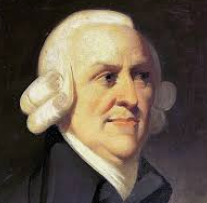
One dominant view in the eighteenth century, which was particularly persuasive among French economists, was that the government should actively promote trade and industry. Advocates of this view were called mercantilists. It was partly in response to the mercantilists that Adam Smith (who is often viewed as the founder of modern economics) wrote The Wealth of Nations (1776), in which he argued for a limited role for government. Smith attempted to show how competition and the profit motive would lead individuals—in pursuing their own private interests—to serve the public interest. The profit motive would lead individuals, competing against one another, to supply the goods other individuals wanted. Only firms that produced what was wanted and at as low a price as possible would survive. Smith argued that the economy was led, as if by an invisible hand, to produce what was desired—and in the best possible way. Adam Smith’s ideas had a powerful influence both on governments and on economists.
0
⚖0
▼Source
source
Joseph E. Stiglitz and Jay K. Rosengard, Economics of the Public Sector (4th ed., 2014)
What the circumstances are, which, in modern Europe, have contributed to disturb this order of nature, and, in particular, to encourage the industry of towns, at the expense of that of the country, Mr. Smith has investigated with great ingenuity; and in such a manner, as to throw much new light on the history of that state of society which prevails in this quarter of the globe. His observations on this subject tend to show, that these circumstances were, in their first origin, the natural and the unavoidable result of the peculiar situation of mankind during a certain period; and that they took their rise, not from any general scheme of policy, but from the private interests and prejudices of particular orders of men.
0
⚖0
▼Source
source
Dugald Stewart, Account of the Life and Writings of Adam Smith, LL.D., quoted in The Works of Dugald Stewart, Vol. VII (1829), p. 57
[T]he great and leading object of Mr. Smith's speculations is to illustrate the provision made by nature in the principles of the human mind, and in the circumstances of man's external situation, for a gradual and progressive augmentation in the means of national wealth; and to demonstrate, that the most effectual plan for advancing a people to greatness, is to maintain that order of things which nature has pointed out; by allowing every man, as long as he observes the rules of justice, to pursue his own interest in his own way, and to bring both his industry and his capital into the freest competition with those of his fellow-citizens. Every system of policy which endeavours, either by extraordinary encouragements, to draw towards a particular species of industry a greater share of the capital of the society than what would naturally go to it; or, by extraordinary restraints, to force from a particular species of industry some share of the capital which would otherwise be employed in it, is in reality, subversive of the great purpose which it means to promote.
0
⚖0
▼Source
source
Dugald Stewart, Account of the Life and Writings of Adam Smith, LL.D., quoted in The Works of Dugald Stewart, Vol. VII (1829), pp. 56-57
Everything that psychology has learned about the processes of human choice is consistent with the view expressed by Adam Smith. People do have reasons for what they do, but these reasons depend very much on how people frame or represent the situations in which they find themselves, and upon the information they have or obtain about the variables that they take into account. Their rationality is a procedural rationality; there is no claim that they grasp the encironment accurately or comprehensively. To predict their behavior in specific instances, we must ourselves know what they are attending to, and what information they have.
0
⚖0
▼Source
source
Herbert Simon, An Empirically-Based Microeconomics (1997), pp. 8-9
I owe to a journey I made with Mr Smith from Edinburgh to London, the difference between light and darkness through the best part of my life. The novelty of his principles, added to my youth and prejudices, made me unable to comprehend them at the time, but he urged them with so much benevolence, as well as eloquence, that they took a certain hold, which, though it did not develop itself so as to arrive at full conviction for some few years after, I can fairly say, has constituted, ever since, the happiness of my life, as well as any little consideration I may have enjoyed in it.
0
⚖0
▼Source
source
Lord Shelburne to Dugald Stewart (1795), quoted in Ian S. Ross (ed.), On The Wealth of Nations: Contemporary Responses to Adam Smith (1998), p. 147
Smith had no illusion that this would be easy to do, nor did he suffer from the delusion that such an exercise would, in any sense, be perfect. But he did have the conviction that the exercise could still be very useful, and the best should not be made into an enemy of the good.
0
⚖0
▼Source
source
Amartya Sen, “Values and Justice”, Journal of Economic Methodology, Vol. 19, No. 2, June 2012, 101–108.
Smith distinguishes with great sophistication the different kinds of reasons people have in taking an interest in the lives of others, separating out sympathy, generosity, public spirit and other motivations. Even though he acknowledged the role of mental attitudes and predispositions, he went on to discuss how reasoning, which is at the heart of rationality, must have a big role in preventing us from being – consciously or unconsciously – too self-centred, or thoughtlessly uncaring.
0
⚖0
▼Source
source
Amartya Sen, “Values and Justice”, Journal of Economic Methodology, Vol. 19, No. 2, June 2012, 101–108.
The global reach of Smith's moral and political reasoning is quite a distinctive feature of his thought, but it is strongly supplemented by his belief that all human beings are born with similar potential and, most importantly for policymaking, that the inequalities in the world reflect socially generated, rather than natural, disparities.There is a vision here that has a remarkably current ring. The continuing global relevance of Smith's ideas is quite astonishing, and it is a tribute to the power of his mind that this global vision is so forcefully presented by someone who, a quarter of a millennium ago, lived most of his life in considerable seclusion in a tiny coastal Scottish town. Smith's analyses and explorations are of critical importance for any society in the world in which issues of morals, politics and economics receive attention. The Theory of Moral Sentiments is a global manifesto of profound significance to the interdependent world in which we live.
0
⚖0
▼Source
source
Amartya Sen, "[http://www.newstatesman.com/ideas/2010/04/smith-market-essay-sentiments The economist manifesto]", New Statesman (23 April 2010)
Adam Smith discovered a remarkable property of a competitive market economy. Under perfect competition and with no market failures, markets will squeeze as many useful goods and services out of the available resources as is possible. But where monopolies or pollution or similar market failures become pervasive, the remarkable efficiency properties of the invisible hand may be destroyed.
0
⚖0
▼Source
source
Paul Samuelson and William Nordhaus, Economics (19th ed., 2009), Chap. 2 : The Modern Mixed Economy