
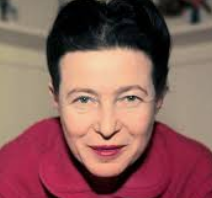
Simone de Beauvoir — Freedom, Otherness, and the Second Sex (1908–1986)
Simone de Beauvoir was a French philosopher, novelist, and political activist whose work stands as one of the most consequential in the history of feminist thought — and as a major contribution to existentialist philosophy in its own right, independent of her association with Sartre.
A graduate of the École Normale Supérieure who placed second in the agrégation in philosophy behind only Sartre — at twenty-one, the youngest person ever to pass the examination — she brought to existentialism a concreteness, a political seriousness, and a attention to embodied experience that transformed it from an abstract philosophy of freedom into a tool for analyzing the actual conditions of human lives.
Her central concern: that freedom is not an abstract metaphysical condition equally possessed by all — but a concrete achievement that social structures can enable or deny, and that the systematic denial of freedom to women is both a philosophical and a political scandal.
The Second Sex — One Is Not Born a Woman
Published in 1949, "The Second Sex" is the founding document of modern feminist philosophy — a work of such range, depth, and analytical power that it transformed the terms of debate about women, freedom, and society in ways that have not yet been fully exhausted.
De Beauvoir's central argument was deceptively simple and philosophically radical: one is not born a woman — one becomes one. Femininity is not a natural fact but a social construction, a set of behaviors, attitudes, and self-understandings imposed on female human beings by a society organized around male interests and perspectives.
She drew on Hegel's master-slave dialectic to analyze the structure of women's oppression — arguing that man had constituted himself as the Subject, the essential, the absolute, by constituting woman as the Other, the inessential, the object defined in relation to him. This was not a biological necessity but a historical and social achievement — one that women had been complicit in partly through what de Beauvoir called bad faith, the flight from the anxiety of freedom into the comfort of a defined role.
The book swept across sociology, history, psychoanalysis, literature, mythology, and lived experience in an encyclopedic survey of how women had been defined, confined, and reduced across Western civilization — and what genuine freedom for women would require.
"One is not born, but rather becomes, a woman."
Existentialism and the Ethics of Freedom
De Beauvoir's philosophical contribution extended well beyond feminist theory. Her "The Ethics of Ambiguity" (1947) offered the most rigorous account of existentialist ethics produced by anyone in the Sartrean circle — and one that in important respects surpassed Sartre's own.
She argued that the human condition is characterized by a fundamental ambiguity — we are simultaneously free subjects and situated beings embedded in bodies, histories, and social relations that we did not choose. The temptation is to resolve this ambiguity dishonestly — either by denying our freedom and treating ourselves as objects determined by nature or society, or by denying our situation and treating ourselves as pure unconditioned consciousness. Both are forms of bad faith.
Genuine ethics, she argued, requires acknowledging both dimensions — accepting our freedom and its demands while remaining honest about the concrete conditions in which that freedom is exercised. And crucially: my freedom is bound up with the freedom of others. To will my own freedom genuinely is to will the conditions under which all human beings can exercise theirs. This social dimension of freedom gave existentialism a political edge that Sartre's more individualist framework struggled to provide.
"To will oneself free is also to will others free."
Embodiment, Aging, and the Concrete Situation
One of de Beauvoir's most consistent philosophical commitments was to the concrete — to the embodied, situated, particular conditions in which human freedom is actually exercised. This commitment distinguished her existentialism from Sartre's tendency toward abstraction and gave her work a phenomenological richness that has made it increasingly valued by philosophers working on embodiment, disability, and aging.
"The Coming of Age" (1970) applied her method to the experience of growing old — a systematic analysis of how society treats the elderly and how the bodily experience of aging transforms a person's relationship to their own freedom. It was an act of philosophical courage to turn the tools of existentialism onto a subject that existentialism's emphasis on radical freedom had largely neglected.
Her memoir "A Very Easy Death" (1964) — an account of her mother's dying — demonstrated that philosophical insight did not require systematic abstraction but could be achieved through the most intimate and painful forms of personal experience. It remains one of the most philosophically honest accounts of death and its witness ever written.
"Old age is something beyond my life, outside it, something of which I cannot have any full inward experience."
The Novel as Philosophy — The Mandarins and Beyond
De Beauvoir was also a major novelist — "The Mandarins," which won the Prix Goncourt in 1954, is a rich portrait of the post-war Parisian intellectual world, its political commitments, its personal entanglements, and its gradual confrontation with the limits of its own idealism.
She believed that fiction could achieve forms of philosophical insight unavailable to the essay — that the concrete particularity of narrative, the experience of inhabiting other consciousnesses, the slow unfolding of moral situations over time, could illuminate the human condition in ways that abstract argument could not reach.
Her memoirs — four volumes covering her entire life — were simultaneously works of philosophy, autobiography, and social history, tracing the development of a consciousness from bourgeois Catholic childhood through intellectual awakening, political commitment, and the reckoning with age and loss that her later work addressed. They remain among the most complete self-portraits any philosopher has left.
"I am too intelligent, too demanding, and too resourceful for anyone to be able to take charge of me entirely. No one knows me or loves me completely. I have only myself."
Sartre, Independence, and a Relationship Philosophy Has Misread
De Beauvoir's relationship with Sartre has too often been used to diminish her — as if proximity to a famous man explained her philosophical achievements rather than representing a collaboration between equals who influenced each other profoundly in both directions.
The influence ran both ways and was substantial. De Beauvoir's insistence on the social and political dimensions of freedom, her attention to embodiment and situation, her concrete analyses of oppression — all of these shaped Sartre's later work in ways he acknowledged. Her argument in "The Second Sex" that the Other is constituted rather than found was philosophically prior to, and in important respects more rigorous than, the equivalent arguments in Sartre's "Being and Nothingness."
Their relationship was open, complex, and sometimes painful — a life experiment in whether a philosophy of freedom could be actually lived rather than merely theorized. The experiment did not always succeed on its own terms. But it was conducted honestly, and de Beauvoir's accounts of it are among the most philosophically serious reflections on love, freedom, and commitment that any philosopher has produced.
"Change your life today. Don't gamble on the future — act now, without delay."
Legacy — The Philosopher Who Made Feminism Philosophical
De Beauvoir's legacy operates simultaneously in philosophy, feminist theory, literature, and politics — in all of them foundational, in all of them contested, in all of them still generative.
"The Second Sex" has been called the most important feminist text ever written — a claim that invites debate but reflects a genuine truth about the book's scope and the depth of its influence on every subsequent wave of feminist thought. Betty Friedan, Judith Butler, Martha Nussbaum — each engaging, extending, or arguing with de Beauvoir — demonstrate the breadth of the tradition she inaugurated.
Her insistence that freedom is concrete and social — that it cannot be theorized in the abstract without attending to the actual conditions in which actual people exercise or are denied it — remains one of the most important correctives to the tendency of political philosophy to confuse ideal conditions with real ones.
On CivSim she stands alongside Luxemburg, Sue Campbell, and Teresa of Ávila — women who worked at the limits of what their social conditions permitted, pushed those limits further than seemed possible, and left behind philosophical work that the tradition they transformed has spent decades fully absorbing.
"Representation of the world, like the world itself, is the work of men — they describe it from their own point of view, which they confuse with absolute truth."
CivilSimian.com created by AxiomaticPanic, CivilSimian, Kalokagathia