
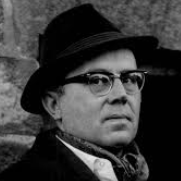
Russell Kirk — Tradition, Order, and the Conservative Mind (1918–1994)
Russell Kirk was an American political philosopher, historian, and man of letters whose 1953 book "The Conservative Mind" almost single-handedly gave American conservatism a coherent intellectual tradition to stand on — tracing a lineage from Edmund Burke through the nineteenth century to the present and arguing that the conservative impulse was not mere resistance to change but a profound and defensible philosophy of human nature and society.
A man of unusual personal integrity who lived by his convictions — choosing a life of letters in a small Michigan town over the career opportunities that his reputation could have secured — he combined serious scholarship with Gothic fiction, moral philosophy with ghost stories, in a body of work as distinctive in style as in substance.
His central concern: that civilization rests on inherited wisdom — on the accumulated moral and cultural deposit of generations past — and that the radical impulse to remake society from abstract first principles destroys what it took centuries to build and cannot replace what it has lost.
The Conservative Mind — A Tradition Recovered
When "The Conservative Mind" appeared in 1953, it landed in an American intellectual landscape in which liberalism was virtually unchallenged and conservatism was widely regarded as having no serious intellectual content — as mere reaction, vested interest dressed in the language of principle.
Kirk's book demolished this picture. Beginning with Edmund Burke's response to the French Revolution and tracing the conservative tradition through John Adams, Coleridge, Disraeli, Newman, and others to the present, he demonstrated that there was a serious, coherent, and philosophically distinguished tradition of thought that had consistently argued for the same cluster of principles: the importance of moral order grounded in religious belief, the value of prescription and tradition over abstract rights, the connection between property and freedom, the necessity of variety and hierarchy in a healthy society, and the deep suspicion of radical change.
The book was immediately recognized as a landmark — by admirers and critics alike — and it provided the intellectual vocabulary that American conservatism would draw on for the next several decades. Without Kirk there is no coherent postwar American conservative movement as a philosophically serious enterprise.
"A people that has lost its memory has lost its mind."
The Six Canons of Conservative Thought
Kirk distilled the conservative tradition into a set of core principles that he refined and restated across his career. At their heart was the conviction that political problems are at bottom religious and moral problems — that the health of a society depends on the health of its spiritual and ethical life, and that attempts to solve social problems through purely technical or economic means will fail because they address symptoms rather than causes.
He argued that the conservative believes in a transcendent moral order — that there are permanent truths about human nature and the good society that are not subject to revision by any generation's preferences. Closely related was his defense of prescription — the wisdom embedded in custom, convention, and inherited institutions — over the abstract rationalism that sought to remake society from first principles derived by individual reason.
Human nature, in Kirk's account, is flawed and limited — not infinitely malleable, not perfectible by the right institutions, but capable of moral development within the constraints that a healthy civilization provides. The radical's faith in human perfectibility was for Kirk not an optimistic but a dangerous delusion — one that had produced, in the twentieth century, catastrophes of a scale that more modest political philosophies would never have risked.
"The conservative is not opposed to social improvement, although he doubts very much whether there is any shortcut to paradise. He is not opposed to social change, but he knows that society and civilization are complex entities that do not easily submit to blueprints and systems."
Burke, Prescription, and the Contract Across Generations
Burke was Kirk's philosophical hero — and through Burke, Kirk developed his most important and most eloquent idea: that society is not a contract between its present members but a partnership between the dead, the living, and the yet unborn.
The living generation does not own civilization — it holds it in trust. The inherited institutions, customs, laws, and moral frameworks that a society passes on to the next generation represent the accumulated wisdom of all who came before — wisdom that no single generation could have created and that no single generation has the right to discard on the grounds that it seems inconvenient or rationally indefensible.
This was not an argument for stasis — Kirk acknowledged that reform was sometimes necessary and that the best conservatives had always been willing to change what needed changing while preserving what deserved preservation. But the burden of proof, in his account, always rested on the reformer rather than the preserver — and that burden was heavier than reformers typically acknowledged.
"Society is a partnership in all science, all art, all virtue, all perfection — a partnership between the dead, the living, and those yet to be born."
— Burke, as quoted and developed by Kirk
Gothic Fiction and the Moral Imagination
Kirk was unusual among political philosophers in taking fiction as seriously as argument — and in practicing it with considerable skill. His short stories, collected in several volumes, are works of Gothic and supernatural fiction that draw on a tradition running from Hawthorne through M.R. James — tales of haunted places, moral consequence, and the persistence of the past in the present.
For Kirk, these were not distractions from philosophy but expressions of its deepest commitments. The imagination, he argued, was a moral faculty — the capacity to perceive the enduring patterns of human experience, to feel the weight of the past, to understand that the world is richer and stranger than rationalist reduction allows. A culture that had lost its Gothic sense — its awareness of mystery, of moral consequence, of the reality of evil — was a culture that had lost something essential and could not replace it with policy analysis.
His concept of the "moral imagination" — derived from Burke — became one of his most influential contributions, taken up by subsequent conservatives as a way of articulating what secular liberalism had abandoned and could not recover by purely rational means.
"The moral imagination is the principal possession that man does not share with the beasts. It is the vision of an enduring moral order, a transcendent order."
Kirk and the Conservative Movement — An Uneasy Relationship
Kirk's relationship with the American conservative movement that his work helped create was characteristically complicated. He was deeply skeptical of libertarianism — regarding the reduction of conservatism to free-market economics as a betrayal of the tradition he had recovered — and he grew increasingly critical of American foreign policy, opposing the Iraq War on the grounds that military adventurism abroad was incompatible with the preservation of ordered liberty at home.
He coined the term "the chirping sectaries" for the libertarians who claimed the conservative label while rejecting its substance — and he maintained throughout his life that genuine conservatism was about the health of community, the cultivation of virtue, and the preservation of cultural heritage, not the maximization of individual freedom or economic efficiency.
The movement he helped found largely ignored these distinctions — embracing his rhetoric while pursuing policies that would have dismayed him. Kirk noticed, and said so, with the dry unhappiness of a man who had watched his children take an inheritance and spend it badly.
"A handful of precepts and a clutch of institutions constitute what we mean by civilization — and they are more easily destroyed than created."
Legacy — The Conservative Who Unsettled Conservatives
Kirk's legacy is genuinely complex. He gave American conservatism its intellectual foundations — and those foundations contain arguments that challenge much of what that movement subsequently became. A Kirkian conservatism would be skeptical of global capitalism's tendency to dissolve inherited communities and cultural traditions, hostile to military adventurism, suspicious of technological utopianism, and deeply committed to locality, piety, and the claims of the past. It would recognize more in common with certain strands of the left — Wendell Berry's defense of place and community, for instance — than with the market liberalism that came to dominate the American right.
On CivSim his work sits in productive tension with de Beauvoir, Luxemburg, and the universalist tradition — a serious philosophical challenge to the premise that abstract principles of justice and equality can be applied without regard to the particular cultural and historical contexts in which people actually live. The tension is real and unresolved — and any philosophy of human flourishing that cannot engage with it has not yet thought through what it is asking people to give up.
"The problem of the conservative is not to discover what is new — plenty of people are employed in that pursuit. His task is to preserve what is old and good, and to fit what is newly necessary into the frame of the enduring."
CivilSimian.com created by AxiomaticPanic, CivilSimian, Kalokagathia