
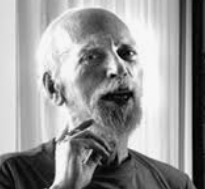
Robert Anton Wilson — Reality Tunnels, Guerrilla Ontology, and the Cosmic Giggle (1932–2007)
Robert Anton Wilson was an American author, philosopher, polymath, and self-described agnostic mystic whose enormous output of novels, essays, and nonfiction made him one of the most widely read and most genuinely subversive philosophical entertainers of the twentieth century.
Best known for the "Illuminatus!" trilogy co-written with Robert Shea — a sprawling, hilarious, and genuinely mind-altering work of countercultural fiction — he developed across his career a philosophical project he called guerrilla ontology: the systematic destabilization of the reader's certainties about what is real, what is true, and who is in charge.
His central concern: that every human being inhabits a "reality tunnel" — a set of assumptions, beliefs, and perceptual filters that determines what they can perceive and what they cannot — and that the most dangerous thing in the world is the person who has forgotten that their tunnel is a tunnel and not the territory.
Reality Tunnels and the Epistemology of Maybe
Wilson's most important philosophical contribution was his development and popularization of the concept of the reality tunnel — the idea, drawing on Alfred Korzybski's general semantics and Timothy Leary's work on imprinting, that every mind filters reality through a system of learned expectations, cultural assumptions, neurological predispositions, and emotional investments that determine what it can and cannot perceive.
No one sees reality directly. Everyone sees their model of reality — and most people mistake the model for the thing itself. The Marxist sees class struggle everywhere. The Christian sees divine providence. The libertarian sees government overreach. The conspiracy theorist sees coordinated malevolence. Each tunnel is coherent within itself and systematically blind to what lies outside it.
Wilson's proposed response was what he called the "snafu principle" extended to epistemology — the practice of maintaining multiple incompatible models simultaneously, of treating every belief as provisional, of inhabiting a position of permanent, cheerful uncertainty that he called "maybe logic." Not agnosticism as defeat but agnosticism as liberation — the freedom that comes from not being imprisoned by any single model of the world.
"Reality is what you can get away with."
Illuminatus! and Guerrilla Ontology in Fiction
The "Illuminatus!" trilogy — co-authored with Robert Shea and published in 1975 — is one of the strangest, most ambitious, and most genuinely philosophical works of American fiction in the twentieth century.
Ostensibly a conspiracy novel about the Illuminati and their sinister control of world history, it is in fact a sustained philosophical joke about the nature of conspiracy thinking itself — a work that presents every conspiracy theory simultaneously, endorses all of them and none of them, and leaves the reader uncertain whether they have understood something true or been comprehensively deceived. That uncertainty is the point.
Wilson called this method guerrilla ontology — the deliberate disruption of the reader's certainties, the injection of doubt into the comfortable assumption that one knows what is real and what is not. The novel does not replace one worldview with another — it dissolves the confidence that any worldview is the final word.
The trilogy became a cult classic of the late counterculture and early internet age — influencing writers, programmers, musicians, and anyone who found in its gleeful epistemological mayhem a description of their own experience of a world in which the official story was clearly insufficient but no single alternative story was clearly better.
"The fnords are everywhere — but only those who have been taught not to see them will fail to notice them."
Prometheus Rising and the Circuits of Consciousness
Wilson's most systematically philosophical work, "Prometheus Rising" (1983), drew on Leary's eight-circuit model of consciousness, Korzybski's general semantics, Gurdjieff's fourth way, and a range of other sources to construct a practical manual for expanding the range of one's reality tunnel.
The book argued that human consciousness operates through a series of circuits or modules — from the most primitive survival circuits through increasingly sophisticated levels of social, intellectual, and transpersonal functioning — and that most people spend most of their time operating on the lower circuits while remaining unaware of the higher ones.
The philosophical project was practical as much as theoretical: Wilson included exercises throughout the text — including the instruction to spend thirty days genuinely assuming that a specific belief is true and noting how one's perceptions change — designed to make the reader experientially aware of how much their reality tunnel shaped their experience. The map is not the territory: the exercise was intended to make this not a slogan but a lived understanding.
"The map is not the territory, and the name is not the thing named."
Discordianism, the Cosmic Joke, and Serious Play
Wilson was deeply influenced by and contributed to the Discordian tradition — a deliberately absurdist quasi-religion centered on Eris, the goddess of chaos and discord, whose "scriptures" insisted that all structures, systems, and certainties were equally arbitrary and equally sacred.
Discordianism was simultaneously a joke about religion and a serious religious statement — a position that Wilson inhabited with characteristic ease. He believed that the ability to hold apparently contradictory propositions in mind simultaneously, to find cosmic humor in the gap between our models and reality, to maintain what he called the "cosmic giggle" — a kind of philosophical lightness in the face of irreducible uncertainty — was a genuine spiritual and intellectual achievement, not mere nihilism dressed in funny clothes.
The cosmic giggle was his alternative to both dogmatic certainty and despairing relativism — a response to the genuine strangeness of existence that neither insisted on a final answer nor collapsed into the view that no answers were worth seeking.
"Belief is the death of intelligence. As soon as one believes a doctrine of any sort, or assumes certitude, one stops thinking about that aspect of existence."
Politics, Anarchism, and the SNAFU Principle
Wilson's politics were consistently anarchist in the broad sense — deeply suspicious of all concentrated power, whether state, corporate, or ecclesiastical — and consistently pluralist, refusing the hard ideological lines that organized political movements demanded.
He developed what he called the SNAFU principle — the observation that communication within hierarchies is systematically distorted by the power dynamics of those hierarchies. People tell their superiors what those superiors want to hear. The CEO gets filtered information. The general receives optimistic reports. The politician hears what their staff thinks they want. The result is that the most powerful people are often the most misinformed — living in the most elaborate reality tunnels of all, insulated from the feedback that might correct them.
This was not merely political observation but epistemological analysis — an account of why hierarchical structures tend to generate systematic ignorance at their apex regardless of the intelligence of those at the top.
"Every war results from the struggle for markets or resources and is fought by the working class for the benefit of the ruling class — your enemies are the ones who try to convince you otherwise."
Legacy — The Philosopher of Maybe
Wilson died in January 2007, having spent his final years in considerable poverty — crowdfunded by readers when disability benefits ran out — and characteristic good humor, blogging from his Santa Cruz apartment with the same philosophical playfulness that had characterized his entire career. His last blog post ended with the words "Oleum Lucis" — oil of light.
His influence is vast and largely unacknowledged — the concept of the reality tunnel has entered popular consciousness without most of those who use it knowing its source, and the culture of skeptical, pluralistic, conspiratorially-aware internet epistemology owes more to Wilson than to any academic philosopher.
He is not a philosopher in the academic sense — he held no university position, followed no school, and produced no technical philosophical apparatus. But the questions he asked and the methods he developed — about how minds are trapped in their own models, about the relationship between belief and perception, about the epistemological consequences of hierarchy — are genuine philosophical questions, addressed with unusual clarity and unusual fun.
On CivSim he sits in a productive and perhaps unexpected alignment with Mannheim and Clifford — all three insisting in different registers that the uncritical confidence of the believer in their own model is the most dangerous epistemic condition a person can occupy, and that the honest response to this danger is not despair but a disciplined, cheerful, and permanently revisable openness to being wrong.
"It only takes twenty years for a liberal to become a conservative without having changed a single idea."
CivilSimian.com created by AxiomaticPanic, CivilSimian, Kalokagathia