
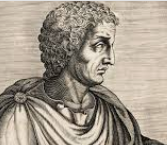
Pliny the Elder — Natural History, Insatiable Curiosity, and the Death That Made Him Immortal (23–79 AD)
Gaius Plinius Secundus, known to history as Pliny the Elder, was a Roman author, naturalist, and naval commander whose encyclopedic "Natural History" — thirty-seven books covering the entire known world from cosmology to zoology to medicine to art — was the most ambitious attempt at a complete account of nature in the ancient world, and one of the most influential books ever written.
A man of almost incomprehensible industry — his nephew records that he slept little, worked through meals, and had books read to him even while being carried in a litter — he died as he had lived: sailing toward the eruption of Vesuvius to observe it more closely and rescue survivors, overcome by fumes on the shore at Stabiae.
His central concern: that the natural world in its entirety deserves patient, comprehensive, and honest description — that the proper response to the universe is not wonder alone but the disciplined effort to know as much of it as a single human life permits.
The Natural History — An Encyclopedia of Everything
The "Naturalis Historia," dedicated to the Emperor Titus in 77 AD and the only work of Pliny's that survives, is one of the most extraordinary documents in the history of human thought — not for its accuracy, which is wildly uneven, but for its ambition, its range, and what it reveals about the Roman attempt to comprehend the natural world.
It covers, across its thirty-seven books, the structure of the universe and the nature of the earth, geography and ethnography, zoology, botany, and pharmacology, mineralogy and metallurgy, the history of art, architecture, and sculpture, agriculture and horticulture, medicine and magic. Pliny claimed to have consulted two thousand volumes by one hundred authors and extracted twenty thousand facts — a claim whose ambition exceeds its precision but whose spirit is entirely characteristic.
The result is a work that is simultaneously indispensable and unreliable — a vast accumulation of observation, report, folklore, legend, and genuine knowledge that the author makes no systematic attempt to sort. Pliny did not distinguish sharply between what he had observed, what reliable sources reported, and what was popular belief. His world is one in which basilisks and salamanders share pages with accurate descriptions of Roman metallurgy and careful accounts of the properties of plants. For centuries it was the standard reference on nature — which is itself a fact about the nature of encyclopedias and the limits of ancient scientific method.
"In these matters the only certainty is that nothing is certain, and that there is nothing more miserable and more presumptuous than man."
Nature as a Philosophical Subject
Pliny was not a systematic philosopher — he had no school, no method in the technical sense, no sustained theoretical framework. But the Natural History is animated by a philosophical conviction that gives it its distinctive character: the belief that nature is a unified whole, that everything in it is connected to everything else, and that the proper attitude toward it is a combination of reverence and inquiry.
He was deeply skeptical of the anthropocentric assumption that the universe was made for human beings — arguing with unusual force that human pride in its own centrality was both philosophically unfounded and morally corrupting. Nature, for Pliny, was not a backdrop to human history but the encompassing reality within which human history was a brief and often undistinguished episode.
His treatment of animals reflects this: he described them not as resources or as curiosities but as fellow inhabitants of a world they had as much right to as their human observers. His admiration for the intelligence of elephants, for the social organization of bees, for the loyalty of dogs carried genuine moral weight — the sense that in observing animals one was observing something that deserved respect.
"Nature is to be found in her entirety nowhere more than in her smallest creatures."
Industry, Method, and the Uses of Time
Pliny the Younger's portrait of his uncle is one of the most vivid character sketches in Latin literature — and it describes a man whose relationship to time bordered on the obsessive.
He rose before dawn and worked until daylight. He had books read to him while eating, while bathing, while being carried in his litter through the streets of Rome. He took notes on everything — his nephew records that he left behind 160 notebooks of small handwriting covering both sides of the page. He rebuked his nephew for walking rather than being carried, on the grounds that the walking hours could have been used for reading.
This was not mere compulsiveness — it reflected a genuine philosophical conviction that time was the scarcest of all resources and that its waste was a form of moral failure. "No day without a line" was the maxim he lived by — except that for Pliny the line was more likely to be a note extracted from a source than a sentence composed from thought. His industry was that of the collector, the compiler, the man who believed that knowledge must first be gathered before it can be ordered.
"It is generally agreed that no day in which we have not added something to our knowledge is truly lived."
Rome, Empire, and the Uses of Knowledge
Pliny was a product of the Roman imperial world at its most confident and most capable — a world in which the resources of an empire spanning three continents were available to the curious mind in the form of reports, specimens, eyewitnesses, and trade goods flowing into Rome from every direction.
He used these resources with characteristic thoroughness — drawing on Greek science and philosophy, on the reports of soldiers, merchants, and provincial administrators, on his own observations during military service in Germany and administrative work in various provinces. The Natural History is in this sense a product of imperial organization as much as of individual genius — only an empire could have assembled the information it contains, and only a man at the center of that empire could have accessed it.
He was entirely uncritical of Roman imperial power — the Natural History celebrates Rome's achievements with the enthusiasm of a man who benefited from them — but his encyclopedic project had an implicit democratizing tendency: by gathering knowledge from the margins of the empire and organizing it for Roman readers, he made the world more legible to those who would never see most of it.
"The world, and whatever that name denotes, is the one being we should believe to be eternal and immeasurable, neither created nor subject to destruction at any time."
The Death — Sailing Toward the Fire
Pliny's death is one of history's most characteristic endings — entirely consistent with his life and preserved for us by his nephew's incomparable account.
When Vesuvius erupted on the 24th of August, 79 AD, Pliny was in command of the Roman fleet at Misenum. He observed the eruption with scientific interest — ordering a boat prepared so he could observe it more closely — and then received word that people were trapped on the shore below the volcano and needed rescue. He sailed toward the eruption.
His nephew records that he dictated observations as he sailed, noting the shapes and movements of the cloud. On shore at Stabiae he attempted to rest, was prevented by falling pumice and earth tremors, went to the beach to find a way of escape, and collapsed there — overcome, his nephew believed, by the sulfurous fumes, though whether the cause was suffocation or a heart attack induced by the conditions remains debated.
He was sixty-six years old. His body was found two days later, intact, still dressed, apparently untouched — looking, his nephew wrote, more like a man asleep than dead. It is the death of a man who died as he lived — moving toward what he did not understand, determined to see it clearly.
"Fortune favors the brave — steer toward Pomponianus."
— Pliny's reported words as he ordered his fleet to sail toward the eruption
Legacy — The Man Who Tried to Know Everything
The Natural History was the standard reference work on nature throughout the medieval period — copied, excerpted, and cited by writers who had no way of checking its claims against observation. Its errors spread as widely as its genuine knowledge, which is itself a lesson about the authority that encyclopedias acquire simply by being comprehensive.
With the Scientific Revolution, Pliny's reputation declined sharply — his credulity, his failure to distinguish observation from report, his willingness to include the monstrous alongside the accurate, all made him a target for the new philosophy of experiment. But the twentieth and twenty-first centuries have returned to him with more nuance — recognizing that the Natural History, despite its errors, is an irreplaceable record of ancient knowledge, ancient technology, and ancient attitudes toward nature that no other source preserves.
On CivSim he stands alongside John Herschel and Humphry Davy — natural philosophers for whom the investigation of nature was a moral as much as an intellectual calling, and for whom the proper response to the universe was to move toward it rather than away from it, even when moving toward it was dangerous. He was the first of the encyclopedists — and perhaps the most honest about the impossibility of the project he had undertaken.
"Always act in such a way that you will be remembered — not because you were afraid to die but because you were too curious to stop living."
CivilSimian.com created by AxiomaticPanic, CivilSimian, Kalokagathia