
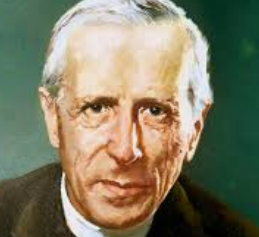
Pierre Teilhard de Chardin — Evolution, the Omega Point, and the Divinization of Matter (1881–1955)
Pierre Teilhard de Chardin was a French Jesuit priest, paleontologist, and visionary philosopher whose attempt to synthesize Christian theology with evolutionary biology and cosmology produced one of the twentieth century's most audacious and most contested philosophical visions.
Forbidden by the Catholic Church to publish his philosophical works during his lifetime — his superiors finding them theologically dangerous — he spent decades in obedience and exile, doing paleontological fieldwork in China while his ideas circulated in manuscript among friends who recognized in them something genuinely new.
His central concern: that the universe is not a static backdrop to human history but a process of progressive complexification converging toward a point of maximum consciousness — and that this convergence is not merely a scientific fact but the deepest expression of what the Christian tradition means by the love of God.
The Phenomenon of Man — Evolution as Cosmic Story
Teilhard's masterwork, written in the 1930s but published only after his death in 1955, proposed a vision of evolution that was simultaneously scientific and mystical — or rather, that refused the distinction.
He argued that matter has always had an interior dimension — what he called the "within" of things — alongside its exterior physical properties. As matter becomes more complexly organized, this interior dimension becomes more pronounced. The appearance of life represents a threshold — a qualitative leap in the complexity and interiority of matter. The appearance of human consciousness represents another — the point at which the interior dimension becomes reflective, capable of knowing itself.
Evolution, on this account, is not a blind mechanical process but a directed movement — not directed by external design but by an internal tendency toward greater complexity and consciousness that Teilhard called "complexification." The arrow of evolution points toward more awareness, more interiority, more being — and the endpoint of this arrow, the attractor toward which the entire process is drawn, he called the Omega Point.
"The history of the living world can be summarized as the elaboration of ever more perfect eyes within a cosmos in which there is always more to see."
The Noosphere and the Convergence of Minds
Teilhard introduced the concept of the noosphere — from the Greek nous, mind — to describe the layer of thought that human consciousness has overlaid on the biosphere, just as the biosphere overlaid the geosphere.
The noosphere is not merely metaphorical. Teilhard argued that human thought, as it develops and interconnects across the globe, constitutes a genuine new layer of reality — a web of consciousness that is progressively drawing all human minds into a single interconnected system. The growth of communication, of shared knowledge, of global culture and global problems — all of this was, for Teilhard, the noosphere thickening, the convergence of minds that the Omega Point required.
The concept anticipated the internet with an uncanniness that has made Teilhard a recurring reference in discussions of digital culture — though his vision of global convergence was suffused with a warmth and a directionality that the actual internet has not consistently displayed.
"The idea is that of the Earth not only becoming covered by myriads of grains of thought, but becoming enclosed in a single thinking envelope so as to form, functionally, no more than a single vast grain of thought."
The Omega Point — Christ as the Convergence of Evolution
For Teilhard, the Omega Point was not merely a cosmological hypothesis — it was a theological one. The attractor toward which evolution converges is what Christian theology calls Christ — not the historical Jesus only, but the Cosmic Christ, the Logos through whom all things were made and toward whom all things are being gathered.
This was the audacious synthesis at the heart of his project — the identification of the scientific description of evolutionary convergence with the theological description of universal redemption. The universe was not merely evolving — it was being drawn toward its own divinization, toward the moment when matter, having become spirit, would be fully united with its source.
He drew on the Pauline vision of Christ as the head of all creation, on the mystical theology of the Eastern Church, and on his own reading of evolutionary science to construct a vision in which the love of God was not an intervention in an otherwise mechanical universe but the very energy that drove the universe's complexification. God was not above the process — God was its attractor, drawing it forward from ahead rather than pushing it from behind.
"Some day, after mastering the winds, the waves, the tides and gravity, we shall harness for God the energies of love, and then, for a second time in the history of the world, man will have discovered fire."
The Paleontologist — Science at the Foundation
Teilhard was not merely a speculative philosopher — he was a working scientist whose fieldwork in China, central Asia, and Africa produced genuine contributions to paleontology. He was involved in the discovery and analysis of Peking Man — Homo erectus pekinensis — one of the most significant paleoanthropological finds of the twentieth century, and his expertise in early human evolution gave his philosophical speculations a grounding in empirical science that purely theological accounts of evolution lacked.
This combination — the trained scientist who was simultaneously a Jesuit priest and a visionary cosmological thinker — was what made Teilhard genuinely unusual. He was not forcing theology onto science from outside but attempting to read a spiritual dimension from within the scientific account of the world, using the tools of the scientist to arrive at conclusions that the scientist alone would not have reached.
Whether this project succeeded or merely seemed to — whether the synthesis was genuine or an elaborate illusion — is a question that philosophers of science, theologians, and scientists have argued about ever since.
"You are not a human being in search of a spiritual experience. You are a spiritual being immersed in a human experience."
Obedience, Exile, and the Hidden Life
The Church's prohibition on publishing his philosophical works was a wound that Teilhard bore with extraordinary patience — and that illuminates something important about his character and his theology.
He submitted to his superiors' judgment without abandoning his convictions — continuing to write, to develop his ideas, to share them in manuscript with friends, while accepting that publication must wait. His letters from these years reveal a man of genuine spiritual depth — not embittered by obedience but finding in his enforced silence a participation in the suffering that his theology required him to embrace.
He died on Easter Sunday, 1955, in New York, where he had been living in exile — having never seen his major works published. They appeared within months of his death and became immediate international sensations, translated into dozens of languages and read by millions who found in them a way of holding together the modern scientific worldview and a sense of transcendent meaning that secular culture had largely abandoned.
"Above all, trust in the slow work of God. We are quite naturally impatient in everything to reach the end without delay. Give our Lord the benefit of believing that his hand is leading you, and accept the anxiety of feeling yourself in suspense and incomplete."
Legacy — The Prophet of Evolutionary Mysticism
Teilhard's reception has been as divided as his vision was unified. Mainstream scientists have generally found his work too theological to count as science — Peter Medawar's withering review of The Phenomenon of Man called it an exercise in "tipsy, euphoristic prose poetry" and found its scientific credentials negligible. Mainstream theologians have found it too scientific, too optimistic about progress, too willing to divinize matter. The Church's monitum of 1962 warned against uncritical acceptance of his philosophical and theological ideas.
And yet he has never stopped being read — because the questions he addressed are real even if his answers are disputed. How does the emergence of consciousness from matter bear on questions of meaning and value? Is evolution a blind process or does it have direction? What would it mean for human beings to take seriously the idea that the universe is moving toward something? These questions persist regardless of whether Teilhard's specific answers survive scrutiny.
On CivSim he stands alongside Bloch and Kazantzakis — thinkers for whom the cosmos is not a static backdrop but an unfinished project, whose incompleteness is the source of both its danger and its promise. Where Bloch found the not-yet in the structure of hope and Kazantzakis in the human will to transcendence, Teilhard found it written into the evolutionary history of matter itself — a cosmic arrow pointing toward a destination he identified with everything that the word love could mean.
"We are not human beings having a spiritual experience — we are spiritual beings having a human experience. The day will come when, after harnessing space, the winds, the tides, and gravitation, we shall harness for God the energies of love. And on that day, for the second time in the history of the world, we shall have discovered fire."
CivilSimian.com created by AxiomaticPanic, CivilSimian, Kalokagathia