
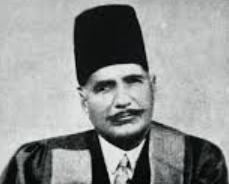
Muhammad Iqbal — The Self, Islamic Renewal, and the Poetry of Becoming (1877–1938)
Muhammad Iqbal was a South Asian Muslim poet, philosopher, and political thinker whose visionary work in Urdu and Persian made him the most influential Muslim intellectual of the twentieth century — and whose philosophical project, combining Islamic mysticism with European philosophy, gave the Muslim world a vocabulary for spiritual and political renewal.
Educated at Lahore, Cambridge, and Munich — where he studied Hegel, Nietzsche, Bergson, and Fichte alongside the classical tradition of Islamic thought — he returned to the subcontinent with a philosophical vision that was neither simply Western nor simply Eastern but a genuine synthesis, shaped by the conviction that Islam contained within it the resources for a dynamic and emancipatory civilization.
His central concern: that the human self — the khudi — was not something to be dissolved in God but something to be developed and strengthened — that the highest spiritual achievement was not annihilation but creative self-affirmation in service of a divine purpose that required human agency and human excellence to fulfill.
Khudi — The Philosophy of the Self
At the heart of Iqbal's philosophy was his concept of khudi — the self, the ego — which he developed in opposition to what he regarded as the dominant mystical tradition's emphasis on the dissolution of the individual in the divine.
The tradition of fana — annihilation of the self in God — had been central to Sufi mysticism for centuries. Iqbal did not dismiss this tradition — he engaged with it deeply and sympathetically — but he argued that it represented only one moment in the spiritual journey, not its culmination. The self that dissolved was the petty, ego-bound self of attachment and desire. But dissolution was not the end: the spiritual person must then reconstitute themselves at a higher level — strengthened, expanded, more genuinely themselves — capable of acting in the world with divine energy.
Khudi was not selfishness — it was the opposite. The fully developed self was one that had moved beyond the narrow confines of personal interest toward a larger identification with humanity and with God's creative purpose. But this movement required the self to become more, not less — more capable, more creative, more fully realized as an agent. The image Iqbal invoked was not the drop dissolving in the ocean but the drop becoming the ocean while remaining itself.
"Arise and elevate your ego to such a height that before every decree of fate, God himself asks of you: what is it that you desire?"
The Reconstruction of Religious Thought in Islam
Iqbal's most directly philosophical work, delivered as a series of lectures in 1930 and published as "The Reconstruction of Religious Thought in Islam," was his sustained attempt to rethink the foundations of Islamic theology in light of modern philosophy and science.
He engaged seriously with Einstein's relativity, Bergson's philosophy of time and consciousness, and the whole tradition of European metaphysics from Kant to Whitehead — arguing that modern thought, properly understood, was not hostile to Islamic theology but in many respects confirmed and extended it. The dynamic, creative universe of modern physics was closer to the Quranic vision of a living, purposive God than the static Newtonian mechanism that nineteenth century materialists had tried to use as a refutation of religion.
He argued for a thoroughgoing reconstruction of Islamic thought — a return to the Quran's own dynamic spirit rather than the fossilized scholasticism that had developed in medieval times — insisting that ijtihad, independent reasoning, was not merely permitted in Islam but required. The intellectual stagnation of the Muslim world was not the fault of Islam but of Muslims who had mistaken the historically contingent formulations of medieval scholars for eternal truths.
"The Quran is a book which emphasizes deed rather than idea. There are, however, men to whom it is not possible to reach the deed except through the idea."
The Poetry — Philosophy in Verse
Iqbal's philosophical ideas reached their widest audience through his poetry — written in Urdu and Persian with a lyrical power and philosophical depth that made him the most celebrated Urdu poet of the modern era and a major figure in Persian literature.
His "Secrets of the Self" (Asrar-i-Khudi), published in Persian in 1915, was his first major philosophical poem — a verse treatise on the development of the self that caused immediate controversy by its apparent departure from Sufi orthodoxy and immediate acclaim by its poetic beauty. His "Mysteries of Selflessness" (Rumuz-i-Bekhudi) followed as a companion piece, balancing the development of the individual self with its integration into community and millat — the community of the faithful.
His Urdu poetry — particularly "Bang-i-Dara" (The Call of the Bell) and his later collections — combined philosophical reflection with lyrical intensity, social criticism with mystical vision, political urgency with spiritual depth. He could write a poem that was simultaneously a meditation on divine love, a critique of colonialism, an argument for Muslim revival, and a work of pure lyrical beauty — and make all four dimensions feel unified by the force of the philosophical vision behind them.
"You are the secret of the Book of God — you are the mirror of the divine face. Life is nothing but the breath of Gabriel — you yourself are the purpose of creation."
Colonialism, Muslim Identity, and the Pakistan Idea
Iqbal's philosophy was inseparable from his political context — the Muslim community of British India, facing colonialism from without and cultural dissolution from within, struggling to find a path that neither imitated the West nor retreated into a frozen traditionalism.
His 1930 presidential address to the Muslim League articulated the idea of a separate Muslim state in northwest India — a vision that contributed to the intellectual foundation of Pakistan, though the specific form that state took was shaped more by subsequent events than by Iqbal's vision. He conceived of this not as a religious state in the theocratic sense but as a space in which Muslim culture and civilization could develop freely — a social laboratory for the reconstruction of Islamic thought and practice that colonialism prevented.
His relationship to nationalism was complex — he criticized the ethnic and territorial nationalisms of European type as fundamentally inimical to Islamic universalism, while advocating for a Muslim political community grounded in shared values and civilization rather than shared blood or soil. The tension between these positions was never fully resolved in his thought — nor has it been resolved in the political realities that his ideas helped bring into being.
"The ultimate spiritual basis of all life is eternal and reveals itself in variety and change. A living experience of this kind of reality is that higher life which religion is supposed to give."
Iqbal and European Philosophy — The Creative Synthesis
Iqbal's engagement with Western philosophy was neither wholesale adoption nor wholesale rejection — it was a sustained creative dialogue in which he took seriously what Western thought had achieved while subjecting it to Islamic critique and finding in Islamic tradition resources that Western thought lacked.
From Nietzsche he took the emphasis on creative self-overcoming and the critique of passive, life-denying spirituality — but he rejected Nietzsche's atheism and his individualism, arguing that the übermensch of Western modernity was a destructive figure without the spiritual grounding that the perfected human being required. The Islamic equivalent — the Insan-i-Kamil, the perfect human — achieved something greater than Nietzsche's vision because it was achieved in relation to God and community rather than in opposition to them.
From Bergson he drew the concept of creative evolution — the idea of life as dynamic, creative thrust — and read it as confirming the Quranic vision of a universe in continuous becoming. From Hegel he took the dialectical movement of history but replaced Hegel's World Spirit with the living God of the Quran, whose relationship with creation was dynamic, purposive, and genuinely responsive to human agency.
"The ego is a free, creative centre of experience. Its essence is the act of directing its own resources toward the realization of values."
Legacy — The Poet-Philosopher of Muslim Modernity
Iqbal is the national poet of Pakistan, celebrated throughout the Muslim world as the thinker who most successfully articulated a vision of Islamic civilization adequate to the modern age. He is studied in schools, quoted in parliaments, invoked in political speeches across the Muslim world — which means, inevitably, that his thought has been simplified and recruited for purposes he might not have recognized.
His philosophical achievement is more specific and more interesting than the uses to which it has been put. The reconstruction of Islamic thought on dynamic, evolutionary, and experiential grounds — grounded in Quranic texts but genuinely engaged with modern philosophy and science — was a serious philosophical project that produced insights about the self, time, creativity, and the relationship between human agency and divine purpose that deserve engagement on their merits, not merely as symptoms of Islamic modernism.
On CivSim he stands alongside Kazantzakis and Teilhard de Chardin — thinkers for whom the universe is not finished, for whom human beings are participants in a cosmic becoming, and for whom the proper response to existence is not passive acceptance but creative engagement with a reality that is always exceeding what it has been. Each reached this vision from a different tradition — Greek Orthodox, Catholic, Islamic — and each made it genuinely their own.
"Move, for in motion is your being — in the tumult of the sea, not in the still harbor. Be a wave: raise your breast against the shore — do not be the foam that life and death are one."
CivilSimian.com created by AxiomaticPanic, CivilSimian, Kalokagathia