
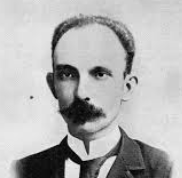
José Martí — Nuestra América, the Republic for All, and the Apostle of Cuban Independence (1853–1895)
José Martí was a Cuban poet, essayist, journalist, political philosopher, and revolutionary — born in Havana in 1853 to Spanish parents, imprisoned at sixteen for publishing a newspaper that supported the Cuban independence uprising, sentenced to hard labor and deported to Spain at eighteen, educated in law and philosophy at Zaragoza, and exiled for most of the rest of his life from the island he died for in 1895 at forty-two — who became, through his writings and his death, the "Apostle of Cuban Independence" and one of the most influential voices in the political and literary culture of Latin America.
He spent his final fifteen years in New York — writing poetry, essays, and journalism, organizing the Cuban Revolutionary Party, corresponding with revolutionaries across the Caribbean, raising money, planning the invasion — and produced in those years the body of work that made him the founder of Spanish American Modernismo, a pioneer of literary journalism, a theorist of anti-imperialism a century before the term became common, and a philosophical voice for a specifically Latin American identity that was neither colonial imitation nor romantic primitivism.
His central concern: "a republic for all" — the creation of a genuinely democratic Cuba grounded in racial equality, human dignity, and social justice, free from both Spanish colonialism and North American imperialism, and expressing a distinctly American — in the hemispheric sense — political and cultural identity.
The Formation — Prison, Exile, and Education
Martí's political consciousness formed early and under pressure. At fifteen, his teacher Rafael María de Mendive introduced him to the literature and politics of independence. At sixteen, he founded a newspaper supporting the revolutionaries of the Ten Years' War. At seventeen, he was arrested and sentenced to six months of hard labor — working in stone quarries — after which he was deported to Spain.
The prison experience shaped everything that followed. He wrote about it in "El presidio político en Cuba" — a searing account of the conditions he witnessed that functioned simultaneously as political testimony, philosophical reflection on suffering and dignity, and moral indictment of colonial brutality. It established the characteristic mode of his writing: direct, personal, morally charged, grounded in observed experience rather than abstract principle.
In Spain he earned degrees in law and philosophy at Zaragoza — producing an essay on "The Spanish Republic and the Cuban Revolution" that argued the newly proclaimed Spanish Republic was hypocritical to claim democratic foundations while refusing Cuba its independence. The argument was characteristically Martían: applying the stated principles of the powerful to their own inconsistent practice.
"Only oppression should fear the full exercise of freedom — those who prohibit it reveal, by prohibiting it, what they are afraid to face."
Nuestra América — The Political Philosophy of Latin American Identity
Martí's 1891 essay "Nuestra América" — "Our America" — is the foundational text of Latin American political identity and one of the most important political essays written in the Western hemisphere. Its argument was simultaneously philosophical, cultural, and political.
Against those who looked to Europe or the United States as models for Latin American development — who believed that progress required importing foreign institutions — Martí argued that authentic Latin American political culture had to grow from its own soil, from a genuine understanding of its own history, peoples, and conditions. The imported government that did not fit the genuine character of a people was not government but imposition — a colonial relationship continued under new management.
He articulated a vision of Latin American unity grounded in common historical experience and shared struggle — not ethnic or racial sameness, but the solidarity of peoples who had emerged from colonial subjugation and who faced the same challenges from external powers. His warning about the United States was explicit and prescient: "The giant with seven-league boots can take a stride and plant his foot on us" — recognizing in North American expansionism a new form of imperial threat to replace the Spanish one that Cuba had not yet escaped.
"The government must be born from the country itself. The spirit of the government must be the same as the spirit of the country. The form of the government must be agreeable to the constitution of the country."
Race and the Republic for All
Martí's political philosophy was distinctive in its treatment of race — at a time and in a context where racial hierarchy was deeply embedded in both colonial and post-colonial social structures. His vision of Cuban independence was explicitly anti-racist: "a republic for all" meant a republic in which all Cubans — of all racial backgrounds — had equal dignity and equal standing.
He wrote directly about race in ways that anticipated twentieth-century anti-racist thought: insisting that "Cuban" was a political and civic identity that transcended the racial categories that Spanish colonialism had used to divide the population, that the cause of independence was inseparable from the cause of racial equality, and that a Cuban republic that reproduced the racial hierarchies of colonialism would have failed its own founding principles.
He also recognized the strategic dimensions of this argument: independence required a unified movement, and a movement that excluded Cuba's Black population — who had fought in the independence struggles and who had suffered most brutally under slavery — was not merely morally deficient but tactically self-defeating.
"Man is more than white, more than mulato, more than Negro — it is incumbent upon any man who cultivates and propagates the antagonism of the races to commit a sin against humanity."
The New York Years — Writing as Political Practice
From 1881 to 1895, Martí lived primarily in New York — writing prolifically for Latin American newspapers, most notably in his regular column for La Nación of Buenos Aires that made him famous across the continent. His journalism was literary and philosophical in character: reports on American political life, technology, culture, and society filtered through a sensibility acutely alert to both what was admirable and what was threatening in the United States.
His essays on Emerson, Whitman, and American transcendentalism showed genuine philosophical engagement — finding in Whitman's democratic poetry of the universal "I" a kindred spirit while also recognizing the limits of North American democratic culture's capacity to extend its ideals to those it exploited. He attended Whitman's lecture in Philadelphia in 1887 and wrote one of the most perceptive critical essays on Whitman produced in the nineteenth century.
He also wrote, in 1883, a remarkable critical assessment of Marx — attending a memorial service in New York and reporting: "Karl Marx studied the methods of setting the world on new foundations, and wakened those who were asleep, and showed them how to cast down the broken props. But being in a hurry, with his understanding somewhat clouded, he did not see that children who do not have a natural, slow, and painful gestation are not born viable." This was neither dismissal nor endorsement — it was the assessment of a philosopher who shared Marx's concern for the exploited while recognizing the dangers of revolutionary impatience.
"Karl Marx studied the methods of setting the world on new foundations — but being in a hurry, he did not see that children who do not have a natural, slow, and painful gestation are not born viable."
The Poetry — Modernismo and the Simple Verses
Alongside his political and philosophical writing, Martí produced a body of poetry that placed him at the founding of Spanish American Modernismo — the first distinctly Latin American literary movement, which broke with European Romanticism and pioneered new forms of personal, sensory, and emotionally direct verse.
His "Versos Sencillos" (Simple Verses, 1891) — written while recuperating in the Catskill Mountains after the intense anxiety of the Inter-American Conference, where a US plan to purchase Cuba had been discussed — are among the most celebrated poems in the Spanish language. Their directness, their sense of moral integrity under pressure, and their connection between the personal and the political gave them a resonance that survived both their author and the specific historical circumstances that produced them. The song "Guantanamera" — which set several of their verses to music — carried his words to audiences who had never heard of Cuba's independence struggle.
"Yo soy un hombre sincero de donde crece la palma — I am an honest man from where the palm tree grows."
— Opening lines of Versos Sencillos
The Death and the Contested Legacy
Martí returned to Cuba in April 1895 to join the invasion he had organized. He died in his first battle — at Dos Ríos on May 19, 1895 — leading a charge against Spanish troops, killed at forty-two. Cuba achieved independence seven years later.
His legacy has been genuinely contested ever since. Both the Cuban revolutionary government after 1959 and Cuban exiles who oppose it have claimed Martí as their own — and both claims involve significant misrepresentation. The regime that claims his name has imprisoned the kinds of dissidents he spent his life defending. The anti-communist exiles who invoke him often overlook his explicit anti-imperialism and his warnings about US power. His own 1883 observation about Marx — that revolutionary impatience produces children who are not viable — applies with equal force to what was done in his name.
On CivSim he belongs alongside Simón Bolívar and Rosa Luxemburg — revolutionary thinkers who died for the causes they advocated and whose ideas were subsequently appropriated by political projects they would have opposed. His vision of a "republic for all" — racially equal, genuinely democratic, free from both colonial domination and imperial replacement — is precisely the vision Universal Humanism requires: not the formal declaration of universal rights but the substantive construction of a political community in which the universality is real.
"A free people is one in which every man, by virtue of being one, has the right to form part of the public will and exercises direct influence in the common good."
CivilSimian.com created by AxiomaticPanic, CivilSimian, Kalokagathia