
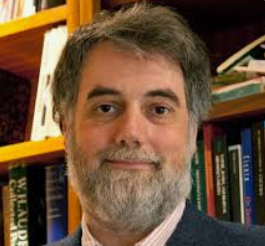
Joseph Shaw — Liturgy, Tradition, and the Philosophical Defense of the Ancient Mass (1971– )
Joseph Shaw is a British philosopher — educated in politics, philosophy, and theology at Oxford, where he earned his doctorate in 2000, and where he served as a tutorial fellow and member of the Philosophy Faculty for eighteen years — who has devoted a substantial portion of his career to the intersection of academic philosophy and Catholic liturgical tradition: as chairman of the Latin Mass Society of England and Wales, as president of Una Voce International, as the editor and author of a body of work arguing the philosophical and cultural case for the preservation and restoration of the Traditional Latin Mass.
His main academic interests — practical ethics, philosophy of religion, and medieval philosophy — connect directly to his public work: the defense of the ancient liturgy is, in his account, not primarily an exercise in ecclesiastical nostalgia but a philosophical and ethical argument about what the sacred requires, what tradition transmits that cannot be reconstructed from scratch, and what the destruction of inherited forms of worship costs a civilization that may not notice the loss until it is too late to recover it.
His central concern: that the liturgy is not a changeable instrument of pastoral utility but a bearer of theological meaning that has been refined over centuries, that its ancient forms encode a relationship to the sacred that modern reformulations systematically flatten, and that the intellectual and artistic culture of the West is inseparable from the liturgical tradition that sustained it.
The Philosophical Position — Virtue, Tradition, and Sacred Form
Shaw's academic philosophy centers on practical ethics in the Aristotelian-Thomistic tradition — virtue ethics, the philosophy of action, and the philosophical foundations of moral theology. This is not incidental to his liturgical work: his argument for traditional liturgy draws on a philosophical account of how moral and spiritual formation occurs — through habituation, through participation in inherited practices, through forms that shape the person over time rather than through consciously chosen positions.
The Aristotelian insight that virtue is formed through repeated action — that we become just by doing just acts, that character is shaped by practice rather than declared by intention — applies, in his view, to liturgical life. The ancient Mass does not primarily communicate a theological message to be accepted or rejected by the intellect; it shapes the worshipper through participation in a form whose meaning is enacted rather than explained. The reformed liturgy's tendency toward verbal explanation and instruction — toward making everything clear and accessible — is, on this account, a philosophical misunderstanding of how religious formation actually works.
"The ancient liturgy enables an ordinary sensual man to approach God and be aware of sanctity and the divine — not by explaining these things to him but by placing him within a form that enacts what cannot be fully articulated."
The Latin Mass and the Intellectuals — An Unexpected Coalition
Shaw's most historically significant scholarly contribution is "The Latin Mass and the Intellectuals" (2023) — a careful account of the petitions submitted to the Vatican between 1966 and 2007 urging the preservation of the Traditional Latin Mass, and of the extraordinarily diverse coalition of people who signed them.
The 1971 petition — now known as the Agatha Christie petition, because Christie was among its most famous signatories — was remarkable for including not only Catholics but Protestants, agnostics, and non-believers: W.H. Auden, Iris Murdoch, Graham Greene, Malcolm Muggeridge, Benjamin Britten, Yehudi Menuhin, René Girard, Franco Zeffirelli, and many others. These were not defending Catholic doctrine — many did not hold it — but arguing that the ancient Mass was a unique cultural and spiritual heritage of Western civilization whose destruction would be an irreversible loss regardless of one's theological commitments.
Shaw's account traces the different philosophical and aesthetic traditions that united these unlikely signatories: Perennialism, artistic modernism (paradoxically anti-modern), medievalism, the sense that something irreplaceable was being casually discarded by institutional reform. The argument was essentially cultural before it was theological — and its success in initially preserving the ancient Mass rested precisely on its non-sectarian character.
"The Mass was saved for cultural rather than theological reasons — practically, the reason traditional Catholics may have the Mass today is that it once inspired Mozart and Fauré to compose Requiems. The argument from literacy ought not to be dismissed."
Liturgy, Family, and Modernity — The Broader Cultural Argument
Shaw's "The Liturgy, the Family, and the Crisis of Modernity" (2023) extended the argument from liturgy to the wider question of how traditional forms of life — liturgical, familial, social — transmit goods that cannot survive the dissolution of those forms.
His argument draws on the same philosophical anthropology that underlies his liturgical writing: that human beings are not primarily autonomous choosers constructing their lives from a menu of options but creatures formed by their participation in inherited practices and institutions — that the family, like the liturgy, is not primarily a voluntary association organized around individual preferences but a natural institution whose forms encode accumulated wisdom about how human beings flourish.
The "crisis of modernity" in his account is the progressive dissolution of these inherited forms — not because they are repudiated but because the philosophical framework of liberal individualism cannot recognize what they do or what their loss costs. A culture that can only value things individuals consciously choose cannot account for what is transmitted through practices that precede and form the people who participate in them.
"The profound study of tradition is the recognition that what is transmitted through inherited forms cannot be fully articulated by those who participate in them — and that this inarticulateness is not a defect but the very mode in which the deepest goods are carried."
The Correctio and Traditionis Custodes — Within the Controversy
Shaw's public intellectual work has made him a significant figure in the controversies within contemporary Catholicism over the direction of the Church under Pope Francis. He was a signatory of the 2017 "Correctio filialis" — the formal correction submitted to Pope Francis by a group of scholars and clergy who alleged that the apostolic exhortation "Amoris laetitia" contained propositions that were heretical or dangerously ambiguous on questions of marriage, divorce, and the sacraments.
He was also among the most prominent critics of Pope Francis's 2021 document "Traditionis custodes," which sharply restricted the celebration of the Traditional Latin Mass — reversing the more permissive policies of Benedict XVI that had allowed widespread celebration of the ancient rite. His criticism has been substantive and philosophical rather than merely organizational: arguing that the restriction misunderstands the nature of liturgical tradition, the relationship between law and custom in the Church, and the cultural and spiritual significance of what was being restricted.
"Educated people are in the vanguard where recognition of the value of tradition is concerned, and are the first to raise the alarm when it is threatened — they wish to call to the attention of the Holy See the appalling responsibility it would incur in the history of the human spirit were it to refuse to allow the Traditional Mass to survive."
— The 1971 petition to Paul VI
Legacy — Philosophy in Service of Tradition
Shaw represents a type of philosopher that the catalogue contains in several versions — the thinker whose academic work and whose public commitments are genuinely integrated, who uses the resources of professional philosophy to articulate and defend positions that most academic philosophers would not take seriously enough to argue against. His willingness to deploy arguments from virtue ethics, philosophical anthropology, and the philosophy of tradition in defense of positions that his Oxford colleagues likely found eccentric is itself philosophically interesting.
On CivSim he belongs alongside Josef Pieper, Jacques Maritain, and Russell Kirk — thinkers in the Catholic and conservative traditions who argued that the modern dissolution of inherited forms was not a liberation but a loss, that the goods transmitted through traditional practice were not reducible to the reasons that could be given for them, and that a civilization that could not recognize what it was discarding in the name of progress had lost something it might not be able to name until it was gone. His challenge to Universal Humanism is the traditionalist one: that the conditions of genuine human flourishing are not created by political arrangements but transmitted through the inherited forms of life — liturgical, familial, cultural — that political arrangements can protect or destroy but cannot themselves produce.
"What do Evelyn Waugh, Agatha Christie, Iris Murdoch, Yehudi Menuhin, René Girard, and Franco Zeffirelli have in common? Along with scores of others — Catholic and not — they signed petitions to save the Catholic Church's ancient Latin liturgy. Their participation proved how deeply the ritual of the Mass had become rooted in the general consciousness."
CivilSimian.com created by AxiomaticPanic, CivilSimian, Kalokagathia