
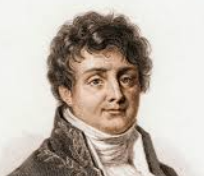
Joseph Fourier — Heat, Mathematics, and the First Vision of the Greenhouse Effect (1768–1830)
Jean-Baptiste Joseph Fourier was a French mathematician, physicist, and government administrator — born in Auxerre in 1768 to a tailor's family, orphaned at nine, educated by Benedictine monks, a prominent participant in the French Revolution, a governor of Lower Egypt under Napoleon, eventually a baron and permanent secretary of the French Academy of Sciences — who, in the interstices of a remarkable administrative career, produced work that changed the foundations of mathematical physics, gave science one of its most universally applied analytical tools, and first identified the phenomenon that we now call the greenhouse effect: the capacity of Earth's atmosphere to retain heat and warm the planet beyond what solar radiation alone would produce.
Today, virtually no branch of science, technology, or engineering is untouched by Fourier's methods. His name appears on the Eiffel Tower among France's greatest scientists. But his most consequential contribution — the greenhouse effect — is the one the world is still reckoning with, two centuries after he first posed the question.
His philosophical creed, stated with characteristic confidence: "There cannot be a language more universal and more simple, more free from errors and obscurities — mathematical analysis is as extensive as nature itself, and it defines all perceptible relations."
The Life — From Orphan to Baron
Fourier's life was as dramatic as his mathematics. Orphaned young and educated by monks, he was drawn to mathematics with an intensity that — according to tradition — led him to gather candle wax in order to make his own candles so he could study at night after the school went dark. He considered the priesthood but found the Revolution more compelling — played an active role in his local revolutionary committee, was briefly arrested in the Terror, survived to teach at the École Normale alongside Lagrange, Laplace, and Monge, and eventually succeeded Lagrange to the Chair of Analysis at the École Polytechnique.
When Napoleon organized the Egyptian expedition in 1798, Fourier went — as part of the Institut d'Égypte, the cultural and scientific organization Napoleon founded in Cairo partly to weaken British influence. He organized the workshops that supplied the French army, contributed mathematical papers to the Cairo Institute, and became governor of Lower Egypt. Cut off from France by the British fleet, he improvised, administered, and survived. After the French capitulation in 1801 he returned home and spent years as prefect of the Isère department in Grenoble — a capable administrator who simultaneously worked on the mathematical theory of heat that would eventually make him famous.
"Heat, like gravity, penetrates every substance of the universe, its rays occupy all parts of space. The theory of heat will hereafter form one of the most important branches of general physics."
The Analytical Theory of Heat — A New Mathematics for Physics
Fourier's "Théorie analytique de la chaleur" (1822) was one of the landmark works in the history of mathematical physics — and one of the most controversial. Its central mathematical claim — that any function of a variable, continuous or discontinuous, could be represented as a series of trigonometric functions — horrified the mathematical establishment. Lagrange, one of the giants of the era, found it incredible. The notion that a discontinuous function — one with sudden jumps in value — could be expressed as an infinite sum of smooth sine waves seemed paradoxical to mathematicians committed to elegant continuity.
Fourier's claim was essentially correct, though it required additional conditions to state precisely — conditions that subsequent mathematicians, including Dirichlet, worked out in the decades after the publication. What he had achieved was the insight that the complicated behavior of physical quantities — heat distributions, vibrations, any periodic phenomenon — could be broken down into simple harmonic components, analyzed separately, and recombined. This decomposition principle — Fourier analysis — became one of the most widely applied tools in all of science: used today in signal processing, quantum mechanics, medical imaging (CT and MRI scans), acoustics, optics, electrical engineering, and climate modeling.
Poincaré later described the Analytical Theory of Heat as "one of the first examples of the application of analysis to physics," calling Fourier's method "a model for all those who wish to cultivate any branch of mathematical physics." The committee that originally evaluated the work found it important but insufficiently rigorous — one of the more accurate but ultimately irrelevant institutional assessments in the history of science.
"Mathematical analysis is as extensive as nature itself, and it defines all perceptible relations. The profound study of nature is the most beautiful source of mathematical discoveries."
The Greenhouse Effect — The Question That Changed Everything
In the 1820s, Fourier posed a deceptively simple question: given the Earth's distance from the Sun and the amount of solar radiation it received, what should its average temperature be? When he calculated the answer, it was substantially colder than the planet actually was — by around 33 degrees Celsius. Something was providing additional heat. But what?
He examined various possibilities — including, incorrectly, radiation from interstellar space — but his most consequential observation was about the atmosphere. He referred to an experiment by de Saussure, who had built a device with multiple layers of glass that trapped sunlight: the interior compartments became significantly warmer than the outside air. Fourier noted that if gases in the atmosphere could form a similar insulating layer — transparent to incoming solar radiation but trapping the infrared heat radiated back from Earth's surface — they would produce exactly the kind of additional warming he was trying to explain.
This was the first articulation of what we now call the greenhouse effect — the first systematic attempt to understand why Earth was warmer than its distance from the Sun would predict, grounded in physical reasoning and mathematical calculation. Fourier did not have the tools to identify which specific gases produced the effect — that was Tyndall's achievement three decades later — and he did not use the term "greenhouse effect" himself. But the question he posed, the conceptual framework he offered, and the conclusion that Earth's atmosphere acted as an insulator were the foundation on which all subsequent climate science was built.
"Fourier's consideration of the possibility that the Earth's atmosphere might act as an insulator of some kind is widely recognized as the first proposal of what is now known as the greenhouse effect."
The Chain — Fourier to Tyndall to Arrhenius
Fourier's question initiated a chain of inquiry whose implications the nineteenth century only partially grasped and whose urgency the twenty-first century has fully realized. Tyndall's experimental work in the 1850s and 1860s — showing that water vapor and carbon dioxide absorbed infrared radiation far more strongly than oxygen or nitrogen — identified the specific mechanism Fourier had hypothesized. Arrhenius's calculations in 1896 extended this to quantify how changes in atmospheric carbon dioxide concentrations would affect global temperatures — the first numerical prediction of human-caused climate change.
The chain ran from Fourier's mathematical question through Tyndall's experimental identification of the mechanism to Arrhenius's quantitative prediction — and from there to the climate science of the twentieth and twenty-first centuries. Fourier's contribution was the beginning: the simple, precise, and unanswerable observation that the planet was warmer than it should be, and the first suggestion of why.
"Fourier was the first person to study the Earth's temperature from a mathematical perspective. He examined variations in temperature between day and night, and between summer and winter, and concluded that the planet was much warmer than a simple analysis might suggest."
The Death and the Obsession
Fourier's attraction to heat extended, according to his acquaintances, to his personal habits: he kept his rooms at extraordinary temperatures and was known to climb into saunas wrapped in multiple layers of clothing — a practice that some contemporaries felt may have contributed to the cardiac condition that killed him in 1830 at sixty-two. Whether true or embellished, the story has a fitting quality — the man who mathematized heat lived as if heat itself were his element.
He is buried at Père Lachaise Cemetery in Paris. His name is inscribed on the Eiffel Tower among the seventy-two scientists whose work made modern France.
"Fourier's theory of heat is one of the first examples of the application of analysis to physics. The results which he obtained are certainly interesting in themselves, but what is still more interesting is the method he used to arrive at them — and which will always be a model for all those who wish to cultivate any branch of mathematical physics."
— Henri Poincaré
Legacy — The Universal Tool and the Planetary Warning
Fourier's legacy divides between his mathematical contribution — the Fourier transform and Fourier analysis, which are genuinely among the most universally applied tools in the history of mathematics — and his climatological contribution — the first identification of the greenhouse effect — which is the more historically significant given where humanity finds itself two centuries later.
On CivSim he belongs alongside Tyndall, Arrhenius, and Darwin — scientists whose work identified the physical and biological realities that civilization must understand to navigate its own future. His greenhouse effect question is not merely a historical curiosity but the origin point of the most consequential scientific inquiry of the modern era — the recognition that atmospheric composition determines planetary temperature, that human activity alters atmospheric composition, and that these facts together constitute the defining challenge of the twenty-first century. Every climate scientist working today is, in a direct intellectual lineage, answering Fourier's question.
"There cannot be a language more universal and more simple, more free from errors and obscurities, more worthy to express the invariable relations of natural things. Mathematical analysis is as extensive as nature itself."
CivilSimian.com created by AxiomaticPanic, CivilSimian, Kalokagathia