
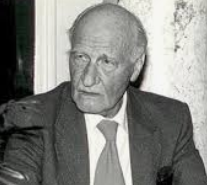
Josef Pieper — Leisure, Virtue, and the Defense of Contemplation Against Total Work (1904–1997)
Josef Pieper was a German Catholic philosopher — born in Westphalia in 1904, educated in philosophy, law, and sociology at Berlin and Münster, professor of philosophical anthropology at Münster from 1950 to 1976 and lecturer there until the age of ninety-two — who produced, over six decades of writing, some of the most accessible and most quietly radical philosophical work in the twentieth century Catholic tradition: a sustained defense of the contemplative life against the totalizing demands of work, a recovery of virtue ethics well before MacIntyre made it academically fashionable, and an argument that leisure was not idleness but the condition of genuine culture.
His "Leisure, the Basis of Culture" was published in 1948 — in a Germany rebuilding from rubble — with an English introduction by T.S. Eliot, and diagnosed the spiritual condition of modernity with a clarity that has lost none of its force. His four essays on the cardinal virtues anticipated by decades the virtue ethics revival associated with Anscombe and MacIntyre. His short essay on the abuse of language and the abuse of power is among the most precise analyses of propaganda ever written.
His central concern: that the modern tendency to define human beings by their labor — to measure worth by productivity, reduce life to function, and treat contemplation as waste — was not merely an economic error but a philosophical and spiritual catastrophe that severed humanity from the sources of genuine culture, genuine knowledge, and genuine happiness.
Leisure, the Basis of Culture — The Argument Against Total Work
Pieper's most famous work began from an observation that sounded counterintuitive in 1948 and has only become more urgent since: that the dominant ideology of modernity — the identification of human value with productive labor — was a form of barbarism, and that genuine culture required its opposite: leisure in the classical sense.
By leisure he did not mean idleness or entertainment — the passive consumption that modern society offered as a reward for work and that served primarily to restore workers for further work. He meant the ancient Greek skholē — the condition of being genuinely free from the compulsion to be useful, to produce, to justify one's existence through activity — in which the mind could encounter reality openly, receive the world as it was rather than process it as raw material for human projects. Leisure was the attitude of receptive openness to being from which philosophy, art, and genuine worship all sprang.
His diagnosis: modern totalitarian states — but also, more insidiously, modern liberal industrialism — had erected "total work" as the organizing principle of human life. The worker who was always working was not free; and a society that could not conceive of genuine leisure was a society that had lost contact with what made human life distinctly human. The feast, the festival, the philosophical conversation — all of these were forms of leisure that industrial society systematically devalued or eliminated.
"Leisure is not the attitude of mind of those who actively intervene, but of those who are open to everything: not of those who grab and grab hold, but of those who leave the reins loose and who are free and easy themselves — that is to say, not care-less, but care-free."
Acedia — The Refusal of Being
Pieper's analysis of acedia — traditionally translated as "sloth" but meaning something more precise and more interesting — was one of his most philosophically original contributions. Acedia, in his account, was not laziness but the sorrowful refusal to affirm the goodness of one's own existence — the withdrawal from the demands that being placed on the person, the preference for the safe non-existence of constant busyness over the risky openness of genuine leisure.
The paradox was that total work was itself a form of acedia: the person who was always busy was, in Pieper's analysis, fleeing from the encounter with being just as surely as the person who lay in bed all day. Both refused the receptive openness that genuine leisure required. Work could be a flight from self just as much as inaction — and a society organized around ceaseless productivity was a society organized around the flight from the deepest demands of existence.
"Acedia is the despair of weakness — not the refusal to do, but the refusal to affirm the goodness of one's own existence, the sorrow that being is as it is and not otherwise."
The Four Cardinal Virtues — Ethics Before MacIntyre
Pieper's work on virtue ethics — his four essays on prudence, justice, fortitude, and temperance, collected in "The Four Cardinal Virtues" — appeared well before the virtue ethics revival that Alasdair MacIntyre's "After Virtue" (1981) is usually credited with inaugurating. In accessible, precise prose, he recovered the classical and Thomistic account of the virtues not as rules to follow but as excellences to cultivate — qualities of character that constituted genuine human flourishing rather than mere rule compliance.
His treatment of prudence (phronēsis / prudentia) was particularly original: presenting it not as cautious circumspection but as the fundamental capacity to perceive what was really true in a given situation and act accordingly — the virtue of attunement to reality rather than the mere application of rules to cases. A person of genuine prudence saw clearly what was there and could therefore act appropriately — while a person who merely followed rules could be systematically deceived about the nature of the situation and therefore consistently wrong despite their rule-following.
His treatment of justice similarly went beyond the procedural to recover the sense in which justice was a form of giving each being its due — a recognition of what things were worth grounded in an accurate perception of reality — rather than a set of procedures for distributing resources.
"Virtue is the enhancement of the human being in a way befitting his nature — not the conformity of behavior to external rules but the becoming of what one genuinely is."
The Abuse of Language, the Abuse of Power — Philosophy as Sophistry's Enemy
Pieper's short essay "Abuse of Language, Abuse of Power" — a text of remarkable economy and clarity — identified a connection between philosophical integrity and political freedom that is as relevant today as when he wrote it.
His argument: genuine communication required the speaker to be oriented toward truth — to say what they believed to be true for the purpose of helping the listener understand reality. The sophist was someone who used language not to communicate truth but to produce effects: to manipulate, to flatter, to persuade through appearance rather than reality. The sophist was not necessarily lying — they were doing something in some ways more corrosive, using the form of truth-communication to achieve ends unconnected with truth.
The connection to power: the powerful could afford sophistry because they did not need to persuade through argument — they could enforce compliance through force. But when power chose to persuade through language, it could only maintain control through sophistry — through the production of appearances that served its interests. The philosopher, whose commitment was to truth rather than to power, was therefore structurally in tension with every form of propaganda.
"The person who has a purpose other than truth in communicating — who uses language to produce effects rather than to share what is real — has severed the connection between word and world that makes genuine human community possible."
Aquinas Without Thomism — The Philosophical Method
Pieper's relationship to Aquinas was distinctive and often misunderstood. He regarded Aquinas as the philosopher who had most clearly articulated the synthesis of Greek philosophy and Christian revelation — as a paradigm for what philosophical thinking could achieve — but he explicitly rejected "Thomism" as an ism, insisting that Thomism "cannot really exist" as a school or system to be followed.
His method was not the application of Thomistic doctrine to contemporary problems but the recovery of Aquinas's way of thinking — his orientation toward the real, his willingness to follow an argument wherever it led, his capacity to integrate Greek philosophy and Christian theology without subordinating either. Pieper was equally at home in Plato — Father Schall observed that "almost every book of Josef Pieper is, in some sense, a commentary on Plato" — and engaged seriously with Heidegger and Sartre even while maintaining his own philosophical tradition. Of Heidegger's language he wrote simply: "It was above all the language of this writer that I could not trust, nor, consequently, the writer himself."
"Pieper maintained that, in his efforts to think about creation, virtue, leisure, and the spiritual life, he remained a philosopher and did not become a theologian — and this distinction mattered to him deeply."
Legacy — The Quiet Radical
Pieper died in 1997 at ninety-three — having lectured at Münster until the previous year — and was mourned as one of the great Catholic philosophers of the century. His influence on Catholic intellectual life in the English-speaking world was significant: his Introduction to Political Philosophy, his Cardinal Virtues, and his Leisure became standard texts at Catholic institutions and attracted readers well beyond religious audiences. The introduction to "Leisure" by T.S. Eliot — perhaps the most distinguished literary endorsement a philosophical text received in the twentieth century — signaled that what Pieper was arguing was not a parochial Catholic concern but a diagnosis of modernity relevant to any thinking person.
His early publication in 1934 that found parallels between Catholic social teaching and Nazi social policy — written before the criminal character of the regime was fully visible — was the most difficult episode of his career; he recognized his mistake almost immediately, asked the publisher to cancel new editions, and in his writings from the same year was already warning against the "destructive counterattack of irrationalism" he saw in Germany. He was eventually banned from publishing by the Nazi regime — which was itself a form of testimony to where his philosophy led.
On CivSim he belongs alongside Maritain, Teresa of Avila, and G.K. Chesterton — Catholic thinkers who found in their tradition not a system of rules to follow but a way of perceiving the world that made visible things that secular modernity systematically missed. His argument about leisure and total work is directly relevant to Universal Humanism's commitment to the good life: a politics organized around necessity for all must have an account of what necessities are for — and Pieper's answer is that they are for leisure, for contemplation, for the encounter with reality that no productivity metric can measure or replace.
"The most acute and threatening crisis of our world is a crisis of leisure — not because we work too much, but because we have forgotten what work is for."
CivilSimian.com created by AxiomaticPanic, CivilSimian, Kalokagathia