
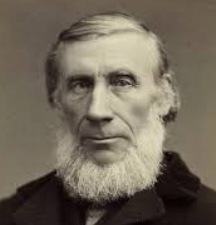
John Tyndall — The Belfast Address, Scientific Naturalism, and the Promise and Potency of Matter (1820–1893)
John Tyndall was an Irish experimental physicist and scientific popularizer — born in County Carlow in 1820 to a poor Protestant family, educated through sheer determination and financial sacrifice in Germany where he earned one of the new research PhDs at Marburg, appointed to a chair at the Royal Institution in London in 1853 where he succeeded Faraday in the role of public science lecturer, and transformed, in August 1874, into one of the most controversial figures in Victorian public life by a single two-hour address in Belfast's Ulster Hall that redrew the boundary between science and religion in ways that are still felt today.
A genuine scientist — his work on the greenhouse effect, the scattering of light in the atmosphere (the Tyndall effect), the germ theory of disease, and the properties of atmospheric gases made him a co-founder of what we now call climate science — and a passionate philosopher of science, he was also a mountaineer, a science communicator of unusual gifts, and a member of the X Club alongside T.H. Huxley and Herbert Spencer — the small private network that steered Victorian science toward institutional dominance and cultural authority.
His central concern: that science alone was competent to speak about the material world, that matter contained within itself the "promise and potency" of all life and mind, and that the authority of dogmatic religion over questions of cosmology, biology, and consciousness was both intellectually unjustified and socially harmful.
The Science — From Faraday to the Greenhouse Effect
Tyndall's scientific career was built on experimental physics of genuine distinction. His work on the thermal properties of gases in the late 1850s established that water vapor and carbon dioxide absorbed infrared radiation significantly more strongly than the major atmospheric components oxygen and nitrogen — the experimental basis for understanding what we now call the greenhouse effect. His 1859 paper on radiant heat and atmospheric gases was the foundational experimental work for the physical understanding of Earth's climate.
The Tyndall effect — the scattering of light by particles in colloid suspensions, which makes the beam of a searchlight visible in foggy air — bears his name. His work on bacterial contamination and the germ theory of disease, his extension and popularization of Pasteur's discoveries, his invention of the light pipe that anticipated modern fiber optics — all of these were genuine scientific contributions that would have sustained a significant scientific reputation even without the Belfast Address that overshadowed them.
"Tyndall was passionate and sensitive, quick to feel personal slights and to defend underdogs. Physically tough, he was a daring mountaineer. His greatest fame came from his activities as an advocate and interpreter of science."
The Belfast Address — Matter's Promise and Potency
On August 19, 1874, Tyndall delivered the presidential address to the annual meeting of the British Association for the Advancement of Science — the most prestigious platform in Victorian science — in Belfast, a city that was then, as he noted, a stronghold of religious belief. The address he gave was not what anyone expected.
He began with a history of scientific thought from the ancient Greeks — tracing the atomic tradition from Democritus through Lucretius, the development of natural philosophy through Galileo and Newton, and the emergence of evolutionary biology through Darwin — presenting it as a single continuous project of explaining natural phenomena through natural causes, progressively freeing inquiry from theological authority.
His central philosophical claim was measured but explosive: the physical universe contained, in matter itself, the "promise and potency" of all life, consciousness, and reason. This was not a claim that matter mechanically produced mind through simple addition — Tyndall was careful to acknowledge the "unfathomable mystery" of how physical processes gave rise to consciousness, calling it "the passage from the physics of the brain to the corresponding facts of consciousness" the hardest problem in philosophy. But it was a claim that this emergence was a natural process rooted in the properties of matter, not a miracle requiring supernatural intervention. Theology had no legitimate claim to speak on such questions — that domain belonged exclusively to science.
"We claim, and we shall wrest from theology, the entire domain of cosmological theory. All schemes and systems which thus infringe upon the domain of science must, in so far as they do this, submit to its control."
The Storm — Pulpits Thundering and Bishops Writing
The reaction was immediate and intense. The audience politely applauded — but the physicist Oliver Lodge recalled the atmosphere growing "more and more sulfurous." The following morning's editorials raised the alarm. Within days, newspapers nationwide were denouncing Tyndall's materialism. The Sunday after the address, Belfast's pulpits thundered against him. At the end of October, the Catholic Bishops of Ireland published a letter half as long as the address itself, condemning his metaphysics. Prominent Presbyterians organized a lecture series specifically to refute his philosophy. Anglican bishops, leading scientists who wanted to preserve a role for religious foundations in scientific work, and philosophers across the denominational spectrum all weighed in against him.
Tyndall's response was philosophically interesting — he strenuously denied that he was advocating atheism or crude materialism. He did not dismiss "the facts of religious feeling" — he regarded them, he said, as "certain as the facts of physics." What he objected to was the translation of subjective religious experience into fixed theological doctrines and the claim of those doctrines to authority over questions that science was competent to answer. Religious feeling was real; religious dogma was not knowledge. This was a careful distinction — but his critics, reading the address in the context of Victorian anxieties about materialism and atheism, were not inclined to honor it.
"I do not dismiss 'the facts of religious feeling.' I regard them as certain as the facts of physics. What I object to is their translation into fixed beliefs — the conversion of personal spiritual experience into dogmatic theological authority over questions that belong to science."
Transcendental Materialism — Between Mechanism and Mystery
Tyndall's philosophical position was more nuanced than either his supporters or his critics acknowledged. Historians of science have called it "transcendental materialism" — a term that captures the combination of a rigorous commitment to naturalistic explanation with an acknowledgment of genuine mystery at the boundaries of knowledge.
He was influenced by Carlyle's romanticism and Emerson's transcendentalism alongside German Naturphilosophie — which gave his materialism a different texture than the reductive mechanism his critics attributed to him. Matter, for Tyndall, was not dead mechanism but dynamic, creative, full of potentiality — almost pantheistic in its vitality, even as it operated through regular natural laws that admitted no supernatural exceptions.
The mystery of consciousness was real and acknowledged. He was among the earliest Victorian scientists to state clearly what is now called the hard problem of consciousness — that the explanatory gap between physical processes and subjective experience could not be bridged by any current scientific framework — while insisting that this gap did not justify theological explanations of mental life. The mystery was a challenge to further scientific inquiry, not a proof of the soul.
"The passage from the physics of the brain to the corresponding facts of consciousness is unthinkable — it is the most formidable fact of our existence. But it does not require theology to explain it: it requires more science, and more patience."
The X Club and the Professionalization of Science
Tyndall's philosophical interventions were part of a coordinated campaign — conducted through the X Club, the informal network he shared with T.H. Huxley, Herbert Spencer, Joseph Hooker, and others — to establish science's institutional independence and cultural authority in Victorian Britain.
The campaign involved popular lectures and essays, intervention in scientific institutions, advocacy for state funding of scientific research, and the systematic challenge to clerical authority over education and natural inquiry. Tyndall's gift for popular science communication — his lectures at the Royal Institution attracted fashionable London audiences who competed for tickets as they would for theatrical performances — made him one of the most effective popularizers in Victorian science. His essay collections "Fragments of Science" and "New Fragments" were widely read well beyond the scientific community.
"Tyndall's Presidential Address is in many ways more important than the Huxley/Wilberforce clash in 1860. Huxley was merely trying to secure a fair hearing for Darwin's theory. Tyndall was making sweeping claims for science as such — providing a complete materialistic explanation of the whole physical world and its origins."
Legacy — The Fault Lines That Still Run
Tyndall died in 1893 — accidentally poisoned by chloral hydrate, the medication he took for his chronic insomnia, administered in error by his devoted wife. The accident was grimly ironic for a man who had spent his career defending the rationality of the material world against those who sought supernatural explanations.
His scientific legacy has been substantially rehabilitated — his co-founding of climate science is now recognized as one of the most consequential contributions in the history of atmospheric physics, and the Tyndall Centre for Climate Change Research bears his name in acknowledgment. His philosophical legacy — the claim that science alone is competent to speak about the material world, that matter contains the "promise and potency" of life and mind, and that religious dogma has no authority over natural inquiry — has largely won the cultural battle he was fighting in 1874.
On CivSim he belongs alongside Huxley, Spencer, and Humphry Davy — the Victorian scientific naturalists who established science's institutional independence and cultural authority in the teeth of theological resistance. His specific contribution — the acknowledgment that the hard problem of consciousness is genuine and unresolved while insisting that it does not require supernatural explanation — is precisely the philosophical stance Universal Humanism needs: honest about what is not yet understood, rigorous about what follows from what is.
"The physical universe contains the promise and potency of all terrestrial life. I say this not as a materialist in the crude sense but as a man who knows that matter — rightly understood — is not the opposite of mystery but its ground."
CivilSimian.com created by AxiomaticPanic, CivilSimian, Kalokagathia