
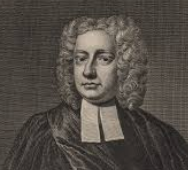
John Theophilus Desaguliers — Newton's Demonstrator, the Premier Grand Lodge, and the Popularization of Newtonian Science (1683–1744)
John Theophilus Desaguliers was a French-born British natural philosopher, clergyman, engineer, and freemason — born in La Rochelle on 12 March 1683, a few months after his father Jean Desaguliers, a Protestant minister, had been driven into exile as a Huguenot by Louis XIV's revocation of the Edict of Nantes. The infant was baptized Jean Théophile in La Rochelle's Protestant temple while his father was on Guernsey; mother and child then escaped to join the father, and in 1692 the family moved to London where Jean Desaguliers later set up a French school in Islington. He died in 1699. His son, now using the anglicized name John Theophilus, attended grammar school in Sutton Coldfield, entered Christ Church Oxford in 1705, graduated BA in 1709, and when his lecturer John Keill left Oxford, continued giving Keill's demonstrations of Newtonian natural philosophy at Hart Hall — the forerunner of Hertford College — on his own. He was twenty-six years old. He died on 29 February 1744 — a leap day — in London, a gentleman described in the press as "universally known and esteemed."
He was Newton's experimental assistant at the Royal Society from 1714. He received the Copley Medal — the Society's highest honor — three times (1734, 1736, 1741). He coined the terms "conductor" and "insulator" in his "Dissertation Concerning Electricity" (1742). He was the third Grand Master of the Premier Grand Lodge of England, founded 1717. He initiated Francis, Duke of Lorraine — later Holy Roman Emperor — into Freemasonry in 1731. He presided when Frederick, Prince of Wales became a Mason. He ventilated the Houses of Parliament. He improved the water supply of Edinburgh. He designed and supervised the fireworks for the first performance of Handel's Music for the Royal Fireworks. He lectured to royal families in English, French, and Latin. He wrote a poem arguing that the Newtonian solar system was the best model of constitutional government.
His central concern, pursued across science, engineering, Freemasonry, and poetry: that the universe revealed by Newton — orderly, law-governed, held together by mutual attraction — was not only philosophically true but the model for how human society should be organized.
The Huguenot Exile — Displacement as Formation
Desaguliers's Huguenot origins shaped everything about him. The Huguenots were French Protestants — a minority sustained by the Edict of Nantes until Louis XIV revoked it in 1685, driving approximately 400,000 Protestants into exile. The Desaguliers family was among them. The infant John was born in the last months of legal Huguenot existence in France — his father's exile and his own birth were simultaneous events. He grew up in a diaspora community that prized education, industry, and professional competence as the means of survival in a foreign country, that had reason to distrust arbitrary royal authority, and that was deeply embedded in the networks of Dissent and religious toleration that defined early Enlightenment Britain.
His intellectual trajectory — from Oxford Newtonian to Royal Society demonstrator to Freemason to public science lecturer — made sense within this formation. He was a man who needed to prove his worth in a society where he had no inherited position, and who found in Newtonian science, Freemasonry, and practical engineering the instruments through which an exile's son could become a gentleman universally known and esteemed.
"If one man sums up the vibrancy and intellectual ferment of Newtonian London, it is the Huguenot exile and pioneering scientist, John Theophilus Desaguliers — a key interlocutor of the early Enlightenment and many of its most important English manifestations: Newtonian science, the Royal Society, Freemasonry, Whiggish politics, practical engineering."
Newton's Demonstrator — Science Made Visible
When Isaac Newton elected Desaguliers to the Royal Society in 1714 as his experimental assistant, the appointment recognized a specific and unusual talent: the ability to design and conduct physical demonstrations that made the abstract principles of Newtonian mechanics immediately comprehensible to audiences without mathematical training. Newtonian physics was expressed in the language of calculus and geometry — accessible to a tiny educated elite. Desaguliers made it visible, tangible, and audible through carefully designed apparatus and precisely staged experiments.
He contributed over sixty articles to the Philosophical Transactions of the Royal Society. He taught 121 courses between his Oxford period and 1734, in English, French, and Latin, to audiences ranging from working craftsmen to royalty. His "Course of Experimental Philosophy" (1734–44) — two volumes published a decade apart — was translated into Dutch and French and remained one of the standard introductions to Newtonian mechanics for decades. He designed apparatus specifically for demonstration purposes — models of the solar system, hydraulic machines, electrical instruments — turning abstract principles into working physical systems that audiences could see in operation. After Newton's death in 1727, Desaguliers maintained the scientific character of the Royal Society's meetings, when the presidency passed to Hans Sloane and there was concern that the Society might drift from experimental science.
"He was a member of the Royal Society, and was presented with the Society's highest honour, the Copley Medal, no less than three times. He was a pioneering engineer: the water supply of Edinburgh, the ventilation of the Houses of Parliament and the first Westminster Bridge all owed him a debt."
Electricity — Conductor and Insulator
Desaguliers's most technically original scientific contribution was his work on electricity — a field still in its pre-systematic phase when he began working on it with Stephen Gray, who at one point lodged in the Desaguliers home. Gray had discovered electrical communication — the phenomenon by which electrical effects could be transmitted through certain materials over a distance — and Desaguliers followed this discovery with systematic investigation of which materials transmitted electricity and which did not. His "Dissertation Concerning Electricity" (1742) — which won a gold medal from the Bordeaux Academy of Sciences and the Copley Medal in 1741 — introduced the terms "conductor" and "insulator" (or "non-electric") into the scientific vocabulary. These terms remain in universal use. The distinction they captured was foundational to the subsequent development of electrical science by Franklin, Volta, and Faraday.
"Desaguliers's 'Dissertation Concerning Electricity' (1742), in which he coined the terms conductor and insulator, was awarded a gold medal by the Bordeaux Academy of Sciences."
Freemasonry — The Social Architecture of Enlightenment
Desaguliers's role in the early history of speculative Freemasonry was as significant as his role in natural philosophy — and he understood the two as related projects. The Premier Grand Lodge of England, founded on 24 June 1717 when four London lodges combined, was from its inception associated with the culture of Newtonian science, Whig politics, religious toleration, and the idea that rational, law-governed order was both the structure of the cosmos and the aspiration of human society. Desaguliers became the third Grand Master in 1719, worked with James Anderson to draft the "Constitutions of Freemasons" (1723) — the foundational document of modern speculative Masonry — and was active in establishing Masonic charity.
His most spectacular Masonic act was the initiation of Francis, Duke of Lorraine — later Holy Roman Emperor Francis I — during a lecture tour of the Netherlands in 1731. He also presided when Frederick, Prince of Wales became a Mason. The spread of Freemasonry through the aristocracy and royalty of Europe was in significant part Desaguliers's personal achievement — the product of his unique position as scientist, lecturer, and clergyman who moved freely between intellectual, court, and civic circles.
"Desaguliers is remembered as being instrumental in the early success of the newly formed Grand Lodge. During a lecture trip to the Netherlands in 1731, Desaguliers initiated into Freemasonry Francis, Duke of Lorraine, who later became Holy Roman Emperor."
The Newtonian System as Political Philosophy
Desaguliers's 1728 poem — "The Newtonian System of the World, the Best Model of Government: An Allegorical Poem" — was both a celebration of Newton's achievement and a political argument expressed through cosmological metaphor. The poem appeared the year after Newton's death, and the same year as Gay's Beggar's Opera — two radically different responses to the same political moment, both using art to make philosophical arguments about how government worked.
Desaguliers argued that the Newtonian solar system — in which each planet maintained its orbit through the balance of gravitational attraction and inertial motion, neither falling into the sun nor flying off into space — was the proper model for constitutional monarchy: sovereign power governed by law, planets moving freely within the constraints of mutual attraction, order maintained not by force alone but by the system's own inherent dynamics. The Hanoverian constitutional settlement — with its limitation of royal prerogative — was presented as the political embodiment of Newtonian order. The poem was dedicated to the Earl of Ilay and contained extensive annotations explaining the science for non-specialist readers.
"His Pow'r, coerced by Laws, still leaves them free" — Desaguliers on the planets' orbits and, by allegory, on constitutional government under Hanoverian settlement: the sovereign whose power is constrained by law but whose subjects remain free within that order.
Practical Engineering — Science Applied to Life
Desaguliers was an engineer as well as a theorist — unusual for a Fellow of the Royal Society in an era when natural philosophy was often considered too refined for practical application. He improved the ventilation of the Houses of Parliament, designing a wheel to remove stale air and creating a more efficient fireplace for the House of Lords. He contributed to the water supply of Edinburgh. He worked on the mechanics of steam engines — working with Thomas Savery on improvements to the atmospheric engine — and on hydraulic machinery. He designed the fireworks for the premiere of Handel's Music for the Royal Fireworks in Green Park in 1749 (which was still associated with him though performed after his death). His engineering work was the practical expression of his philosophical conviction that Newtonian science was not merely a description of the world but a tool for improving it.
"How he who taught two gracious kings to view All Boyle ennobled, and all Bacon knew" — James Cawthorn, inaccurately reporting Desaguliers's impoverished end while correctly identifying his achievement: the man who made Newton's universe visible to kings.
Legacy — The Connector of the Early Enlightenment
Desaguliers was the connecting tissue of the early British Enlightenment — the person who linked Newton to the public, Newtonian science to Freemasonry, Freemasonry to the European aristocracy, experimental philosophy to practical engineering, and all of these to the constitutional politics of the Hanoverian settlement. He was not the most original thinker of his age — his natural philosophy was expository rather than original — but he was among the most consequential, because the ideas he transmitted and the institutions he helped build shaped the intellectual and social culture of the eighteenth century far more than most of the period's original thinkers.
"A gentleman universally known and esteemed."
— The London press announcements of his death, 1744
CivilSimian.com created by AxiomaticPanic, CivilSimian, Kalokagathia