
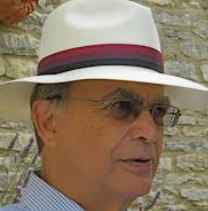
John L. Heilbron — The History of Physics, the Cathedrals as Observatories, and the Science of Institutions (1934–2023)
John L. Heilbron was an American historian of science whose more than twenty books — ranging across electricity in the early modern period, the quantum revolution, the biography of Galileo, Max Planck's moral compromises under the Nazi regime, and the astonishing role of cathedral floors as the most precise solar observatories of their age — made him the leading historian of the physical sciences of his generation, and one of the most important in the history of the discipline.
Kuhn's graduate student, Berkeley's Vice Chancellor, the founding director of its Office for History of Science and Technology, the editor of the Oxford Companion to the History of Science, and the winner of both the Pfizer Prize and the Sarton Medal — the two highest honors in his field — he combined prodigious archival range with a sharp eye for the human and institutional dimensions of scientific practice that no amount of purely internalist history could capture.
His central concern throughout his career: that science could not be understood from its ideas alone — that the institutions, personalities, patronage relationships, and social contexts within which scientific work was done were not merely the background to the history of ideas but part of the subject matter itself.
Electricity in the 17th and 18th Centuries — The Foundations of a Field
Heilbron's 1979 magnum opus on early modern electricity was received immediately as a landmark — a work whose 1,600-item bibliography, assembled before digital catalogues existed, covered virtually every significant text in the field in multiple European languages.
The book traced the rise of experimental physics as a recognizable intellectual enterprise — from the polymathic curiosity of the seventeenth century through the systematic quantification of the eighteenth — showing how electricity went from a cabinet curiosity to a science with theories, measurements, institutions, and practitioners. It demonstrated in exhaustive detail how university professors, Jesuit pedagogues, academicians, and public lecturers — often working independently across Europe — collectively built the experimental tradition that made Franklin's theoretical contributions possible.
The range and depth of the scholarship were remarked on even by other historians — one colleague called it "a barely believable triumph of textual and archival research." It set the standard for what a single-author history of a scientific field could achieve, and it has not been superseded.
"Heilbron understood institutions and how they channelled and sustained a scientist's work — the intersection of people, scientific ideas, and institutions was his domain."
— Cathryn Carson, UC Berkeley
The Sun in the Church — Cathedrals as Solar Observatories
Heilbron's most celebrated and most surprising work turned one of the standard narratives of Western intellectual history upside down. The conventional story of the relationship between the Catholic Church and the heliocentric revolution was one of conflict — Galileo's trial as the paradigm case of religious opposition to scientific truth. Heilbron's 1999 Pfizer Prize winner told a different story entirely.
From the sixteenth to the eighteenth century, the Church had a pressing practical problem: the reform of the calendar required precise astronomical measurements of the sun's motion that existing instruments could not provide. The solution, developed by a succession of Italian astronomers and clerics, was to use the cathedrals themselves as giant solar observatories — cutting holes in their roofs and laying meridian lines into their floors, creating instruments of extraordinary precision that tracked the sun's path with an accuracy unmatched by any purpose-built observatory of the period.
Heilbron documented this tradition across a dozen Italian cathedrals — including the Duomo in Florence and San Petronio in Bologna — showing that the Church had been not the enemy but in crucial respects a patron and institutional home of the astronomical work that eventually confirmed heliocentrism. The clerics who built these instruments were not despite their faith but partly because of their institutional needs among the most careful observers of the heavens in early modern Europe.
"Turning the narrative of hostility between religion and science on its head, Heilbron built an empirical case for how church clerics had contributed to the triumph of heliocentric theory — using cathedrals as the most precise solar instruments of their age."
Max Planck — The Dilemmas of an Upright Man
Heilbron's 1986 biography of Max Planck was one of the first serious accounts of a figure whose historical importance was unquestioned but whose moral record under the Nazi regime had been handled with delicacy bordering on evasion.
Planck had been the dominant figure in German physics for the first three decades of the twentieth century — the discoverer of the quantum of action, the president of the Kaiser Wilhelm Society, a man of genuine personal integrity and considerable moral courage who nonetheless remained in Germany throughout the Nazi period, accommodated the regime to the extent he believed necessary to preserve German science, and was used by the Nazis as a symbol of the continuity of German cultural achievement. His son was executed for his role in the attempt on Hitler's life in 1944.
Heilbron's title — "The Dilemmas of an Upright Man" — captured the book's approach: neither hagiography nor condemnation but the careful analysis of what it meant to be a person of genuine integrity navigating an institution under totalitarian pressure — and what the limits of integrity were when the institution was itself compromised. The book was a model of the kind of biography that took seriously both the science and the man.
"The student took seriously the teacher's demand that scholars consider the history of science as it really happened, rather than favouring the smoothed-out narratives that retrospection might bring."
Galileo — Finding Something New to Say
When Oxford University Press asked Heilbron to write a biography of Galileo, he accepted only after assuring himself that he could find something genuinely new to say about the most written-about scientist in the Western tradition. The 2010 biography showed he had been right to think he could.
Heilbron brought to Galileo the same institutional and contextual approach that had distinguished all his work — situating Galileo within the patronage system of Renaissance courts, the culture of learned dispute and demonstration, the economic pressures of a working mathematician-engineer, and the complex negotiations with church authorities that shaped his scientific publications as much as his observations. It was a Galileo rendered fully human — ambitious, strategic, sometimes reckless — rather than the heroic martyr of scientific freedom that the standard narrative preferred.
"Heilbron's Galileo is still a standard biography — and various historians have described it as 'the way to do it.'"
Kuhn's Student — But Not Kuhn's Disciple
Heilbron's intellectual formation was inseparable from Thomas Kuhn — he had been Kuhn's graduate student at Berkeley in the early 1960s, when Kuhn was writing "The Structure of Scientific Revolutions," and he worked with Kuhn on the Sources for History of Quantum Physics project, one of the most important archival undertakings in the history of the discipline.
But he did not follow Kuhn's philosophical tack. Heilbron was a historian, not a philosopher of science, and he shared Kuhn's insistence on the importance of context and community while declining the more abstract arguments about the nature of scientific change. He thought history was hard enough without engaging in abstract arguments about how science works — a characteristically dry observation that nonetheless marked a genuine intellectual choice. Where Kuhn's influence generated a generation of sociologists and philosophers of science wrestling with relativism, Heilbron's influence was more directly historical — archival, contextual, institutionally grounded.
"In his last phone call with Kuhn, his adviser told him to 'keep the faith' — a reaction against the relativistic ideology that had assailed historians of science, and which, against Kuhn's wishes, had been provoked by The Structure of Scientific Revolutions."
Legacy — The Historian Who Held the Whole Field in View
Heilbron died in Padua in November 2023 — in the same city where Galileo had made his first astronomical observations — having published his last book, "The Ghost of Galileo," in 2021. He was eighty-nine. His colleagues at Berkeley wrote that "like no other historian of physics of his era, he held the entire sweep of his field's history in view."
The range of his work is genuinely remarkable: from medieval astronomy to twentieth century big science, from Italian cathedral floors to German physics institutes, from the quantification of electricity to the moral biography of Planck — all of it done with the same archival thoroughness, the same eye for human and institutional complexity, and the same refusal to let the history of ideas float free of the people and institutions that produced them.
On CivSim he belongs alongside I. Bernard Cohen and Pierre Duhem — historians of science who understood that the history of human knowledge was not the progressive revelation of eternal truths but the contingent achievement of particular people in particular institutions at particular moments — and that understanding how it actually happened was both more honest and more instructive than the triumphalist narrative it usually replaced.
"His approach saw him investigating the influence of politics, personalities, and institutions on the emergence of new scientific ideas — science as it really happened, not the smoothed-out narrative that retrospection might bring."
CivilSimian.com created by AxiomaticPanic, CivilSimian, Kalokagathia