
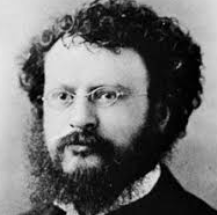
John Fiske — Cosmic Philosophy, Prolonged Infancy, and the Reconciliation of Evolution with Religion (1842–1901)
John Fiske — born Edmund Fisk Green in Hartford, Connecticut on 30 March 1842, who assumed his great-grandfather's name when his mother remarried in 1855 — was an American philosopher, historian, and public lecturer who became the most effective popularizer of evolutionary philosophy in the United States. A precocious child who doubted orthodox Christianity by his teens, he graduated from Harvard in 1863, passed the bar exam in 1864, briefly practiced law, lectured in philosophy and history at Harvard from 1869 to 1879, and spent the remaining decades of his life as a public lecturer and writer, delivering over 500 lectures on American history between 1888 and 1893 alone. He met Darwin, Spencer, and Huxley personally in London in 1873–74. Darwin wrote to him: "I never in my life read so lucid an expositor (and therefore thinker) as you are." He died on 4 July 1901 — Independence Day — in Gloucester, Massachusetts.
His major philosophical work was "Outlines of Cosmic Philosophy" (1874) — four volumes developing a synthesis of Spencer's evolutionary philosophy, Darwinian natural selection, Berkeleian idealism, and theistic religion — which he believed would eventually be seen to surpass Newton's Principia in significance. He was wrong about this, but not entirely wrong about the importance of the project: the reconciliation of evolution with religion was, and remains, one of the central problems of modern intellectual life, and Fiske addressed it with genuine philosophical seriousness.
His central concern: to demonstrate that the universe revealed by modern science — a universe governed by evolutionary law, without miraculous intervention — was not hostile to religion but was the fullest expression of it, and that evolution was not the enemy of human dignity but the mechanism through which it had been produced.
The Encounter with Spencer — A Philosophy for the Age
Fiske encountered Herbert Spencer's thought in 1860, while still an undergraduate at Harvard. Spencer was in the process of constructing his "Synthetic Philosophy" — the most ambitious attempt in Victorian thought to unify all knowledge under the principle of evolution, extending Darwin's natural selection from biology to psychology, sociology, ethics, and cosmology. For Fiske, who had already lost his Calvinist faith and was searching for a framework adequate to the scientific age, Spencer's philosophy was revelatory. He spent the rest of his intellectual life developing, applying, and publicly explaining it.
His "Outlines of Cosmic Philosophy" acknowledged this debt explicitly: Fiske called himself "a disciple and expositor of the philosophy of Herbert Spencer." But he was not merely a transcriber. Where Spencer was sometimes obscure, Fiske was luminous. Where Spencer was anti-religious, Fiske was reconciling. Where Spencer resisted what he called the "Unknowable" as simply unknowable, Fiske found in it the proper object of religious experience. Darwin's judgment — that Fiske was the most lucid expositor he had ever read — reflected a genuine quality: the ability to make difficult philosophical ideas accessible without distorting them.
"I never in my life read so lucid an expositor (and therefore thinker) as you are."
— Charles Darwin, letter to John Fiske, 1874
Cosmic Theism — Evolution as God's Method
The philosophical achievement Fiske claimed as his own was the reconciliation of evolutionary science with theistic religion. His argument was elegant and drew on multiple philosophical traditions. Following Spencer, he distinguished between the knowable — the regularities of phenomena that science could discover — and the Unknowable — the underlying power that manifested in phenomena. This Unknowable was not the Cartesian God of miracles and interventions, but the immanent power underlying all existence. Science described how phenomena behaved; religion addressed what they ultimately were. There was no contradiction because they operated on different levels.
Combining this with a modified Berkeleian idealism — the view that reality was fundamentally mental or spiritual rather than material — Fiske concluded that the Infinite Power underlying all phenomena was more properly characterized as quasi-psychical than as quasi-material. The universe was not a machine but a mind. And evolution was the process through which that mind progressively realized its potential through the development of conscious beings. "Evolution is God's way of doing things." The phrase was simple but philosophically defended: it was not a retreat from science but an interpretation of it that preserved what religion properly sought to express.
"What underlies and creates our experience — the 'Unknowable,' 'Deity,' 'Absolute Power' — is the only proper concern of religion, while the regularities discoverable among the phenomena in which Deity manifests itself are the scientist's laws of nature. Thus Fiske's 'cosmic theism' reconciles religion and science."
The Prolongation of Infancy — His Most Original Contribution
Fiske considered the prolongation of human infancy his most important and most original philosophical contribution — and it was genuinely significant. In "The Progress from Brute to Man" (1873), later incorporated into "Outlines of Cosmic Philosophy," he argued that the distinguishing characteristic of the human species was not brain size alone but the duration of infant helplessness. Human infants were helpless far longer than the young of any other species — requiring years of intensive parental care before becoming capable of independent existence.
This extended helplessness was not a deficiency but an evolutionary adaptation: it allowed the developing brain to accumulate experience and social learning before being required to function independently. It also had profound social consequences. The long period of infant care required stable family structures — not merely the momentary mating of most animals but sustained parental cooperation over years. The family was therefore not a cultural institution imposed on biological nature but a biological necessity produced by evolutionary pressure. And from the family — the first institution of sustained cooperation and altruism — grew all higher social organization. Prolonged infancy was the evolutionary basis of civilization itself.
Edward Morse, addressing the American Association at Buffalo in 1876, called this theory "one of the most important contributions yet made to the Doctrine of Evolution" and the first rational explanation of the origin and persistence of family bonds. Later scholars have credited Fiske's insight as anticipating aspects of modern developmental biology and evolutionary psychology.
"The prolonged infancy of Homo sapiens enables extended parental care and familial bonds, which cultivate altruism and inhibit savage instincts, gradually transforming human nature toward a state of universal brotherhood. Fiske believed this theory was his most important contribution to philosophy — and that it was the evolutionary basis of civilization itself."
The Destiny of Man — Progress Beyond Natural Selection
Fiske's 1884 "The Destiny of Man, Viewed in the Light of His Origin" extended his evolutionary philosophy in a direction unusual for the period: he argued that the decisive characteristic of human evolution was that social conditions had substantially diminished the operation of natural selection on the human species. In other animals, the unfit perished without descendants; in human societies, social organization — medicine, cooperation, care for the helpless — allowed the survival and reproduction of individuals who would have perished in a purely natural state. Fiske saw this as "a fact of unparalleled grandeur" — a sign not of degeneration but of transcendence.
The implication: the future of humanity was no longer primarily biological. Evolution would continue — but increasingly through cultural, moral, and social development rather than through the selective elimination of the unfit. The human species had, in a real sense, taken charge of its own development — and the direction of that development was toward increasing altruism, increasing social cooperation, and the progressive realization of the brotherhood of man that he identified with the core of Christianity.
"Man is slowly passing from a primitive social state in which he was little better than a brute, toward an ultimate social state in which his character shall have become so transformed that nothing of the brute can be detected in it."
— Fiske, The Destiny of Man (1884)
American History — Evolution Applied to Democracy
From around 1880, Fiske turned increasingly to American history, which he interpreted through his evolutionary framework as the climax of a long historical development toward representative democracy. He was a hugely popular lecturer on this subject — his talks on American colonial and revolutionary history drew large audiences across the country and in Britain. His "The Critical Period of American History" (1888) was a bestseller.
The interpretation embedded his genuine scholarship in an evolutionary teleology that was both compelling and ideologically convenient: American democracy was not merely a political arrangement but the most advanced stage yet reached in the political evolution of the human species. Anglo-Saxon institutional traditions — the town meeting, common law, federalism — were the highest expression of the tendency toward ordered liberty that evolution was progressively realizing. These views shaded into Anglo-Saxon supremacism that Fiske unfortunately shared with many late-Victorian thinkers — the belief in the racial superiority of Anglo-Saxon peoples that he derived from the same craniometric pseudo-science that Galton and Broca were producing. This is a genuine and serious mark against his legacy.
"Fiske attempted to show that religion and scientific knowledge could be reconciled, and became a popular lecturer promoting the concept of the United States as the climax of a historical evolution toward a free democratic republic. His Anglo-Saxon supremacism — derived from the craniometric pseudo-science of his era — is a serious limitation that honest engagement with his work must acknowledge."
Legacy — The Popularizer and His Limits
Fiske was among the most widely read and widely heard American public intellectuals of the last quarter of the nineteenth century. He brought evolutionary philosophy to audiences that would never have read Spencer or Huxley directly, and he did so with genuine philosophical care rather than mere vulgarization. His cosmic theism provided a framework through which thousands of educated Americans navigated the apparent conflict between the science they respected and the religious tradition they valued.
His philosophical reputation declined rapidly after his death — partly because his Spencerian framework fell out of fashion, partly because his historical writing was superseded by more rigorous scholarship, and partly because the Anglo-Saxon supremacism embedded in his work became, rightly, indefensible. His prolonged infancy theory remained genuinely valuable and has been vindicated by subsequent developmental biology. His project of reconciling evolutionary science with religious meaning remains as urgent as it was in 1874.
"Evolution is God's way of doing things."
— John Fiske's condensed cosmic philosophy
CivilSimian.com created by AxiomaticPanic, CivilSimian, Kalokagathia