
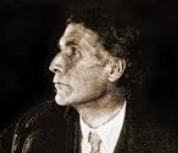
John Cowper Powys — Elemental Philosophy, the Imagination, and the Art of Solitude (1872–1963)
John Cowper Powys was an English-Welsh novelist, philosopher, poet, and lecturer whose enormous output — sixteen novels, half a dozen books of philosophy, a remarkable autobiography, thousands of letters, and thirty years of itinerant lectures across America — constitutes one of the most singular and most underread bodies of work in twentieth century English literature.
Descended through his mother from John Donne and William Cowper, profoundly shaped by Thomas Hardy and the Wessex landscape, and in his final decades immersed in Welsh mythology and history, he was a writer for whom landscape, mythology, and philosophy were not separate concerns but aspects of a single psycho-sensuous engagement with existence — what he called the ecstatic response to the natural world that he believed the trained imagination could sustain through the whole of a human life.
His central concern: that the grand philosophical systems of the tradition — too abstract, too moral, too pure-minded — offered little solace to actual human beings facing actual difficulty, and that what was needed was a practical philosophy of living — one that addressed the genuine texture of human experience with the same seriousness that religion had once brought and that secular modernity had abandoned without replacement.
The Novels — Wessex and Wales
Powys did not achieve recognition as a novelist until his late fifties — "Wolf Solent" (1929), his fifth novel, was the first to be acclaimed — and the four Wessex novels that followed ("A Glastonbury Romance," "Weymouth Sands," "Maiden Castle," and "Wolf Solent" itself) established him as one of the most original voices in English fiction.
The novels are marked by an unusual combination of qualities: dense psychological analysis of introspective characters who develop personal mythologies as their primary means of engagement with the world; extraordinarily sensuous evocation of landscape — the Dorset and Somerset of his childhood given a presence as powerful as any character; and an elemental philosophical vision in which the cosmos itself is felt as alive, resonant with forces and presences that resist reduction to the merely material.
"A Glastonbury Romance" — a thousand pages of collective mystical experience set in the town of Arthurian legend — is perhaps his most ambitious work, and among the most seriously strange novels in English: a book in which the Grail myth is not a literary device but a genuine metaphysical presence, in which the narrator is explicitly positioned as God or something like God, and in which the comic, the erotic, the mystical, and the political coexist with an abandon that no other English novelist of the century matched.
"I consider how my deepest impulses are neither exactly sadistic nor masochistic or mystical or theatrical or quite sane or quite mad, that there ought to be coined a completely new formula for what I am — and perhaps this is true for every separate living soul."
The Philosophy — Elementalism and the Psycho-Sensuous Life
Powys's philosophical works — "The Complex Vision," "A Philosophy of Solitude," "In Defence of Sensuality," "The Art of Growing Old" — were not academic philosophy and did not pretend to be. He described them as practical guides to happiness — and was entirely honest that they were written partly for money, partly for his American lecture audiences, and partly because he genuinely believed that the tradition of popular philosophy — from Epicurus to Montaigne to the Stoics — had something real to offer that academic philosophy had abandoned in its pursuit of rigor.
His philosophical position he sometimes called "elementalism" — a profound identification with the universe as it is, a response to the natural world that was neither the anthropomorphic projection of human desires onto nature nor the cold reduction of nature to mechanism, but something between — a sense of the cosmos as charged with significance that could be tapped by the trained imagination without requiring the theological framework that had once supported it.
The ecstatic response to landscape that Wordsworth described — the "spots of time," the intimations of immortality — Powys believed could be cultivated deliberately and retained into old age by anyone willing to practice the appropriate mental habits. This was philosophy as self-help in the original sense — not therapy for the distressed but instruction in how to live well.
"The grand metaphysicians of the past are too abstract and technical for simple minds to use — they provide no solace to those who have to work, suffer privation, insecurity, poverty, malice, jealousy, cruelty. Philosophy must address these concerns just as religion once did."
The Lectures — Thirty Years Across America
Before he was known as a novelist, Powys was known as a lecturer — one of the most extraordinary and most popular itinerant lecturers in America in the first three decades of the twentieth century. From 1905 to 1930 he barnstormed across the United States, lecturing on Hardy, Dickens, Dostoevsky, Rabelais, and the great figures of European literature with an intensity and personal identification that was less criticism than conjuration — he seemed to become the writers he discussed, channeling them for his audiences with the physicality and emotional abandon of a performer.
He wrote novels on trains and in hotel rooms, philosophical works on the road, kept an obsessive correspondence with readers and friends. The life of the itinerant lecturer — one of the more unusual modes of intellectual existence available in early twentieth century America — gave him an intimate knowledge of the country and its people that shaped his understanding of what philosophy needed to do for ordinary people facing ordinary difficulty.
"Powys describes A Philosophy of Solitude as 'a short textbook of the various mental tricks by which the human soul can obtain comparative happiness beneath the normal burden of human fate.'"
Wales — Return and Immersion
In 1935, in his early sixties, Powys fulfilled a long-cherished ideal by moving to Wales — first to Corwen in Denbighshire, then finally to Blaenau Ffestiniog — and spending the remaining three decades of his long life immersed in Welsh language, history, and mythology.
He learned Welsh, read the Mabinogion and the Welsh chronicles, befriended Welsh scholars and poets, and wrote the two works that his admirers consider his masterpieces: "Owen Glendower" (1941) — a vast historical novel about the last great Welsh revolt against English rule — and "Porius" (1951), set in a Wales of 499 AD, at the intersection of Roman, Celtic, and Christian civilization, and perhaps the most mythologically ambitious novel written in English in the twentieth century.
The late Welsh period produced in Powys what the best encounters between an outsider and a tradition sometimes produce — not assimilation but genuine mutual transformation. Wales gave him a depth of mythological resource that the Wessex landscapes could not provide; and he gave Wales the kind of sustained imaginative engagement that produced not tourist enthusiasm but something stranger and more lasting.
"Powys is a writer who changes how you see the world."
— Michael Henderson, The Telegraph
The Autobiography — Self-Portrait of an Extraordinary Mind
Powys's "Autobiography" of 1934 is one of the strangest and most revealing documents in the history of English self-writing — a work that John Gray called "mesmerisingly strange," showing Powys as "a kind of magical shape-shifter, eluding the reader — and perhaps himself — even as he engages the most reckless self-revelation."
He wrote about his sadistic and masochistic impulses, his sexual peculiarities, his ulcers and hypochondria, his mystical experiences and his philosophical speculations, with an honesty so excessive that it constituted its own form of privacy — no reader could be sure they were getting the truth rather than an elaborate performance of self-revelation. He said himself that he was not quite sane or quite mad, neither mystical nor theatrical, and that perhaps a new formula was needed for what he was.
The Autobiography is philosophical as much as personal — an extended inquiry into what a self actually is, how it relates to its past and its landscape, what the imagination can make of experience, and whether the ecstatic response to the world is a form of knowledge or a form of delusion — or both simultaneously.
"The cultivation of a psycho-sensuous philosophy is as important for the modern person as the Christian religion was for an earlier generation — and the imagination is the faculty through which it must be cultivated."
Legacy — The Underread Giant
Powys died in 1963 at ninety-one — having written into old age with undiminished energy — and his reputation has never recovered from the combination of critical neglect, the sheer length and difficulty of his major novels, and the cheerful eccentricity of his philosophical writings that made him difficult to place in any category.
He is widely regarded among those who know him as one of the genuinely great English novelists of the twentieth century — "A Glastonbury Romance" and "Porius" are works of an ambition and originality that no other English novelist of the period matched — while remaining almost unknown outside a devoted cult. His philosophical works are read by those who seek what he promised — practical wisdom rather than systematic theory — and find there a voice of unusual warmth, honesty, and philosophical seriousness that academic philosophy has largely been unable to provide.
On CivSim he belongs alongside Kazantzakis, Wilson, and Wendell Berry — thinkers who found in the particular and the sensuous — in landscape, in place, in the ecstatic response to the natural world — philosophical resources that abstract theory consistently undervalued. His claim that the imagination is a faculty of knowledge as real and as important as reason is not a romantic fantasy but a serious philosophical position that the tradition has not yet adequately engaged.
"The ecstasy of the young child before the mystery of the world — this need not be lost. The trained imagination can keep it alive through the whole of a human life."
CivilSimian.com created by AxiomaticPanic, CivilSimian, Kalokagathia