
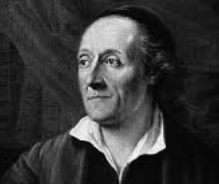
Johann Kaspar Lavater — Physiognomy, the Face of the Soul, and the Celebrity of a Bad Idea (1741–1801)
Johann Kaspar Lavater was a Swiss Protestant pastor, poet, theologian, and physiognomist whose four-volume "Physiognomic Fragments" made him one of the most famous and most widely read intellectuals in Europe in the final decades of the eighteenth century — celebrated by Goethe, annotated by William Blake, and admired across Germany, France, and England for a system of character-reading from facial features that was simultaneously philosophically interesting, empirically unsound, and morally dangerous.
A man of genuine personal warmth, deep religious conviction, and considerable literary talent — but also of spectacular intellectual overconfidence — he embodied the eighteenth century's characteristic willingness to dress theological preconceptions in the language of science and present the result as empirical discovery.
His central concern: that the divine could be read in the human face — that the inner soul left its mark on outer features in ways that the trained observer could decipher — and that this reading constituted both a science of humanity and a contribution to human knowledge and human love.
Physiognomic Fragments — The Science That Wasn't
Lavater's four-volume "Physiognomische Fragmente zur Beförderung der Menschenkenntnis und Menschenliebe" — "Physiognomic Fragments for the Promotion of Human Knowledge and Human Love" — published between 1775 and 1778, was one of the publishing sensations of the late eighteenth century. Translated into English, French, and multiple other languages, enriched with contributions from Goethe and Herder, illustrated with hundreds of engravings of faces, it proposed that the human character could be reliably read from the features of the human face — the forehead, the nose, the chin, the set of the eyes — through a systematic method of observation and inference.
The underlying premise was both theological and philosophical. Lavater believed that God had created human beings as unities of soul and body — that the inner character necessarily expressed itself in the outer form. A virtuous soul would produce noble features; a base character would leave its mark in debased ones. The face was the mirror of the soul — and the physiognomist, by learning to read that mirror, could achieve a knowledge of persons deeper than any conventional social interaction provided.
He distinguished his system from ancient physiognomy — claiming to focus on the individual rather than the general type, on the "lines of countenance" specific to each person rather than on racial or typological categories. In practice, the distinction was less clear than he claimed, and the system's application to social categories and racial types by subsequent enthusiasts demonstrated how easily physiognomical thinking slides from the individual to the collective.
"He alone is an acute observer who can observe minutely without being observed."
Goethe, Blake, and the Silhouette — The Cultural Reach
Lavater's physiognomic project attracted collaborators and admirers who were far more intellectually distinguished than the project warranted. Goethe worked with him on the Physiognomic Fragments — their friendship later severed by Lavater's religious zealotry — and contributed observations and interpretations to the text. Herder also contributed, though with more reservations.
In England, William Blake engraved the frontispiece for the English edition of Lavater's "Aphorisms on Man" in 1788 — and then covered his personal copy with over a hundred marginal annotations, engaging seriously with Lavater's ideas about inner virtue expressing itself in outward form, finding in it resonances with his own mystical vision of the human form divine. The collaboration between the physiognomist and the visionary poet is one of cultural history's odder pairings — and Blake's annotations are philosophically richer than Lavater's original text.
Lavater's work also catalyzed what he himself called "a golden age of silhouettes" — the fashion for profile portraits traced from shadows — since he believed the profile silhouette, capturing the precise line of the forehead, nose, and chin, provided the most accurate physiognomic data. Silhouettes became fashionable across Europe partly as physiognomic tools, carried by people who wanted their character reliably assessed or their friends reliably evaluated.
"Who in the same given time can produce more than others has vigor; who can produce more and better, has talents; who can produce what none else can, has genius."
The Critics — Lichtenberg, Kant, and the Empirical Objections
Not everyone was persuaded. Georg Christoph Lichtenberg — the physicist and aphorist, arguably the finest German wit of the era — mounted the most devastating contemporary critique. He distinguished physiognomy, Lavater's claim to read innate character from static facial features, from what he called pathognomy — the study of transient emotional expressions — which he regarded as somewhat more defensible but still severely limited.
Lichtenberg's objection cut to the philosophical core: external appearances were shaped not solely by inner disposition but by climate, illness, nutrition, occupation, and life circumstances. The face was not a transparent window to the soul but a surface shaped by a hundred contingent factors having nothing to do with character. More seriously, he warned of the social consequences — a society that accepted physiognomical method risked condemning people for the shape of their faces before they had committed any crime. The slide from character-reading to prejudice was not hypothetical.
Kant expressed skepticism in his "Anthropology from a Pragmatic Point of View" — more diplomatically than Lichtenberg but with similar philosophical reservations. Even Herder, who had contributed to the Fragments, grew more critical as the system's inconsistencies became apparent.
"Widespread acceptance of physiognomical methods could lead to miscarriages of justice — preemptively condemning children based on presumed facial indicators of vice before any crime occurs."
— Lichtenberg's warning about physiognomy's social dangers
The Mendelssohn Affair — Religious Zealotry and Its Limits
In 1769 Lavater sent Moses Mendelssohn a German translation of the Genevan philosopher Charles Bonnet's "Philosophical Palingenesis" — a work arguing for the truth of Christianity — along with a public demand that Mendelssohn either publicly refute Bonnet's arguments or convert to Christianity.
This was a spectacular miscalculation — philosophically, personally, and politically. Mendelssohn's response was measured and devastating: he refused to do either, pointing out that his principles forbade public controversy on religious questions, that he regarded the Lavater challenge as a form of coercion, and that a Jew who genuinely respected his own faith had no obligation to defend it to the satisfaction of Christian interlocutors. Prominent intellectuals across Germany — including Lichtenberg and Herder — sided with Mendelssohn. The affair ended as what one historian called "more of an embarrassment to Lavater" — his religious confidence had collided with both philosophical sophistication and simple human dignity, and the collision left him looking small.
The episode illuminates something about Lavater's character — his genuine personal warmth and his genuine religious conviction coexisted with an inability to recognize how his certainties appeared to those who did not share them. He was not a bigot in any simple sense; he genuinely believed he was offering Mendelssohn a gift of truth. But the gift was imposed without consent — which is a failure of the imagination that physiognomy's premise — that you can read a person's inner life without their participation — expresses in concentrated philosophical form.
"You are not very good if you are not better than your best friends imagine you to be."
The Theological Vision — God in the Face
Lavater was not merely or primarily a physiognomist — he was a deeply committed Protestant pastor whose physiognomy grew out of theological convictions about the relationship between soul and body, inner and outer.
His "Prospects into Eternity" and his devotional writings were widely read as religious literature — expressions of a Pietist Christianity that emphasized personal religious experience, direct encounter with the divine, and the insufficiency of merely rational religion. In this he belonged to the Counter-Enlightenment tradition alongside Hamann and Herder — insisting against Enlightenment rationalism that genuine knowledge of human beings required more than empirical observation and logical inference.
The tragedy of his intellectual career is that his theological instinct — that the inner person matters more than external appearance — was precisely inverted by his physiognomical method, which proposed to read the inner person through external appearance. The desire to see the soul was genuine; the method was its betrayal.
"God is what satisfies the needs of man — the Bible is historically true but it is to be interpreted subjectively, through the inner light that God has placed in every human heart."
Legacy — The Dangerous Popularity of Pseudoscience
Lavater died in January 1801 — shot the previous year by a French grenadier during the occupation of Zurich, dying eventually of his wound — having spent his final years watching his physiognomical reputation decline and his religious influence wane.
His legacy is uncomfortable in ways that deserve honest acknowledgment. Physiognomy was taken up in the nineteenth century as a pseudo-scientific foundation for racial classification, criminal anthropology, and the various systems of biological determinism that would reach their most terrible expression in the twentieth. Lavater did not intend this — his focus was always on the individual, his subtitle promised to promote human love — but the method's logic moved in that direction regardless of his intentions. The idea that inner character is written in outer form is extremely difficult to confine to benign uses.
On CivSim he stands as one of the catalogue's warning figures — alongside Ostanes and the pseudepigraphical tradition — a reminder that the desire to read what is hidden has generated some of the most seductive and most dangerous intellectual fashions in human history. The face is not transparent. The soul is not legible. And the confidence that one can read other people's inner lives from external signs — however warmly motivated — is a form of presumption that has caused serious harm.
"Physiognomy as Lavater practiced it was a science of the imagination — a systematic projection of what one wished to find onto the faces of those one observed. The tragedy is that the imagination projected real consequences onto real lives."
CivilSimian.com created by AxiomaticPanic, CivilSimian, Kalokagathia