
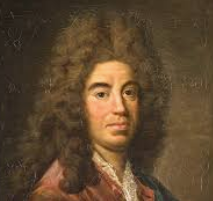
Jean de La Bruyère — Characters, Satire, and the Art of Moral Observation (1645–1696)
Jean de La Bruyère was a French philosopher, moralist, and satirist whose single major work — "Les Caractères" — is considered one of the masterpieces of French literature and one of the most penetrating studies of human vanity, social ambition, and moral failure ever produced in a European language.
A middle-class Parisian who spent twelve years as tutor and librarian in the household of the Prince de Condé at Chantilly — observing at close range the aristocratic world whose absurdities he anatomized — he published his "Characters" in 1688 and spent the eight years remaining to him expanding, revising, and defending it against the powerful enemies it inevitably created.
His central concern: that the moral failures of his society — vanity, flattery, ambition, the worship of wealth and rank — could be exposed and perhaps corrected by the sustained, precise, and unflinching observation of how people actually behaved, held up to the light of what they claimed to be.
Les Caractères — The Method and the Achievement
"Les Caractères" began as a translation of Theophrastus — the ancient Greek philosopher and successor to Aristotle who had produced thirty brief sketches of human character types. La Bruyère's translation, presented as a kind of appendix to Theophrastus's ancient originals, gradually overwhelmed its occasion — his own observations, reflections, and portraits expanded through eight editions during his lifetime into something wholly original.
The book defied easy classification then and defies it now. It combined the aphorism of Pascal, the maxim of La Rochefoucauld, the essay tradition of Montaigne, and the "portrait" — the elaborate literary picture of a specific individual's characteristics — into a form that had no precise antecedent and has not been exactly reproduced since. Organized into chapters on different aspects of social life — On Man, On Society and Conversation, On the Court, On the Great, On Merit, On Women, On Fashion — it moved without warning between a general reflection and a devastating personal sketch, between a philosophical observation and a comic set piece, between tender sympathy and withering contempt.
He acknowledged the debt to his predecessors with characteristic frankness: "Everything has been said long ago," he wrote at the beginning, "and we are too late to be born, for more than seven thousand years, people have been living and thinking. The harvest of the wisest and most beautiful observations on human morals has been removed, and we have only to pick up the ears left by the ancient philosophers and the wisest of our contemporaries." The self-deprecation was strategic — and false. What he produced was genuinely new.
"Everything has been said long ago, and we are too late to be born — for more than seven thousand years, people have been living and thinking on earth."
The Portrait — Vanity and Its Masks
La Bruyère's most celebrated technique was the portrait — a detailed sketch of a fictional character who was recognizably drawn from life, thinly disguised by a classical or invented name. These portraits were the source of his enormous success and his endless enemies — readers immediately began compiling "keys" identifying the real people behind the fictional names, and those who recognized themselves were understandably enraged.
La Bruyère denied that any portrait was of a single individual — insisting they were composites, types, not individuals. The denial may have been technically true and was certainly prudent. But the portraits worked precisely because their targets recognized themselves in them — because the observation was accurate enough to sting specific people while being general enough to describe many.
The recurring subject of the portraits was vanity in all its forms — the aristocrat who mistakes birth for merit, the climber who mistakes wealth for worth, the flatterer who mistakes compliance for wisdom, the wit who mistakes cleverness for depth. La Bruyère observed these figures with the patience of a naturalist and the precision of a surgeon — noting the exact gestures, the tell-tale phrases, the small self-betrayals by which people reveal what they most wish to conceal.
"The pleasure of criticizing robs us of the pleasure of being moved by some very fine things."
The Court of Louis XIV — Power and Its Performances
La Bruyère's years in the Condé household gave him access to the world of the French aristocracy at the height of Louis XIV's reign — a world of extraordinary wealth, elaborate ceremony, and systemic corruption, in which the cultivation of appearance had become the primary occupation of the ruling class.
His chapter on the court is one of the most penetrating accounts of how power corrupts the people who surround it — of how proximity to greatness generates not the virtue one might hope for but a kind of moral vertigo, in which all values are suspended and the only currency is the favor of the powerful. The courtier must learn to appear to be what the prince wishes him to be, not what he is — and the long practice of this performance eventually destroys the capacity for anything else.
This was not merely social satire but moral philosophy — La Bruyère was making a claim about what institutional power did to persons, about how social structures shaped and deformed the self. His observations anticipated by two centuries the sociological analysis of Simmel and Goffman — the detailed account of how social performance constitutes rather than merely expresses identity.
"Life at court is a serious, melancholy game which requires us to arrange our pieces and batteries, have a plan, follow it, foil that of our adversary, sometimes take risks and play on impulse."
On the Poor — The Uncomfortable Pages
Among the most striking passages in "Les Caractères" are those concerning the rural poor — passages that sit with uncomfortable force alongside the wit and satire of the rest.
La Bruyère described the French peasants with a bluntness that shocked his first readers and retains its power today — comparing them to animals, describing their labor and their wretchedness with the same unsparing observation he brought to the aristocratic vices of his courtly portraits. The point was not contempt but exposure — this was what the luxury and elegance of Versailles rested on, what it required, what it was made possible by.
The juxtaposition of aristocratic vanity and peasant misery was deliberate and philosophically serious — an implicit argument about the relationship between the social performances he anatomized in his portraits and the material conditions that made them possible. It was a critique embedded in observation rather than explicit argument — which is precisely the method of the "Characters" throughout.
"There are certain wild animals, male and female, scattered over the country, dark, livid, burned by the sun, attached to the earth which they dig and work with unconquerable stubbornness; they have something like an articulate voice, and when they stand upright they display a human face — and indeed they are human beings."
Style — The Right Word in the Right Place
La Bruyère's prose style was remarked on by his contemporaries and has been admired ever since — for its variety, its precision, its capacity to modulate without warning between the comic and the devastating, the general and the particular, the tender and the contemptuous.
He wrote with an immense and richly varied vocabulary — always seeking, in his own formulation, the one word that was exactly right rather than merely close. The "Characters" is not terse like Pascal or epigrammatic like La Rochefoucauld — it is more various, more given to portrait and scene, more willing to sacrifice philosophical compression for the vividness of a particular observation. Flaubert and the Goncourt brothers admired it; Stendhal read it for style. It was, in a precise sense, literary philosophy — philosophy that required the resources of literature to do what it was doing.
"Between all expressions which render one of our thoughts, there is but one which is the right one."
Legacy — The Single Book That Was Enough
La Bruyère died in 1696 at fifty — probably of a stroke — having spent his last years defending his book and expanding it through successive editions, inserting new portraits with each revision and watching his enemies compile keys to identify the victims. He was eventually elected to the French Academy in 1693 — on his fourth attempt, and only by a narrow margin — his enemies within it having done everything they could to keep him out.
He wrote one book. It was enough — more than enough — to secure him a permanent place in the history of moral philosophy and of French literature simultaneously. He belongs in the tradition of Theophrastus, Montaigne, and Pascal — the writers who took human nature seriously enough to observe it without illusion and to describe what they saw with sufficient precision to make the observation useful.
On CivSim he belongs alongside Montaigne and Timon of Athens — thinkers whose engagement with human moral failure was too direct and too specific to be comfortable, whose portraits made enemies precisely because they were accurate, and whose work endures because the vanities they described have not yet been corrected and show no signs of being so. His method — patient observation, precise description, and trust in the reader to draw the moral — is one of the most philosophically honest in the entire tradition.
"The majority of men devote their lives to making their lives miserable."
CivilSimian.com created by AxiomaticPanic, CivilSimian, Kalokagathia