
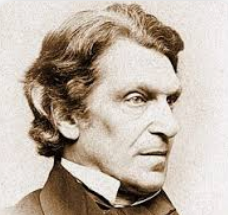
James Martineau — Conscience, Motive, and the Authority of Inner Life (1805–1900)
James Martineau was a British Unitarian minister, philosopher, and theologian who lived for ninety-five years and spent most of them in sustained, serious engagement with the deepest questions of ethics, religion, and the philosophy of mind — producing a body of work that placed him among the most respected religious philosophers of Victorian England.
Brother of the more famous Harriet Martineau — with whom he permanently broke over her embrace of positivism — trained as a minister but shaped more decisively by German idealism than by any theological tradition, he embodied the Victorian attempt to hold together religious faith and rational inquiry without capitulating to either orthodoxy or materialism.
His central concern: that the last appeal in all researches into religious truth must be to the judgment of the human mind — and that this appeal, honestly conducted, would vindicate neither dogmatic theology nor dogmatic atheism but something more nuanced, more personal, and ultimately more honest than either.
From Necessitarianism to Transcendentalism — A Philosophical Journey
Martineau began his intellectual life within the dominant framework of early nineteenth century Unitarianism — the associationist, necessitarian philosophy of David Hartley and Joseph Priestley, which held that mental events were entirely determined by prior causes through the mechanism of association, and that human freedom was an illusion.
He taught from James Mill and Thomas Brown as texts in his early years at Manchester New College — and found, increasingly, that he could not defend their positions. The necessitarian account of the mind seemed to him to undercut the very foundations of moral responsibility — if all my actions are the inevitable products of prior causes stretching back before my birth, what sense can be made of guilt, repentance, or moral growth? What could it mean to say that one ought to do otherwise than one inevitably does?
By 1839 he had concluded that necessitarianism was incompatible with anything recognizable as moral experience — and his subsequent philosophical development moved consistently toward an intuitionist, transcendentalist position that took the deliverances of consciousness seriously as evidence about the nature of reality, rather than as epiphenomena to be explained away. A year of study in Germany in 1848-49, encountering German idealism directly, confirmed and deepened this development — what he called, with characteristic seriousness, "a new intellectual birth."
"The last appeal in all researches into religious truth must be to the judgment of the human mind — not to external authority, not to the pronouncements of tradition, but to the living conscience that God has given to every human being."
Types of Ethical Theory — The Ethics of Motive
Martineau's most important philosophical work, published when he was eighty years old, was a comprehensive survey and critical assessment of the main types of ethical theory — from hedonism and utilitarianism through intuitionism and idealism — culminating in his own positive account of what moral philosophy required.
His central ethical conviction was that morality was fundamentally an ethics of motive rather than of action or consequence. What made an act right or wrong was not its outcomes — as utilitarianism held — nor its conformity to a rule — as Kantian deontology held — but the quality of the will or motive from which it sprang. The morally significant question was always: what moved this person to act? And the hierarchy of motives — from the lowest impulses of appetite and self-preservation through the higher motives of compassion and justice to the supreme motive of reverence for God — provided the structure of moral life.
He was not indifferent to consequences — he acknowledged that prudence and benevolence had to take outcomes seriously. But he insisted that the moral worth of an action was determined by the motive, not the outcome — and that a morality that evaluated actions solely by consequences had lost sight of the moral agent who was the proper subject of moral evaluation.
"The moral worth of an action is not in the success of its consequences but in the quality of the will that produced it — for it is the will, and not the world, that lies within the agent's power."
The Seat of Authority in Religion — Conscience Over Scripture
Martineau's most consequential theological work — and the one that defined his position in the Victorian religious landscape — was his sustained argument that the authority of religion rested ultimately in personal religious experience and conscience rather than in scripture, tradition, or ecclesiastical institution.
He argued that the Bible was not the word of God in the sense of an infallible external revelation — it was a record of human encounters with the divine, valuable and inspiring but requiring the individual's own conscience to discriminate between its higher and lower elements. The authority that validated religious belief was the inner light of consciousness — the direct, personal experience of moral and spiritual reality that no external institution could supply and no external authority could replace.
This was not mere subjectivism — Martineau was not saying that religious belief was merely personal preference. He was making a stronger claim: that the human mind, honestly employed, was capable of genuine religious knowledge, and that the deliverances of moral consciousness and religious experience had evidential weight that dogmatic theology had systematically undervalued.
"It is not in the pages of a book, however sacred, that the presence of God is most surely found — it is in the silence of the conscience that knows itself answerable to something beyond itself."
The Break with Harriet — Science, Religion, and Sibling Rivalry
The permanent estrangement between James and his more famous sister Harriet was one of Victorian intellectual life's more painful family ruptures — and it was directly philosophical in its origin.
In 1851 Harriet published, with Henry George Atkinson, "Letters on the Laws of Man's Nature and Development" — a work advocating a thoroughgoing materialist and atheist position. James responded in the Prospective Review with "Mesmeric Atheism" — a review that was both philosophically sharp and personally wounding, treating his sister's atheism as both intellectually confused and morally dangerous.
Harriet never forgave him. The two siblings — who had been close in childhood and had read the classics together as children in Norwich — were estranged for the rest of their lives, each representing a different response to the dominant philosophical pressures of the Victorian age. Harriet moved toward positivism and materialism, finding in the new sciences a sufficient account of human reality. James moved toward transcendentalism and idealism, finding in consciousness and conscience evidence that no materialist reduction could explain away.
"To maintain that God exists but that nothing can be known of him is to play with words — an unknown God is no God at all, and a religion built on unknowing is no religion."
Intuitionism, Free Will, and the Dignity of Consciousness
At the basis of all Martineau's constructive thought was his intuitionism — the view that we must accept as true certain deliverances of consciousness that give us directly information about the external world, the self, and morality.
He rejected the Kantian project of critical philosophy as generating excessive skepticism about the mind's capacities — arguing that neither Kant nor Hamilton nor Mill had given us genuine reason to distrust the basic intuitions of consciousness. The intuition of free will — the sense of oneself as a genuine agent capable of acting otherwise — was not a philosophical error to be dissolved but a datum to be taken seriously. The intuition of an external world, of other minds, of moral obligation — all these were trustworthy until adequate reasons for distrust were produced.
This was a philosophically defensible position that has been periodically rediscovered under various names — the epistemological approach of "innocent until proven guilty" toward common sense and intuition is more defensible than its critics have always acknowledged. Martineau's specific intuitionism was less technically developed than it could have been — but the underlying insight was sound.
"The sense of freedom — the conviction that I could have done otherwise — is not a philosophical error to be corrected. It is the very bedrock of moral life, and any philosophy that explains it away has explained away morality itself."
Legacy — The Ninety-Five Year Conversation
Martineau lived long enough to write his most important books after his eightieth birthday — "Types of Ethical Theory" at eighty, "A Study of Religion" at eighty-three, "The Seat of Authority in Religion" at eighty-five — a concentration of philosophical productivity in old age that has few parallels in the history of the discipline. He died in 1900 at ninety-five, having outlived most of the Victorian intellectual world that had formed him.
His reputation declined rapidly after his death — partly because the idealist tradition he represented was displaced by the analytic movement, partly because his prose was indeed florid and diffuse by modern standards, and partly because his theological commitments made him easy to dismiss by a philosophical culture that was rapidly secularizing.
What deserves preservation is his central ethical conviction — that morality is primarily an ethics of motive, that the moral quality of an action is located in the will that produces it, and that any ethics that loses sight of the agent in its attention to consequences or rules has missed something essential about what moral evaluation is for. This is a genuinely important position that holds up independently of the theological framework within which Martineau developed it.
On CivSim he sits alongside Joseph Butler and William Kingdon Clifford — thinkers who insisted on taking conscience seriously as moral data, who refused the reduction of ethics to calculation, and who found in the inner life of the moral agent resources that more externalist accounts of ethics consistently undervalue.
"No external authority — church, scripture, or tradition — can substitute for the living conscience of the individual who must answer for their own soul."
CivilSimian.com created by AxiomaticPanic, CivilSimian, Kalokagathia