
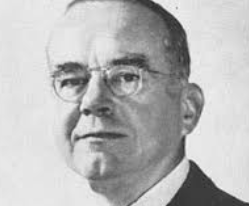
James Burnham — The Managerial Revolution, Power, and the Machiavellian Tradition (1905–1987)
James Burnham was an American philosopher and political theorist whose remarkable intellectual trajectory — from Princeton and Oxford through Trotskyism and into the conservative movement — produced in "The Managerial Revolution" (1941) one of the most influential and most discussed works of political sociology in the twentieth century, and whose analytical framework for understanding how power actually operates in modern societies continues to shape political thinking decades after his death.
A friend of Trotsky who broke with him in 1940, a Cold War strategist who called for rollback rather than containment, an editor at National Review who was simultaneously too pessimistic for most conservatives and too power-focused for most liberals — he was one of those thinkers whose central insight was more important than any of his particular positions, and whose influence spread through channels he would not always have chosen.
His central concern: that in modern industrial society, genuine political and economic power had migrated from the owners of capital to a new class of managers, executives, technicians, and administrators — and that this migration was reshaping capitalism, socialism, and democracy in ways that neither left nor right had yet adequately understood.
The Managerial Revolution — The Central Thesis
Burnham's 1941 masterwork began from an observation about the modern corporation that Berle and Means had documented in their 1932 study of American business: that ownership and control had become separated. In the large modern corporation, the shareholders nominally owned the enterprise but the managers actually ran it — and the managers, not the shareholders, made the decisions that determined what the enterprise was and did.
Burnham extended this observation into a general theory of twentieth century social development. Capitalism, he argued, was not being replaced by socialism — the Marxist prediction was wrong. It was being replaced by a new kind of society in which the managers had become the ruling class — not because they owned the means of production but because they controlled them. The real owners — shareholders, in the corporate context; citizens, in the democratic context — were being displaced by those who possessed the technical knowledge and organizational capacity to run modern institutions.
This was happening simultaneously in capitalist democracies, in Nazi Germany, and in the Soviet Union — which were, beneath their ideological differences, converging on a similar social structure in which a managerial elite ruled through control of the state and of the major productive institutions. The ideology differed; the underlying social reality was similar.
"It is a historical law, with no apparent exceptions so far known, that all social and economic groups of any size strive to improve their relative position with respect to power and privilege in society."
Orwell's Response — The Book That Inspired 1984
Burnham's thesis had an immediate and consequential reader in George Orwell — who wrote two extended essays on Burnham and drew on his analysis in constructing the world of "Nineteen Eighty-Four." The three world-states of Orwell's novel — Oceania, Eurasia, and Eastasia — are direct developments of Burnham's prediction that three great managerial super-states would emerge from the collapse of the old capitalist world order. The Inner Party of Oceania is the managerial class given its ultimate expression. O'Brien's philosophy of power for its own sake is Burnham's analysis of the managerial impulse taken to its logical conclusion.
Orwell both agreed with and criticized Burnham — agreeing that something like the managerial revolution was occurring, but criticizing what he called Burnham's "power worship," his tendency to assume that any system in the ascendant was invincible and that democratic resistance was futile. Orwell wrote that Burnham was unable to imagine a world in which current trends were discontinued — a failure of the historical imagination that made him simultaneously insightful about structure and systematically wrong about outcomes.
"Capitalism is disappearing, but Socialism is not replacing it. What is now arising is a new kind of planned, centralized society which will be neither capitalist nor democratic. The rulers of this new society will be the people who effectively control the means of production."
The Machiavellians — Power Without Illusions
Burnham's 1943 follow-up examined the tradition of political realism — Machiavelli, Mosca, Pareto, Michels, and Sorel — as the most honest and most useful approach to understanding how political power actually works.
He argued that the Machiavellian tradition, which he subtitled "Defenders of Freedom," was paradoxically the most reliable defense of liberty — not because it valued liberty in the abstract but because it understood power realistically enough to know that concentrated power was always dangerous, that ruling classes always sought to perpetuate themselves, and that institutional checks on power were therefore the only practical safeguard of freedom. The naive idealist who believed in the goodness of rulers was more dangerous to liberty than the cynical realist who understood their actual motivations.
He distinguished between the "formal" meaning of political texts — their ostensible content, their stated purposes — and their "real" meaning — what they actually served, what interests they expressed, what power they consolidated. Political ideologies were always, in significant part, rationalizations of power interest — not therefore useless, but always requiring the kind of unsentimental reading that the Machiavellian tradition had developed.
"The real meaning of texts and political doctrines is often disguised in their formal meaning — to understand what is happening, one must ask: whose interest does this serve?"
The Break with Trotsky — and with Marxism
Burnham's break with Trotsky in 1940 was one of the more philosophically serious political divorces of the period — documented in extended written exchanges that both parties published and that illuminate the genuine philosophical differences between them.
Burnham had already concluded, before the break, that the Soviet Union was not a workers' state in any meaningful sense but a new form of bureaucratic class rule — a conclusion Trotsky refused to accept. The Nazi-Soviet Pact and the Soviet invasion of Finland were the political triggers, but the underlying disagreement was about the nature of historical change — whether socialist revolution remained possible, whether the working class could be a vehicle of liberation, whether Marxist categories were adequate to what was actually happening in the modern world.
Burnham concluded they were not — and that conclusion, rather than a conversion to conservatism, was the starting point of everything that followed. His trajectory from Trotskyism to the right was propelled not by a change in values but by a consistent application of his analytical method to the evidence that Marxism could not account for.
"The Russian workers' state is a myth — what exists is a new ruling class that uses the language of socialism to legitimize a structure of power indistinguishable in essentials from what it claimed to replace."
Suicide of the West — Liberalism as Ideology
Burnham's 1964 book — his most conservative and most polemical work — argued that liberalism had become the dominant ideology of the managerial class, and that its characteristic pathologies — guilt about Western civilization, reluctance to defend it, systematic self-doubt — constituted a form of civilizational self-destruction.
He saw liberalism not as a coherent political philosophy but as a syndrome — a cluster of attitudes and emotional dispositions that, taken together, systematically undermined the willingness to defend the institutions and civilization from which they had emerged. The liberal who insisted on seeing both sides of every conflict in which Western civilization was engaged was, in Burnham's analysis, performing exactly the kind of moral self-disarmament that the enemies of that civilization required.
The book was widely read on the right as a foundational text — and widely criticized for the racial dimensions of its analysis, which reflected assumptions that subsequent decades did not sustain. The central argument about ideological self-undermining remains discussed; the specific content requires substantial qualification.
"Liberalism is the ideology of Western suicide — not by external conquest but by the systematic erosion of the will to defend what has been built."
Legacy — The Analyst Who Was Right About Structure
Burnham's specific predictions were mostly wrong — the Axis did not win World War II, the Soviet Union was not invincible, and capitalism was not replaced by a managerial superstate in the form he described. But his structural analysis — that the separation of ownership and control had created a new ruling class defined by institutional position rather than property ownership — has proved more durable.
The concept of the "managerial class" has been appropriated by thinkers across the political spectrum — by Milovan Djilas in his analysis of the Soviet "New Class," by C. Wright Mills in "The Power Elite," by contemporary analysts of professional-managerial elites — each finding in Burnham's framework tools for understanding forms of elite power that neither classical Marxism nor liberal theory had adequately theorized.
On CivSim he belongs alongside Pareto, Aron, and Revel — political thinkers who approached power with unsentimental realism, who refused to allow ideological preference to determine what they saw, and who paid the price of being taken seriously by neither side while being read carefully by both. His insight that modern power is primarily organizational rather than proprietary — that it flows from control of institutions rather than ownership of assets — is as relevant in 2026 as it was in 1941.
"Whether ownership is corporate and private or statist and governmental, the essential demarcation between the ruling elite and the mass is not ownership so much as control of the means of production — and the managers control."
CivilSimian.com created by AxiomaticPanic, CivilSimian, Kalokagathia