
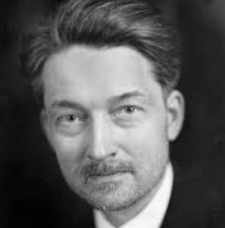
Jacques Maritain — Thomism, Personalism, and the Philosophical Foundation of Human Rights (1882–1973)
Jacques Maritain was a French Catholic philosopher and theologian whose more than sixty books made him the most influential Thomist of the twentieth century — the philosopher who more than any other translated the thought of Thomas Aquinas into terms that could engage modern philosophy, modern politics, and the emerging language of human rights.
A man who began at the Sorbonne on the verge of suicide — searching with his future wife Raïssa for some answer to the apparent meaninglessness of life — and found it through Bergson, then through Léon Bloy, then through conversion to Catholicism and immersion in Aquinas — he spent the rest of his long life developing a philosophical anthropology grounded in the dignity of the person and a political philosophy grounded in natural law and democratic pluralism.
His central concern: that the human person — not the individual of liberal theory, not the collective of socialist theory, but the person in the full Thomistic sense of a being open to the transcendent — was the foundation of both moral philosophy and political legitimacy, and that a civilization adequate to this person required both the protection of rights and the cultivation of the common good.
The Conversion and the Thomistic Foundation
Maritain's philosophical trajectory was decisively shaped by his personal history in ways that were inseparable from his philosophical conclusions. He and Raïssa had made a pact at the Sorbonne to commit suicide within a year if they found no adequate response to the spiritual aridity and intellectual meaninglessness they experienced in French positivist culture. Bergson's lectures offered a first reprieve — demonstrating that positivism was not the only option — and Léon Bloy's fiercely Catholic literary personality drew them toward a conversion they completed in 1906.
The encounter with Aquinas transformed this religious commitment into philosophical vocation. Maritain found in Thomism not the stale scholasticism of seminary textbooks but a living metaphysical tradition that could engage modern philosophy on its own terms while grounding it in a richer account of being, knowledge, and the human person than modernity had managed to provide. His task became the renovation of Thomism — not its repetition but its creative development in dialogue with the genuine achievements and genuine failures of modern thought.
"The philosophy of Aristotle, as revived and enriched by Thomas Aquinas, is proposed here for the reader's acceptance not because it is Christian, but because it is demonstrably true. Its agreement with the dogmas of revelation is an external sign of its truth — but from its own rational evidence, it derives its authority as a philosophy."
Person and Individual — The Thomistic Distinction
Central to Maritain's philosophical anthropology was a distinction between the individual and the person — a distinction that grounded both his critique of liberal individualism and his critique of collectivism.
As an individual, the human being was part of the material world — a particular instance of a species, subject to the laws of nature, dependent on society, a component of the social whole. As a person, the human being was something different — a being with a spiritual soul, an interior life, an orientation toward transcendent goods that exceeded what any society could provide or demand. The person had a dignity that no collective — not the state, not the church, not the nation — could legitimately override.
This distinction enabled Maritain to defend human rights against both liberal individualism, which grounded them in autonomy, and collectivism, which dissolved them in the common good. Rights belonged to persons — not because persons were self-sufficient atoms but because they were oriented toward transcendent goods that required protection from social absorption. The common good was real and important — but it was the common good of persons, not a substitute for them.
"The people are the very substance, the living and free substance, of the body politic. The people are above the State — the people are not for the State, the State is for the people."
Natural Law and the Universal Declaration of Human Rights
Maritain's most consequential practical contribution was his role in the philosophical grounding of the Universal Declaration of Human Rights (1948) — the most important document in the history of international human rights law.
He served on the UNESCO committee that laid the intellectual groundwork for the Declaration — and his approach there was characteristically shrewd. He recognized that the delegates from different nations, different religions, and different philosophical traditions could not agree on a common philosophical foundation for human rights — but they could agree on the rights themselves. Practical agreement was possible where theoretical agreement was not — and the Declaration should rest on that practical agreement rather than on any single philosophical tradition's account of its grounds.
This pragmatic pluralism was philosophically innovative and anticipated Rawls's later concept of overlapping consensus — the idea that a just society could be grounded in principles that people with different comprehensive doctrines could accept for different reasons. Maritain's own reasons were Thomistic — natural law grounded in human nature as understood in light of God — but he was willing to work alongside people whose reasons were entirely different.
"We agree on these rights, provided we are not asked why. With the 'why' the dispute begins."
Integral Humanism — Christianity and Democracy
Maritain's political philosophy, developed above all in "Integral Humanism" (1936) and "Man and the State" (1951), proposed a form of Christian democracy that was neither theocracy nor mere secular liberalism.
He argued that Christianity could not be made subservient to any political form — that the Church's authority was in the order of eternal life, above the order of temporal politics — but also that a healthy temporal order required the moral and spiritual values that Christianity had historically fostered. Democratic pluralism was not the enemy of Christianity but the political form most adequate to the dignity of the person.
He had broken with the "Action Française" movement in 1926 when it was condemned by the Pope for its nationalistic and anti-democratic tendencies — a decisive political choice that shaped everything that followed. The Catholic intellectual who might have provided philosophical legitimacy to French fascism instead became one of the most important Catholic voices for democracy, pluralism, and human rights.
"Democracy is linked to Christianity — not because it is the only form of government that Christians may accept, but because it is the form most consonant with the dignity that Christianity recognizes in every human person."
The Degrees of Knowledge — Epistemology and Mysticism
Maritain's epistemological masterwork, "The Degrees of Knowledge" (1932), was his most technically ambitious philosophical contribution — a systematic account of the different kinds and levels of human knowing, from empirical science through philosophy and metaphysics to theology and mystical experience.
He argued that different modes of knowing had their own proper objects, methods, and levels of certainty — and that the conflicts between science, philosophy, and theology were largely the result of different modes of knowing claiming authority over questions that properly belonged to others. Science should not claim to answer metaphysical questions; metaphysics should not claim to do empirical science; theology should not override the conclusions of natural reason. Each had its proper domain — and together they constituted the full range of human cognitive achievement.
The work also engaged with mysticism — arguing that contemplative experience constituted a genuine form of knowledge of God that philosophy alone could not achieve, and that the Carmelite tradition in particular provided the most adequate account of the mystical life. His later engagement with Raïssa's own mystical experience made this more than an academic exercise.
"Philosophy and science and theology are not rivals — they are different modes of knowing whose proper relationship is not competition but cooperation, each illuminating from its own level what the others can only partially see."
Legacy — The Philosopher Between Worlds
Maritain's influence was enormous and is difficult to categorize — he was too conservative for secular liberals, too liberal for Catholic traditionalists, too philosophical for practitioners, and too political for pure philosophers. One can say that he would be considered by present-day liberals as too conservative, and by many conservatives as too liberal. This position between worlds is often a mark of genuine originality — the thinker who does not fit cleanly into existing categories is usually the one who is addressing questions that those categories were not designed to handle.
His influence on the Universal Declaration of Human Rights, on the Second Vatican Council's declaration on religious freedom, and on Catholic social thought more broadly constitutes a genuine contribution to the political history of the twentieth century — not merely to the history of philosophy. The Catholic human rights tradition that helped shape Christian Democratic parties across Europe and Latin America owed a substantial debt to the conceptual framework he developed.
On CivSim he belongs alongside Dworkin, Thomas Aquinas, and Rosa Luxemburg — thinkers who believed that rights were real and that their reality required serious philosophical grounding, not merely political assertion. His personalism — the insistence that the human person in its full spiritual and material reality was the foundation of all legitimate political order — connects directly to Universal Humanism's core commitments to preservation of life and necessity for all.
"Man is a reality which, subsisting spiritually, constitutes a universe unto itself, relatively independent within the great whole of the universe and facing the transcendent Whole which is God. This dignity of the person is the foundation of all rights."
CivilSimian.com created by AxiomaticPanic, CivilSimian, Kalokagathia