
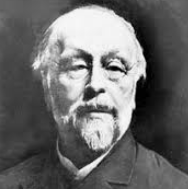
Hippolyte Taine — Race, Milieu, Moment, and the Science of Culture (1828–1893)
Hippolyte Taine was a French historian, critic, and philosopher whose ambition to place the study of literature, art, and history on the same scientific footing as the natural sciences produced the most influential and most contested critical method of nineteenth century France — the triad of race, milieu, and moment — and made him the chief theoretical influence on French naturalism, the founder of literary historicism as a critical movement, and one of the architects of the modern discipline of the history of ideas.
Failed in his agrégation examination for refusing to embrace the fashionable philosophical eclecticism of Victor Cousin, praised by Nietzsche as "the first of living historians," cited by Kropotkin as the one writer who truly understood the French Revolution because he had counted three hundred outbreaks before July 14, and condemned posthumously as the architect of French right-wing historiography — he was, throughout his career, a figure who generated controversy proportionate to his influence.
His central concern: that the great cultural products of any civilization — its literature, its art, its philosophy — were not the spontaneous creations of isolated genius but the determined products of identifiable causes, and that the task of the critic and historian was to identify those causes with the same precision that a chemist identified the components of a compound.
Race, Milieu, Moment — The Critical Triad
Taine's most famous contribution to intellectual history was his systematic articulation of three conditioning factors behind any cultural product — stated most clearly in the celebrated "Introduction" to his "History of English Literature" (1864), which became the foundational text of literary historicism.
By "race" he did not mean race in the modern biological sense — he meant the collective cultural dispositions, the inherited temperament and sensibility, that persisted in a people across generations: the accumulation of psychological and moral tendencies that a person absorbed from their culture of origin without conscious awareness. By "milieu" he meant the particular circumstances — social, political, geographical, economic — that modified or developed these inherited dispositions in the individual. By "moment" he meant the momentum of accumulated cultural tradition — the spirit of the age, what later thinkers would call Zeitgeist — the particular intellectual and aesthetic configuration into which an artist was born.
Together, these three factors could in principle explain any cultural product — any poem, painting, philosophical system, or historical event — by reducing it to the interaction of identifiable causes. Every reality, Taine claimed, could be reduced to a formula by discovering its single operative principle — its "faculté maîtresse," the predominant characteristic that determined everything else about it.
"Vice and virtue are products like vitriol and sugar — given the same data, the physicist produces the same substance. Let us take facts for what they are worth and learn from them."
The History of English Literature — Determinism Applied
Taine's most influential work was his five-volume "History of English Literature" — not, despite its title, primarily a work of literary criticism but a sustained exercise in cultural history, using English literature as a window into the English national character and its historical formation.
His analysis was sweeping and impressionistic — moving across centuries with an energy and confidence that later scholarship would find excessive — but it demonstrated what the method could do when applied by a critic of genuine intelligence and learning. The portrait of Shakespeare that emerged from his analysis was shaped by Taine's account of the violence and passion of the English national temperament as he understood it — a reading that subsequent critics found reductive but that had the virtue of connecting the literary texts to the social and historical world in ways that "pure" literary criticism could not.
The "Introduction" to this work became the most read and most discussed statement of the historicist method in literary study — translated into multiple languages, influential on literary scholars across Europe, and foundational for the tradition of contextual criticism that continued through the twentieth century into what would eventually be called New Historicism.
"The same great causal factors underlie any cultural artifact of a given age and society — by studying the literary documents, one may understand the psychology of their author, which in turn can be explained by reference to race, milieu, and moment."
The Origins of Contemporary France — Revolution and Its Aftermath
The Franco-Prussian War of 1870 and the Paris Commune shattered whatever remaining optimism Taine had carried from his earlier positivist confidence in historical progress. He spent the last two decades of his life on his massive "Origins of Contemporary France" — a work that applied his historical method to the question of how France had arrived at its current condition — examining the ancien régime, the Revolution, and the Napoleonic period with the same analytical intensity he had brought to literary history.
His reading of the Revolution was deeply critical — treating it not as the triumph of reason and liberty that republican historiography celebrated but as a catastrophic breakdown of social order whose causes lay in the abstract rationalism of the philosophes and whose consequences were the destruction of the organic institutions — family, church, guild, province — that had given French society its cohesion. This analysis made him the founding text of what one scholar called "the architectural structure of modern French right-wing historiography" — a legacy he did not seek but could not avoid.
His contemporary Alphonse Aulard, who analyzed Taine's text with the explicit purpose of refuting it, found surprisingly few factual errors — fewer, as Augustin Cochin noted, than in Aulard's own work. The historical facts were mostly right; the interpretation was what republican France contested.
"Out of the trauma of 1871, Taine forged the architectural structure of modern French right-wing historiography."
The Critique — Determinism Against Genius
Taine's critical system attracted powerful objections almost from the moment of its articulation — and the objections identified genuine weaknesses that the system's admirers were reluctant to acknowledge.
The most fundamental: the method explained mediocrity better than it explained greatness. Gustave Lanson argued that race, milieu, and moment could not among themselves account for genius — that whatever produced Shakespeare or Dante was not simply the interaction of cultural factors that also produced hundreds of minor writers in the same period. The method worked best for explaining why a period produced a certain kind of literature in general; it could not explain why particular individuals rose so far above the general level.
Leo Spitzer pressed on the scientific foundations — arguing that the vaguely Darwinian science underlying the triad was tenuous at best, that the relationship between the three terms was never clearly specified, and that "moment" in particular seemed redundant — implied by the other two without adding genuinely independent explanatory power. These criticisms have force, and subsequent literary historians have been more modest in their claims for what contextual explanation can achieve.
"Taine explained mediocrity better than he explained greatness — the same conditions produced a hundred minor writers and one Shakespeare, and his method could not account for the difference."
— Gustave Lanson's summary critique
Naturalism — The Literary Legacy
Whatever the philosophical limitations of his method, Taine's practical influence on French literature was enormous and demonstrable. The 1911 Encyclopædia Britannica stated that "the tone which pervades the works of Zola, Bourget, and Maupassant can be immediately attributed to the influence we call Taine's" — and the assessment was accurate. Zola's naturalist novels — with their meticulous documentation of the social and biological conditions that produced their characters, their insistence that human beings were products of heredity and environment — were direct applications of Taine's theoretical program to fiction.
Taine had given French literature a scientific ambition — the attempt to understand and represent human life with the same rigor and comprehensiveness that a scientist brought to the study of natural phenomena — and the naturalist movement pursued that ambition with an energy that transformed French fiction for the remainder of the century.
"The tone which pervades the works of Zola, Bourget and Maupassant can be immediately attributed to the influence we call Taine's."
Legacy — The Uncomfortable Inheritance
Taine's legacy is genuinely ambivalent — shaped by the political appropriation of his historical work, the legitimate philosophical objections to his method, and the genuine intellectual achievement of having founded an approach to cultural history that has never been superseded even when it has been substantially modified.
His insistence that cultural products were determined by their conditions — that literature, art, and philosophy could not be understood apart from the historical and social contexts that produced them — has proved more durable than his specific triad. The New Historicism of the 1980s and 1990s, the sociology of literature, the cultural history movement — all of these owe a debt to Taine's basic insight even where they reject his particular formulation.
On CivSim he belongs alongside Vilfredo Pareto and Karl Mannheim — thinkers who sought to understand cultural products by reference to the social conditions that produced them, who brought scientific ambition to the study of human culture, and who generated both enormous influence and substantial controversy by following that ambition to conclusions that more comfortable thinkers preferred to avoid. His challenge to literary idealism — the notion of genius as a spontaneous creation independent of its conditions — remains as important as the specific form of his answer.
"To understand a book, a man, or a work, you must study the race, the milieu, and the moment — these three forces are the sources of the essential man, from which all the rest proceeds."
CivilSimian.com created by AxiomaticPanic, CivilSimian, Kalokagathia