
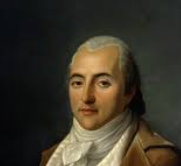
Henri de Saint-Simon — Industrialism, the Science of Society, and the Golden Age Before Us (1760–1825)
Claude Henri de Rouvroy, Comte de Saint-Simon, was a French social theorist, reformer, and impresario of ideas — born on 17 October 1760 into one of the most distinguished aristocratic families in France, who fought in the American Revolutionary War in 1780, was captured by the English navy, released, traveled to Mexico to promote a Panama Canal project, offered his services to the Spanish to build a canal from Madrid to the Atlantic, returned to France, renounced his aristocratic title, made a fortune speculating in confiscated church properties during the Revolution, lost it, nearly lost his mind, worked for years on the charity of friends, attempted suicide in 1823 by shooting himself in the head six times — losing sight in one eye but surviving — and died on 19 May 1825, his major work unfinished, attended by disciples who would systematize his ideas into one of the most influential movements of the nineteenth century.
His collaborators and successors included Auguste Comte (who published his first positivist writings in Saint-Simon's journals), the historian Augustin Thierry, and Olinde Rodrigues. The Saint-Simonians who followed him — Prosper Enfantin and Michel Chevalier among them — promoted the Suez Canal, the Channel Tunnel, the French railway system, and the industrialization of Algeria. Thomas Carlyle was influenced by him. John Stuart Mill was influenced by him. Napoleon III was influenced by him. Marx and Engels credited him with perceiving the French Revolution as class war and recognized economic conditions as the basis of political institutions. Friedrich Engels found in him "the breadth of view of a genius, containing in embryo most of the ideas of the later socialists."
His central concern: that the old order — organized around feudalism, aristocracy, military conquest, and the authority of the Church — was being replaced by a new industrial order organized around science, production, and material improvement, and that this transition required a new philosophy, a new social organization, and eventually a new religion adequate to its requirements.
The American Experience — Aristocracy Renounced
Saint-Simon's formative political experience was his service in the American Revolutionary War and his observation of the early American republic. He was struck by the absence of hereditary social privilege — by the sense that in America, status flowed from contribution rather than from birth. He returned to France convinced that the aristocratic principle — the organization of society around inherited rank — was not only unjust but inefficient: it placed people in positions of authority not by virtue of their capacity but by virtue of their birth. He renounced his own title, and the renunciation was both symbolic and intellectual: he was committing himself to the view that merit was the only legitimate basis for social authority.
The French Revolution reinforced this conviction negatively: the Terror showed what happened when the old order was destroyed without a coherent new principle to replace it. The lesson Saint-Simon drew was not that the old order should be preserved but that its replacement had to be organized around a positive principle — not merely the negation of aristocracy and church but the affirmation of something better. That positive principle was science and industry.
"The golden age which a blind tradition has hitherto placed behind us is in reality before us."
— Saint-Simon
Industrialism — The Productive Classes Against the Idle
Saint-Simon's central political distinction was between the productive and the idle — between those whose activities contributed to the material welfare of society and those whose positions were parasitic on it. His concept of the "industrial class" was unusually broad: it included manual workers, engineers, scientists, bankers, managers, and industrial entrepreneurs — everyone whose activity produced something. Against this he placed the "idle classes" — the traditional aristocracy, the rentier who lived on inherited property without contributing to its productivity, the military establishment whose function was conquest rather than production.
The political implication: governance should pass to the productive classes. Not to any single element within them — Saint-Simon was not a workers' movement thinker in the later Marxist sense — but to a combined authority of scientists, engineers, and industrialists, organized by merit and contribution rather than birth and privilege. He coined the word "industrialism" for this vision and spent his last decade elaborating its institutional forms.
"The scientists, the men whose chief occupation is to observe and reason, will demonstrate the possibility of a great increase in well-being for all classes. The most important industrials will judge what is immediately practical. The bankers will direct financial movements. In their hands, politics will become the complement of the science of man."
— Saint-Simon
The Science of Society — Positivism Before Comte
Saint-Simon's most intellectually ambitious claim was that society could and should be studied by the same scientific methods that had produced Newton's physics and Lavoisier's chemistry. A genuine science of human society would discover the laws by which social organizations developed, would allow the prediction of future social conditions, and would provide the rational basis for political decisions that intuition, tradition, and ideology could not. He was among the first to argue for what would later be called sociology — the study of society as an object of natural-scientific investigation.
His young collaborator Auguste Comte took this idea and developed it into the systematic philosophy of positivism — the most rigorous and influential account of what a science of society would look like, and what it would require. The quarrel between Saint-Simon and Comte — which ended their collaboration bitterly — was partly about credit and partly about substance: Comte's positivism was more rigorously anti-theological than Saint-Simon's later thought, which moved in the direction of a new religion rather than away from religion entirely. The irony was that Saint-Simon's most systematic work was done not by him but by the disciples he trained and inspired.
"Saint-Simon's call for a 'science of society,' similar to the natural sciences, influenced his disciple Auguste Comte and the development of sociology and economics as fields of scientific study. He was, without writing a single enduring work, one of the originators of the 'positivist organicist' school that for a century thereafter was to vie with utilitarianism and Marxism for theoretical predominance in the social sciences."
Philosophy of History — Critical and Organic Epochs
Saint-Simon and his circle developed a philosophy of historical stages — one of the first systematic attempts to understand history as development through necessary phases. They distinguished between "critical" epochs (in which the dominant force was philosophy and critical reason, characterized by dissolution of old authority, egotism, and social conflict) and "organic" epochs (in which the dominant force was religion and positive belief, characterized by solidarity, association, and constructive organization). The Middle Ages were an organic epoch — feudal and hierarchical but socially coherent. The Enlightenment was a critical epoch — intellectually liberating but socially dissolving. What was required was a new organic epoch adequate to the industrial age.
This framework — historical progress through dialectically opposed phases — directly anticipated Hegel's dialectic and Marx's historical materialism. Engels acknowledged the debt explicitly. The idea that history moved through determinate stages toward a higher synthesis, that the present was a transitional period between an exhausted old order and an emerging new one, that the philosopher's task was to understand this transition and to accelerate it — all of this was in Saint-Simon before it was in Hegel or Marx.
"Marx and Engels credited Saint-Simon with perceiving the French Revolution as a 'class war' and recognizing that economic conditions are the basis of political institutions. While they admired his 'breadth of view,' they critiqued him for believing that social change could be achieved through peaceful persuasion of elites rather than proletarian revolution."
The New Christianity — Religion as Social Technology
Saint-Simon's final and unfinished work — "Nouveau Christianisme" (1825) — represented his most radical departure from Enlightenment rationalism. Having spent his career arguing for science and industry as the basis of the new order, he arrived at the conclusion that society required not just a science but a religion — a new form of moral authority capable of directing the productive classes toward the welfare of all, and especially toward the improvement of "the poorest and most numerous class."
The New Christianity was not a restoration of Catholic or Protestant doctrine — he had no use for their dogmatic apparatus — but a reduction of Christianity to its essential moral content: the brotherhood of man, the duty to work for the welfare of all, the organization of society around the principle of love. Scientists and artists, he argued, should play the role that priests had played in medieval Christendom — providing the moral and spiritual direction that the productive classes needed to prevent their energy from being directed toward mere private accumulation.
"The aim of life should be directed towards improving the condition of the poorest and most numerous class."
— Saint-Simon
The Saint-Simonians — From Cult to Civilization
After Saint-Simon's death in 1825, his disciples organized themselves into something between a philosophical school and a religious movement — eventually forming a commune, wearing special costumes, and following the charismatic Prosper Enfantin whose interpretation of the master's "social individual is the couple" led to doctrines of sexual liberation that scandalized Paris. The movement eventually dispersed — but its former members went on to remarkable practical achievements. They promoted the Suez Canal (realized 1869), helped build the French national railway system, established feminist journals, and promoted the economic development of Algeria under French colonialism — the last of which showed how easily a doctrine of progress and improvement could be co-opted by the project of empire it had no principled basis to oppose.
Thomas Carlyle, John Stuart Mill, Napoleon III, and the young Léon Walras all found in Saint-Simonism resources for their own projects. The movement's ideas on the emancipation of women — developed by followers who took Saint-Simon's "social individual is the couple" as a principle of gender equality — were among the most radical feminist positions in early nineteenth-century Europe.
"Friedrich Engels found in Saint-Simon 'the breadth of view of a genius,' containing in embryo most of the ideas of the later socialists. Saint-Simon's proposals of social and economic planning were ahead of his time, and succeeding Marxists, socialists, and capitalist reformers alike were indebted to his ideas in one way or another."
— Britannica, summarizing his legacy
Legacy — The Founder of Too Many Things
Saint-Simon's intellectual legacy is unusually diffuse — he influenced too many competing traditions for any single one to own him. He is claimed as the founder of French socialism, the grandfather of technocracy, the precursor of positivism, the originator of sociology, an early prophet of European integration, and an ancestor of both capitalism and planning. This breadth reflects both his genuine originality and his systematic deficiency: he perceived patterns and possibilities with unusual clarity but articulated them unsystematically, leaving it to others to work out the implications.
"He was one of the first to grasp the revolutionary implications of 'industrialization' (a word he coined) for traditional institutions and morality, and to conceptualize the industrial system as a distinctive type. He was also among the earliest to advocate a naturalistic science of society as a rational guide to social reconstruction."
CivilSimian.com created by AxiomaticPanic, CivilSimian, Kalokagathia