
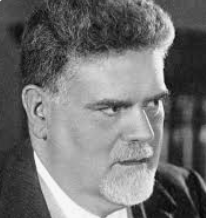
Giovanni Gentile — Actual Idealism, the Ethical State, and the Philosopher of Fascism (1875–1944)
Giovanni Gentile was an Italian philosopher, pedagogue, and politician whose development of "actual idealism" — actualism — made him the most technically ambitious philosopher in the Italian idealist tradition, and whose embrace of Fascism, his ghostwriting of Mussolini's "Doctrine of Fascism," and his service as the regime's chief intellectual made him the century's most consequential example of a serious philosopher placing serious philosophy at the service of a criminal state.
He called himself the philosopher of Fascism — Mussolini agreed — and he was shot by communist partisans outside Florence in April 1944, the last prominent figure to be killed by the Italian resistance before liberation. His death, like his life, was consequential and almost entirely self-determined.
His central philosophical concern: that all reality is the pure act of thought — that nothing exists outside consciousness, and that the only genuine idealism is one that identifies reality entirely with thinking in the present act, dissolving the distinction between subject and object, theory and practice, individual and state, in the single undivided act of spirit knowing itself.
Actual Idealism — The Pure Act of Thought
Gentile's philosophical system was developed most fully in "The Theory of Mind as Pure Act" (1916) — a work of radical Hegelian idealism that pushed the idealist tradition to an extreme that Hegel himself had not reached.
Where Hegel distinguished between the Idea as it exists in itself, in nature, and in spirit's self-knowledge, Gentile collapsed these distinctions entirely. Reality was not the Idea but the pure act of thinking — the "pensiero pensante" (thought thinking) rather than the "pensiero pensato" (thought thought). The object of thought — whatever thought has already produced and made fixed — is abstract and secondary. The real is the living act of thinking itself, in its present self-creation, before any result is fixed.
This position dissolved the distinction between subject and object — there was no object outside consciousness to which thought corresponded. Reality was consciousness in the act of producing itself. Past and future existed only in the present act of thought that constituted them. History was not a sequence of events outside thought but the thought that constituted those events in the living present of remembrance and anticipation. This was idealism at its most radical — "the subjective extreme of the idealist tradition," as scholars describe it.
"The only true reality is the pure act of the thinking that thinks — self-consciousness in the present moment, in which the spirit that comprises all existing is manifested. Reality lies in the productive and self-creative act of thinking, not in the object thought."
The Ethical State — Where Philosophy Became Politics
The political consequences of Gentile's idealism were not incidental to his philosophy but derived from it — and this is what made his case philosophically significant rather than merely politically unfortunate.
If reality is the single self-creating act of spirit — if the distinction between subject and object, individual and universal, self and other is dissolved in the living totality of thought — then the individual as a separate entity standing over against society is an abstraction, a "pensiero pensato," not a living reality. The living individual exists only in their participation in the larger whole of social and historical spirit. True freedom was not freedom from the state but freedom realized through participation in the state — for only through the ethical community did the individual become genuinely themselves.
Gentile called this the "ethical state" — drawing on Hegel but radicalizing the concept. The state was not an institution that individuals used to pursue their ends; it was the concrete embodiment of their genuine will, the actualization of freedom rather than its limitation. Liberalism, which set the individual against the state, was based on an abstraction — the isolated individual — that had no genuine reality. Fascism, which demanded the total integration of the individual into the national community, was philosophically correct.
"The authority of the State and the freedom of the citizen constitute a continuous circle wherein authority presupposes liberty and liberty authority. Liberalism broke this circle, setting the individual against the State — this is the error that Fascism corrects."
The Doctrine of Fascism and the Intellectual Service of the Regime
Gentile ghostwrote the first section of Mussolini's "The Doctrine of Fascism" published in 1932 — the regime's most authoritative philosophical self-presentation — and wrote the 1925 Manifesto of the Fascist Intellectuals, which attracted signatures from major Italian writers and artists. He served as Minister of Public Education, implementing the Gentile Reform of 1923 — the first major legislation of the Fascist government, which Mussolini called "the most Fascist reform" — a classically oriented, elitist restructuring of the Italian school system designed to form the new Fascist elite.
He was simultaneously sincere and mistaken — sincerely convinced that his philosophy provided the correct theoretical foundation for Fascism, and mistaken about what Fascism actually was and would become. His philosophical influence on the regime was in practice marginal — Mussolini was not in the business of following philosophical systems — and Gentile's influence waned from the late 1920s as the regime's practical politics diverged increasingly from what his philosophy would have required.
But he remained committed to the end — supporting the Salò Republic after Mussolini's fall in 1943, still believing, or needing to believe, that the philosophical vision of national spiritual unity could survive the evident catastrophe of the political reality. He was assassinated in April 1944.
"Everything is in the State, and nothing human or spiritual exists, much less has value, outside the State."
Croce and the Parting of Ways
Gentile's relationship with Benedetto Croce — his closest philosophical colleague for two decades, his partner in editing "La Critica," his collaborator in the revival of Italian idealism — and their eventual and irrevocable separation is one of intellectual history's most instructive case studies in how the same philosophical inheritance can lead two equally serious thinkers to diametrically opposed political conclusions.
Both began from Hegel. Both rejected positivism and Marxist materialism. Both believed philosophy had consequences for political life. Croce concluded that liberalism was the proper political expression of the idealist understanding of freedom — that genuine freedom required institutional protection, pluralism, and the separation of power. Gentile concluded that liberalism was a philosophical error — that the individual abstracted from community was an illusion and that the ethical state was freedom's true expression.
Croce's rejection of Fascism was total and sustained — he published the Manifesto of Anti-Fascist Intellectuals in direct response to Gentile's Manifesto of 1925, and remained a consistent critic throughout the Fascist period. The contrast between the two men — same tradition, same training, radically different conclusions — suggests that the philosophy alone did not determine the politics, and that personal disposition, moral character, and the willingness to look honestly at what is actually happening were at least as important as philosophical argument.
"There was no more motivating philosophical ground for Gentile's support of Fascism than for Croce's rejection of it — in both cases the support or rejection makes sense only when welded to personal dispositions, convictions and interests."
— scholarly assessment of the Gentile-Croce divergence
Education, the Enciclopedia Italiana, and the Practical Work
Beyond his strictly philosophical work, Gentile's most lasting legacy may be the Enciclopedia Italiana — begun in 1925, completed in its first edition in 1936 — which he planned and edited and which remains one of the great encyclopedic achievements of the twentieth century. It recruited the best Italian scholars across every field and produced work of genuine intellectual quality alongside its propagandistic function. That scholarship of this quality could be produced within and for a Fascist regime is itself a disturbing fact worth understanding.
His educational reforms were more straightforwardly ideological — the Gentile Reform created a classical, humanistic, rigidly hierarchical educational system that served the regime's elitist ambitions while reflecting Gentile's genuine conviction that the humanities were the proper foundation of civilized life. It lasted in some form until 1962 — outliving the regime that created it by seventeen years.
"Education is the process of revelation of the Absolute — the means by which the individual spirit comes to recognize itself in the universal spirit that is its true nature."
Legacy — The Warning That Philosophy Carries
Gentile's place in CivSim's catalogue is uncomfortable and deliberately so. He is not here as a villain but as a philosopher — one whose technical work was genuine and whose political catastrophe is philosophically instructive.
His case illuminates several things that the catalogue consistently tries to illuminate. First: that serious philosophy can reach seriously wrong conclusions — that the internal coherence of a philosophical system is no guarantee of its political or moral adequacy. Second: that the dissolution of the individual in a larger whole — however philosophically motivated — is one of the most consistently dangerous moves in political thought, with consequences that no amount of sophisticated idealism can make benign. Third: that the relationship between a philosopher's ideas and the political uses to which those ideas are put is complex, never deterministic, and always requires attention to the particular human being making the particular choices — as Croce's counter-example demonstrates.
On CivSim he stands alongside Carl Schmitt and Julius Evola — thinkers whose philosophical seriousness did not prevent and in some respects enabled their service to regimes that were enemies of everything the catalogue most deeply values. Understanding why requires engaging with their philosophy, not merely condemning their politics — which is the harder and more necessary work.
"The individual as an abstraction standing over against society has no genuine reality — but the state that absorbs the individual completely has no genuine freedom. Between these two errors lies everything that matters."
CivilSimian.com created by AxiomaticPanic, CivilSimian, Kalokagathia