
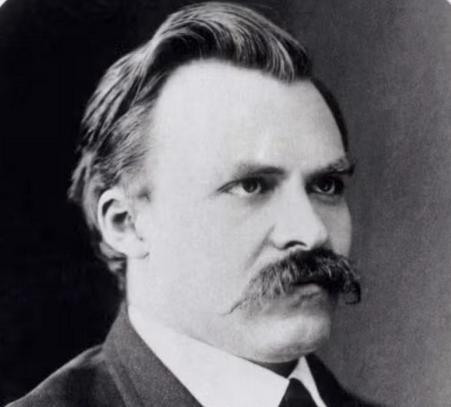
4 months 1 week ago
The value of many men and books rests solely on their faculty for compelling all to speak out the most hidden and intimate things.
4 months 1 week ago
Most people are not seeking truth; they are searching for comfort in illusions.
4 months 1 week ago
A moral system valid for all is basically immoral.
▼
Source
source
Generally attributed to Nietzsche, this is a quotation from Curtis Cate's Friedrich Nietzsche: A Biography (2003) and is the author's interpretation of Nietzsche's Aphorism 221 (Beyond Good and Evil)
4 months 1 week ago
It is certainly not an overstatement to say that no one has ever spoken so greatly and so nobly of what a philosopher is as Nietzsche.
▼
Source
source
Leo Strauss, "Existentialism", lecture delivered in 1956, published in Interpretation, Spring 1995, Vol. 22, No. 3
4 months 1 week ago
I think he sets a certain standard, let's say a standard of seriousness. (Q: Doesn't he seem intolerant to you, even merciless?) Sontag: He's very vehement, yes. Kafka too was very vehement, and he excluded a great deal, in his life and in his work. These are people whose lives I find exemplary in some respect-their thoughts, their ideas, their work, their seriousness.
▼
Source
source
1987 interview in Conversations with Susan Sontag edited by Leland Poague (1995)
4 months 1 week ago
They muddy the waters to make them look deep.
▼
Source
source
A [https://www.google.com/search?q=%22they+muddy+the+waters+to+make%22+%22deep%22&udm=36&tbs=cdr%3A1%2Ccd_min%3A1800%2Ccd_max%3A2005 google books search with dates restricted to 1800-2005] finds only three sources, the earliest one being [https://www.goog
4 months 1 week ago
The individual has always had to struggle to keep from being overwhelmed by the tribe. If you try it, you will be lonely often, and sometimes frightened. But no price is too high to pay for the privilege of owning yourself.
▼
Source
source
Often misattributed to Nietzsche, and was actually said by Rudyard Kipling during a [https://quoteinvestigator.com/2026/03/02/struggle-keep/#bd78df33-983a-4bb4-88dd-577e032bba7a-link 1935 interview] that was published in Reader's Digest in 1959.
4 months 1 week ago
If you crush a cockroach, you're a hero. If you crush a beautiful butterfly, you're a villain. Morals have aesthetic criteria.
▼
Source
source
[https://www.goodreads.com/quotes/11842662-if-you-crush-a-cockroach-you-re-a-hero-if-you Sometimes attributed to Nietzsche], the quote appears in none of his works, the likely origin is a [https://x.com/samalmightysam/status/278540504386371584 2012 tweet]
4 months 1 week ago
All I need is a sheet of paper and something to write with, and then I can turn the world upside down.
▼
Source
source
Commonly attributed to Nietzsche, but is most likely from Cornelia Funke’s Inkheart trilogy.
4 months 1 week ago
Those who dance appear insane to those who cannot hear the music.
▼
Source
source
First recorded appearance: Germaine de Staël's On Germany (1813). ". . . sometimes even in the habitual course of life, the reality of this world disappears all at once, and we feel ourselves in the middle of its interests as we should at a ball, where we
4 months 1 week ago
Meaning and morality of one's life come from within oneself. Healthy, strong individuals seek self-expansion by experimenting and by living dangerously. Life consists of an infinite number of possibilities, and the healthy person explores as many of them as possible. Religions that teach pity, self-contempt, humility, self-restraint and guilt are incorrect. The good life is ever-changing, challenging, devoid of regret, intense, creative, and risky.
▼
Source
source
Attributed to Nietzsche on quotes sites and on social media, the original quotation is from An Introduction to the History of Psychology by B. R. Hergenhahn (2008, page 226) and is the author's summary of Nietzsche's ideas: "The meaning and morality of on
4 months 1 week ago
On the heights it is warmer than people in the valleys suppose, especially in winter. The thinker recognizes the full import of this simile.
4 months 1 week ago
He that prefers the beautiful to the useful in life will, undoubtedly, like children who prefer sweetmeats to bread, destroy his digestion and acquire a very fretful outlook on the world.
4 months 1 week ago
Everyone who enjoys thinks that the principal thing to the tree is the fruit, but in point of fact the principal thing to it is the seed.—Herein lies the difference between them that create and them that enjoy.
4 months 1 week ago
My task is to throw a light on that which we must always love and revere, of which no subsequent knowledge can rob us: man in his greatness.
4 months 1 week ago
I tell the story of these philosophers in simplified form: I merely wish to bring out in each system that point which represents a piece of the personality, and which history must preserve as a part of what is irrefutable and indisputable.
4 months 1 week ago
The possibility has been established for the production of...a master race, the future "masters of the earth"...made to endure for millennia — a higher kind of men who...employ democratic Europe as their most pliant and supple instrument for getting hold of the destinies of the earth.
▼
Source
source
Sec. 960 (Notebook W I 8. Fall 1885 - Fall 1886, KGW VIII, 1.85-6, KSA 12.87-8)
4 months 1 week ago
There is only nobility of birth, only nobility of blood. When one speaks of "aristocrats of the spirit," reasons are usually not lacking for concealing something. As is well known, it is a favorite term among ambitious Jews. For spirit alone does not make noble. Rather, there must be something to ennoble the spirit. What then is required? Blood.
▼
Source
source
Sec. 942 (Notebook W I 5. August - September 1885, KGW VII, 3.412, KSA 11.678)
4 months 1 week ago
To those human beings who are of any concern to me I wish suffering, desolation, sickness, ill-treatment, indignities — I wish that they should not remain unfamiliar with profound self-contempt, the torture of self-mistrust, the wretchedness of the vanquished: I have no pity for them, because I wish them the only thing that can prove today whether one is worth anything or not — that one endures.
▼
Source
source
Sec 910 (Autumn 1887, KSA 12.513)
4 months 1 week ago
The homogenizing of European man ... requires a justification: it lies in serving a higher sovereign species that stands upon the former which can raise itself to its task only by doing this. Not merely a master race whose sole task is to rule, but a race with its own sphere of life, with an excess of strength ... strong enough to have no need of the tyranny of the virtue-imperative.
▼
Source
source
Sec. 898 (Notebook W II 1. Fall 1887, KGW VIII, 2.88-90, KSA 12.424-6)
4 months 1 week ago
The rights a man arrogates to himself are related to the duties he imposes on himself, to the tasks to which he feels equal. The great majority of men have no right to existence, but are a misfortune to higher men.
▼
Source
source
Sec. 872 (Notebook W I 1. Spring 1884, KGW VII, 2.97-8, KSA 11.101-2)
4 months 1 week ago
A declaration of war on the masses by higher men is needed! ... Everything that makes soft and effeminate, that serves the end of the people or the feminine, works in favor of universal suffrage, i.e. the domination of the inferior men. But we should take reprisal and bring this whole affair to light and the bar of judgment.
▼
Source
source
Sec. 864 (Notebook W II 5. Spring 1888, KGW VIII, 3.157-62, KSA 13.365-70)
4 months 1 week ago
The only thing of interest in a refuted system is the personal element. It alone is what is forever irrefutable.
▼
Source
source
p. 25
4 months 1 week ago
Whoever wishes to justify Philosophy must show ... to what ends a healthy culture uses and has used philosophy.
▼
Source
source
p. 27
4 months 1 week ago
Where could we find an instance of cultural pathology which philosophy restored to health? If philosophy ever manifested itself as helpful, redeeming, or prophylactic, it was in a healthy culture. The sick, it made even sicker.
▼
Source
source
p. 27
4 months 1 week ago
The good generally displeases us when it is beyond our ken.
4 months 1 week ago
"Grant me, ye gods, but one certainty," runs Parmenides' prayer, "and if it be but a log's breadth on which to lie. on which to ride upon the sea of uncertainty. Take away everything that comes-to-be, everything lush, colorful, blossoming, illusory, everything that charms and is alive. Take all these for yourselves and grant me but the one and only, poor empty certainty.”
▼
Source
source
p. 81
4 months 1 week ago
The concept of greatness is changeable, in the realm of morality as well as in that of esthetics. And so philosophy starts by legislating greatness.
▼
Source
source
p. 43
4 months 1 week ago
Science rushes headlong, without selectivity, without “taste,” at whatever is knowable, in the blind desire to know all at any cost. Philosophical thinking, on the other hand, is ever on the scent of those things which are most worth knowing, the great and the important insights.
▼
Source
source
p. 43
4 months 1 week ago
Philosophy leaps ahead on tiny toeholds; hope and intuition lend wings to its feet. Calculating reason lumbers heavily behind, looking for better footholds, for reason too wants to reach that alluring goal which its divine comrade has long since reached.
▼
Source
source
p. 40
4 months 1 week ago
... the republic of creative minds: each giant calling to his brother through the desolate intervals of time. And undisturbed by the wanton noises of the dwarfs that creep past beneath them, their high spirit-converse continues.
▼
Source
source
p. 32
4 months 1 week ago
The quest for philosophical beginnings is idle, for everywhere in all beginnings we find only the crude, the unformed, the empty and the ugly. What matters in all things is the higher levels.
▼
Source
source
p. 30
4 months 1 week ago
The very reason the Greeks got so far is that they knew how to pick up the spear and throw it onward from the point where others had left it. Their skill in the art of fruitful learning was admirable. We ought to be learning from our neighbors precisely as the Greeks learned from theirs, not for the sake of learned pedantry but rather using everything we learn as a foothold which will take us up as high, and higher, than our neighbor.
▼
Source
source
p. 30
9 months 2 weeks ago
Knowledge more than a Means. Also without this passion I refer to the passion for knowledge, science would be furthered: science has hitherto increased and grown up without it. The good faith in science, the prejudice in its favour, by which States are at present dominated (it was even the Church formerly), rests fundamentally on the fact that the absolute inclination and impulse has so rarely revealed itself in it, and that science is regarded not as a passion, but as a condition and an "ethos." Indeed, amour-plaisir of knowledge (curiosity) often enough suffices, amour-vanity suffices, and habituation to it, with the afterthought of obtaining honour and bread; it even suffices for many that they do not know what to do with a surplus of leisure, except to continue reading, collecting, arranging, observing and narrating; their "scientific impulse" is their ennui.
9 months 2 weeks ago
Morality is herd instinct in the individual.
9 months 2 weeks ago
To what extent can truth endure incorporation? That is the question; that is the experiment.
9 months 2 weeks ago
Art furnishes us with eyes and hands and above all the good conscience to be able to turn ourselves into such a phenomenon.
9 months 2 weeks ago
Good prose is written only face to face with poetry.
9 months 2 weeks ago
Without art we would be nothing but foreground and live entirely in the spell of that perspective which makes what is closest at hand and most vulgar appear as if it were vast, and reality itself.
9 months 2 weeks ago
But let us not forget this either: it is enough to create new names and estimations and probabilities in order to create in the long run new "things."
9 months 2 weeks ago
Pardon me, my friends, I have ventured to paint my happiness on the wall.
9 months 2 weeks ago
A thinker sees his own actions as experiments and questions as attempts to find out something. Success and failure are for him answers above all.
9 months 2 weeks ago
The reasons and purposes for habits are always lies that are added only after some people begin to attack these habits and to ask for reasons and purposes. At this point the conservatives of all ages are thoroughly dishonest: they add lies.
9 months 2 weeks ago
If each us had a different kind of sense perception — if we could only perceive things now as a bird, now as a worm, now as a plant, or if one of us saw a stimulus as red, another as blue, while a third even heard the same stimulus as a sound, then no one would speak of such a regularity of nature, rather, nature would be grasped only as a creation which is subjective in the highest degree. After all, what is a law of nature as such for us? We are not acquainted with it in itself, but only with its effects, which means in its relation to other laws of nature which, in turn, are known to us only as sums of relations. Therefore all these relations always refer again to others and are thoroughly incomprehensible to us in their essence.
9 months 2 weeks ago
When someone hides something behind a bush and looks for it again in the same place and finds it there as well, there is not much to praise in such seeking and finding. Yet this is how matters stand regarding seeking and finding "truth" within the realm of reason. If I make up the definition of a mammal, and then, after inspecting a camel, declare "look, a mammal' I have indeed brought a truth to light in this way, but it is a truth of limited value. That is to say, it is a thoroughly anthropomorphic truth which contains not a single point which would be "true in itself" or really and universally valid apart from man. At bottom, what the investigator of such truths is seeking is only the metamorphosis of the world into man.
9 months 2 weeks ago
As a genius of construction man raises himself far above the bee in the following way: whereas the bee builds with wax that he gathers from nature, man builds with the far more delicate conceptual material which he first has to manufacture from himself.
9 months 2 weeks ago
One may certainly admire man as a mighty genius of construction, who succeeds in piling an infinitely complicated dome of concepts upon an unstable foundation, and, as it were, on running water. Of course, in order to be supported by such a foundation, his construction must be like one constructed of spiders' webs: delicate enough to be carried along by the waves, strong enough not to be blown apart by every wind.
9 months 2 weeks ago
Everything which distinguishes man from the animals depends upon this ability to volatilize perceptual metaphors in a schema, and thus to dissolve an image into a concept. For something is possible in the realm of these schemata which could never be achieved with the vivid first impressions: the construction of a pyramidal order according to castes and degrees, the creation of a new world of laws, privileges, subordinations, and clearly marked boundaries, a new world, one which now confronts that other vivid world of first impressions as more solid, more universal, better known, and more human than the immediately perceived world, and thus as the regulative and imperative world.
9 months 2 weeks ago
The venerability, reliability, and utility of truth is something which a person demonstrates for himself from the contrast with the liar, whom no one trusts and everyone excludes. As a "rational" being, he now places his behavior under the control of abstractions. He will no longer tolerate being carried away by sudden impressions, by intuitions.
9 months 2 weeks ago
We still do not yet know where the drive for truth comes from. For so far we have heard only of the duty which society imposes in order to exist: to be truthful means to employ the usual metaphors. Thus, to express it morally, this is the duty to lie according to a fixed convention, to lie with the herd and in a manner binding upon everyone. Now man of course forgets that this is the way things stand for him. Thus he lies in the manner indicated, unconsciously and in accordance with habits which are centuries' old; and precisely by means of this unconsciousness and forgetfulness he arrives at his sense of truth.
CivilSimian.com created by AxiomaticPanic, CivilSimian, Kalokagathia