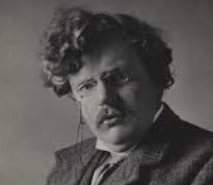
The big commercial concerns of to-day are quite exceptionally incompetent. They will be even more incompetent when they are omnipotent.
0
0
Source
source
p. 23
Prince, I can hear the trumpet of Germinal, The tumbrils toiling up the terrible way; Even to-day your royal head may fall — I think I will not hang myself to-day.
0
0
Source
source
A Ballade of Suicide, envoi
To-morrow is the time I get my pay —My uncle’s sword is hanging in the hall —I see a little cloud all pink and grey —Perhaps the rector’s mother will not call —I fancy that I heard from Mr. GallThat mushrooms could be cooked another way —I never read the works of Juvenal —I think I will not hang myself to-day.The world will have another washing day;The decadents decay; the pedants pall;And H. G. Wells has found that children play,And Bernard Shaw discovered that they squall;Rationalists are growing rational —And through thick woods one finds a stream astray,So secret that the very sky seems small —I think I will not hang myself to-day.
0
0
Source
source
A Ballade of Suicide, sts. 2 and 3
The strangest whim has seized me. ... After all I think I will not hang myself to-day.
0
0
Source
source
A Ballade of Suicide, st. 1
The gallows in my garden, people say,Is new and neat and adequately tall.
0
0
Source
source
A Ballade of Suicide, st. 1
Prince, Prince-Elective on the modern plan, Fulfilling such a lot of People’s Wills, You take the Chiltern Hundreds while you can— A storm is coming on the Chiltern Hills.
0
0
Source
source
A Ballade of the First Rain, envoi
Prince, Bayard would have smashed his swordTo see the sort of knights you dub — Is that the last of them — O LordWill someone take me to a pub?
0
0
Source
source
A Ballade of an Anti-Puritan
They spoke of Progress spiring round, Of Light and Mrs. Humphry Ward — It is not true to say I frowned, Or ran about the room and roared; I might have simply sat and snored — I rose politely in the club And said, “I feel a little bored; Will someone take me to a pub?”
0
0
Source
source
A Ballade of an Anti-Puritan, st. 1
I’ll read "Jack Redskin on the Quest" And feed my brain with better things.
0
0
Source
source
A Ballade of a Book Reviewer
But for the Virtuous Things you do,The Righteous Work, the Public Care,It shall not be forgiven you.
0
0
Source
source
Ballade d'une Grande Dame
Heaven shall forgive you Bridge at dawn, The clothes you wear — or do not wear — And Ladies’ Leap-frog on the lawn And dyes and drugs, and petits verres.
0
0
Source
source
Ballade d'une Grande Dame
Talk about the pews and steeples  And the cash that goes therewith!But the souls of Christian peoples...            Chuck it, Smith!
0
0
Source
source
Antichrist, or the Reunion of Christendom
Are they clinging to their crosses?
0
0
Source
source
Antichrist, or the Reunion of Christendom
It is all as of old, the empty clangour, The scrawled on a five-foot page, The huckster who, mocking holy anger, Painfully paints his face with rage. * * * We that fight till the world is free, We have no comfort in victory; We have read each other as Cain his brother, We know each other, these slaves and we.
0
0
Source
source
A Song of Defeat
For we that fight till the world is free, We are not easy in victory: We have known each other too long, my brother, And fought each other, the world and we.
0
0
Source
source
A Song of Defeat
   Nelson turned his blindest eye On Naples and on liberty.
0
0
Source
source
Blessed are the Peacemakers, st. 3
White founts falling in the courts of the sun, And the Soldan of Byzantium is smiling as they run.
0
0
Source
source
Lepanto
Even the tyrant never rules by force alone; but mostly by fairy tales. And so it is with the modern tyrant, the great employer. The sight of a millionaire is seldom, in the ordinary sense, an enchanting sight: nevertheless, he is in his way an enchanter. As they say in the gushing articles about him in the magazines, he is a fascinating personality. So is a snake. At least he is fascinating to rabbits; and so is the millionaire to the rabbit-witted sort of people that ladies and gentlemen have allowed themselves to become.
0
0
Source
source
p. 19
Literary men are being employed to praise a big business man personally, as men used to praise a king. They not only find political reasons for the commercial schemes—that they have done for some time past—they also find moral defences for the commercial schemers. ... I do resent the whole age of patronage being revived under such absurd patrons; and all poets becoming court poets, under kings that have taken no oath.
0
0
Source
source
pp. 15-17
A fairly clear line separated advertisement from art. ... The first effect of the triumph of the capitalist (if we allow him to triumph) will be that that line of demarcation will entirely disappear. There will be no art that might not just as well be advertisement.
0
0
Source
source
p. 6
In a time of sceptic moths and cynic rusts, And fattened lives that of their sweetness tire In a world of flying loves and fading lusts, It is something to be sure of a desire. Lo, blessed are our ears for they have heard; Yea, blessed are our eyes for they have seen: Let the thunder break on man and beast and bird And the lightning. It is something to have been.
0
0
Source
source
The Great Minimum
To have seen you and your unforgotten face, Brave as a blast of trumpets for the fray, Pure as white lilies in a watery space, It were something, though you went from me today. To have known the things that from the weak are furled, Perilous ancient passions, strange and high; It is something to be wiser than the world, It is something to be older than the sky.
0
0
Source
source
The Great Minimum
It is something to have wept as we have wept, It is something to have done as we have done, It is something to have watched when all men slept, And seen the stars which never see the sun. It is something to have smelt the mystic rose, Although it break and leave the thorny rods, It is something to have hungered once as those Must hunger who have ate the bread of gods.
0
0
Source
source
The Great Minimum
And he smiles, but not as Sultans smile, and settles back the blade.... (But Don John of Austria rides home from the Crusade.)
0
0
Source
source
Lepanto
Cervantes on his galley sets the sword back in the sheath, (Don John of Austria rides homeward with a wreath.)
0
0
Source
source
Lepanto
It is he that saith not ‘Kismet’; it is he that knows not fate; It is Richard, it is Raymond, it is Godfrey in the gate!
0
0
Source
source
Lepanto
Don John of Austria is going to the war.
0
0
Source
source
Lepanto
Strong gongs groaning as the drums beat far.
0
0
Source
source
Lepanto
And above the ships are palaces of brown, black-bearded chiefs,And below the ships are prisons, where with multitudinous griefs,Christian captives sick and sunless, all a labouring race repinesLike a race in sunken cities, like a nation in the mines.
0
0
Source
source
Lepanto
The walls are hung with velvet that is black and soft as sin,And little dwarfs creep out of it and little dwarfs creep in.He holds a crystal phial that has colours like the moon,He touches, and it tingles, and he trembles very soon,And his face is as a fungus of a leprous white and greyLike plants in the high houses that are shuttered from the day.
0
0
Source
source
Lepanto
The cold queen of England is looking in the glass; The shadow of the Valois is yawning at the Mass.
0
0
Source
source
Lepanto
Our chiefs said 'Done,' and I did not deem it; Our seers said 'Peace,' and it was not peace; Earth will grow worse till men redeem it, And wars more evil, ere all wars cease.
0
0
Source
source
A Song of Defeat — first appeared, in part, in George William Russell's Sketches and Snapshots (1910)
I am not fighting a hopeless fight. People who have fought in real fights don't, as a rule.
0
0
Source
source
Ch. XXIII: "The March on Ivywood" (Patrick Dalroy loq.)
For there is good news yet to hear and fine things to be seen, Before we go to Paradise by way of Kensal Green.
0
0
Source
source
Ch. XXI: "The Road to Roundabout" ("The Rolling English Road", l. 23)
Marriage is a duel to the death, which no man of honour should decline.
0
0
Source
source
Michael Moon in Part II, ch. IV
The academic mind reflects infinity, and is full of light by the simple process of being shallow and standing still.
0
0
Source
source
Arthur Inglewood in Part II, ch. I
As for science and religion, the known and admitted facts are few and plain enough. All that the parsons say is unproved. All that the doctors say is disproved. That's the only difference between science and religion there's ever been, or will be.
0
0
Source
source
Michael Moon in Part II, ch. I
Atheism is indeed the most daring of all dogmas ... for it is the assertion of a universal negative
0
0
Source
source
"Charles II", p. 59
The Christian ideal has not been tried and found wanting. It has been found difficult; and left untried.
0
0
Source
source
The Unfinished Temple
If a thing is worth doing, it is worth doing badly.
0
0
Source
source
Folly and Female Education
But whenever one meets modern thinkers (as one often does) progressing toward a madhouse, one always finds, on inquiry, that they have just had a splendid escape from another madhouse. Thus, hundreds of people become Socialists, not because they have tried Socialism and found it nice, but because they have tried Individualism and found it particularly nasty.
0
0
Source
source
'The New House,' pp. 161-162
Poets have been mysteriously silent on the subject of cheese.
0
0
Source
source
'Cheese,' p. 70
It is the one great weakness of journalism as a picture of our modern existence, that it must be a picture made up entirely of exceptions. We announce on flaring posters that a man has fallen off a scaffolding. We do not announce on flaring posters that a man has not fallen off a scaffolding. Yet this latter fact is fundamentally more exciting, as indicating that that moving tower of terror and mystery, a man, is still abroad upon the earth. That the man has not fallen off a scaffolding is really more sensational; and it is also some thousand times more common. But journalism cannot reasonably be expected thus to insist upon the permanent miracles. Busy editors cannot be expected to put on their posters, "Mr. Wilkinson Still Safe," or "Mr. Jones, of Worthing, Not Dead Yet." They cannot announce the happiness of mankind at all. They cannot describe all the forks that are not stolen, or all the marriages that are not judiciously dissolved. Hence the complex picture they give of life is of necessity fallacious; they can only represent what is unusual. However democratic they may be, they are only concerned with the minority.
0
0
Source
source
Part IV: "A Discussion at Dawn", 2nd paragraph
"I swear to you, then," said MacIan, after a pause. "I swear to you that nothing shall come between us. I swear to you that nothing shall be in my heart or in my head till our swords clash together. I swear it by the God you have denied, by the Blessed Lady you have blasphemed; I swear it by the seven swords in her heart. I swear it by the Holy Island where my fathers are, by the honour of my mother, by the secret of my people, and by the chalice of the Blood of God." The atheist drew up his head. "And I," he said, "give my word."
0
0
Source
source
Part II: "The Religion of the Stipendiary Magistrate", last paragraphs
The whole object of travel is not to set foot on foreign land; it is at last to set foot on one's own country as a foreign land.
0
0
Source
source
Ch. XXXI: "The Riddle of the Ivy"
[A]rt is limitation. [...] The most beautiful part of every picture is the frame.
0
0
Source
source
Ch. XXIII: "The Toy Theatre"
Fairy tales...are not responsible for producing in children fear, or any of the shapes of fear; fairy tales do not give the child the idea of the evil or the ugly; that is in the child already, because it is in the world already. Fairy tales do not give the child his first idea of bogey. What fairy tales give the child is his first clear idea of the possible defeat of bogey. The baby has known the dragon intimately ever since he had an imagination. What the fairy tale provides for him is a St. George to kill the dragon. Exactly what the fairy tale does is this: it accustoms him for a series of clear pictures to the idea that these limitless terrors had a limit, that these shapeless enemies have enemies in the knights of God, that there is something in the universe more mystical than darkness, and stronger than strong fear.
0
0
Source
source
Ch. XVII: "The Red Angel" | Paraphrased: "Fairy tales are more than true — not because they tell us dragons exist, but because they tell us dragons can be beaten." Epigraph of Neil Gaiman's Coraline (2004). When questioned about the quote on his [http://n
Misers get up early in the morning; and burglars, I am informed, get up the night before.
0
0
Source
source
Ch. X: "On Lying in Bed"
It is a quaint comment on the notion that the English are practical and the French merely visionary, that we were rebels in arts while they were rebels in arms.
0
0
Source
source
Ch I: The Victorian Compromise and Its Enemies (p. 8)
The mind moves by instincts, associations and premonitions and not by fixed dates or completed processes. Action and reaction will occur simultaneously: or the cause actually be found after the effect. Errors will be resisted before they have been properly promulgated: notions will be first defined long after they are dead.
0
0
Source
source
Ch I: The Victorian Compromise and Its Enemies (p. 17)

CivilSimian.com created by AxiomaticPanic, CivilSimian, Kalokagathia